
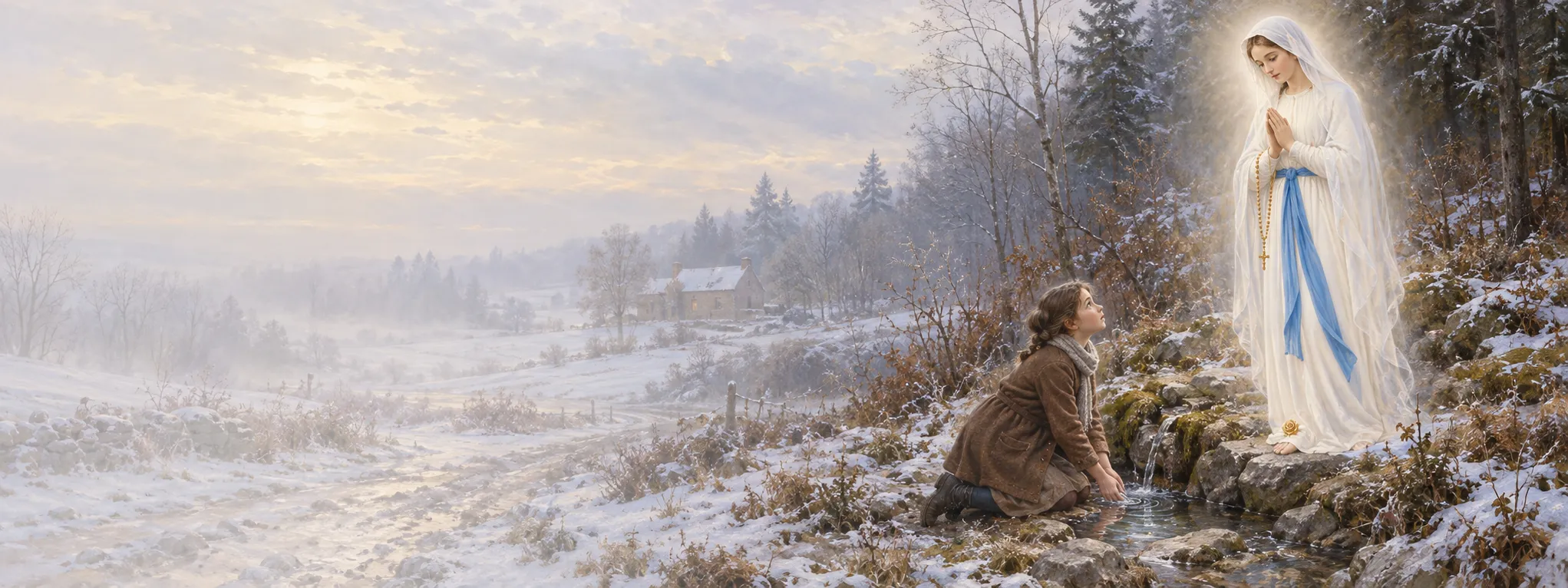
On January 15, 1933, eleven-year-old Mariette Beco looked through a window of her family’s modest home in Banneux and saw a luminous lady in the garden. This was the first of eight encounters over the following weeks. The lady identified herself as the Virgin of the Poor, led Mariette to a nearby spring, and asked for a small chapel.
The message of Banneux gives particular attention to people living with poverty, illness, and suffering. According to Mariette’s account, Mary said the spring was for all nations and for the relief of the sick. She encouraged persevering prayer and offered the reassurance of her motherly presence. The spring and the chapel became places where pilgrims brought their burdens and found renewed hope.
On August 22, 1949, Bishop Louis-Joseph Kerkhofs of Liège definitively recognized the eight apparitions. Banneux continues to welcome pilgrims from many countries, with a special commitment to the sick and to those in need. Its lasting invitation is to draw closer to Christ through prayer and to live our faith through practical care for others.
Church status: The eight apparitions were definitively recognized by Bishop Louis-Joseph Kerkhofs of Liège on August 22, 1949, following earlier recognition with reservations in 1942 and 1947.
Setting and people
The bishop’s recognition names the eight dates: January 15, 18, 19, and 20; February 11, 15, and 20; and March 2, 1933. They were separate encounters, not daily apparitions throughout the period.
Mariette’s family and home
Mariette was born on March 25, 1921. At the time of the apparitions, she was the eldest of seven children. Her family lived in difficult circumstances in a modest house outside the village, near woodland. This gives the title Virgin of the Poor a concrete human setting: the encounter was reported by a child whose own family knew material hardship.
Mariette’s later life
Mariette generally avoided publicity and saw her role as that of a messenger. The sanctuary’s biography describes how public curiosity, repeated questioning, admiration, and ridicule marked her childhood.
She later worked as a nursing assistant and married Mathieu Hoeberigs in 1942. Her adult life included family difficulties, bereavement, and illness. She continued to affirm her account while resisting attempts to make her a public religious figure. During St. John Paul II’s visit in 1985, she met him privately. She died on December 2, 2011, aged ninety. The apparitions did not spare her the ordinary difficulties of life.
Father Louis Jamin
Father Louis-Marie Jamin, the local priest, was closely involved in the events and in the growth of the shrine. He helped arrange the small chapel requested in Mariette’s account and later co-founded the International Union of Prayer associated with Banneux.
The eight apparitions
This chronology summarizes Mariette’s account as presented by the sanctuary.
| Date | Reported event |
|---|---|
| January 15 | Mariette sees the lady from inside her home. Her mother prevents her from going outside. |
| January 18 | The lady leads her to the spring and tells her to put her hands into the water. |
| January 19 | She identifies herself as the Virgin of the Poor and explains that the spring is for all nations and for the sick. |
| January 20 | She asks for a small chapel. |
| February 11 | After a break of about three weeks, she returns and speaks of relieving suffering. |
| February 15 | Mariette passes on the priest’s request for a sign. The answer stresses trust and prayer; a private communication is also reported. |
| February 20 | Mary again urges abundant prayer. |
| March 2 | In the final encounter, she identifies herself as the Mother of the Saviour and Mother of God, repeats the call to prayer, and says farewell. |
The spring was already there: Mary led Mariette to it, rather than a new spring being uncovered.
The message and its meaning
The Virgin of the Poor
The title expresses Mary’s particular closeness to those who lack security, health, companionship, or hope. In his 1985 homily at Banneux, St. John Paul II stressed that poverty takes many forms and linked Mary’s welcome with Christ’s mission to bring good news to the poor. The title therefore has both a material and a spiritual dimension.
Relief of suffering
I come to relieve suffering.
The shrine’s anniversary booklet sets these words beside the spring’s purpose for all nations and the sick. This relief includes consolation, accompaniment, renewed courage, and practical help; it is not a promise that every pilgrim will be physically cured. St. John Paul II’s 1999 letter joined prayer at Banneux with the work of caregivers, hospital staff, and all who visit the sick and the elderly.
All nations
The spring’s universal scope is a distinctive part of the account: no nationality or social position places anyone outside the reach of God’s mercy.
Prayer and trust
Mariette’s account returns again and again to prayer. The answer to the request for a sign is often translated:
Believe in me, I will believe in you.
These unusual words belong to the reported encounter. They invite a trusting response; they do not replace faith in God.
At Banneux, Mary draws near to those who feel overlooked or burdened. She invites us to bring our needs to God in prayer and to recognize the suffering of others. Her motherly care leads us toward Jesus and calls us to become instruments of His compassion.
What the Church has said
A long investigation
The investigation was neither quick nor unanimous. The sanctuary’s historical review describes three commissions:
- A first commission reached a cautiously favourable assessment in 1935.
- A second commission produced a negative report in 1942.
- A later investigation drew on Father René Rutten’s extensive critical study of the testimony and reached a favourable conclusion.
The shrine’s account also acknowledges concerns at the time about how close the events were to the widely publicized apparitions at Beauraing.
Earlier recognition with reservations
In his final pastoral letter, Bishop Kerkhofs stated that he had already recognized the events with reservations in 1942 and 1947. These earlier decisions of the bishop are distinct from the assessments of the individual commissions.
Definitive recognition: August 22, 1949
On August 22, 1949, Bishop Kerkhofs recognized the reality of the eight apparitions without reservation, naming Mariette and the eight dates. St. John Paul II’s 1999 letter for the fiftieth anniversary confirms this as the date of definitive recognition.
Later milestones
| Date | Development |
|---|---|
| May 25, 1933 | The foundation stone of the small chapel was laid. |
| August 15, 1933 | The chapel and its bell were blessed. |
| September 24, 1934 | The International Union of Prayer was founded. |
| August 22, 1949 | Definitive recognition of the apparitions. |
| May 21, 1985 | St. John Paul II visited and celebrated Mass for the sick. |
| July 31, 1999 | St. John Paul II wrote a letter marking fifty years since the recognition. |
The chapel was built and blessed before the final judgment; its early blessing was not a formal approval of the apparitions.
Sources and historical questions
One principal visionary
Mariette is the principal witness to the appearances and the spoken messages. Others could watch what she did and hear what she reported, but their presence does not mean they shared her experience. Her account is distinct from the observations of those who accompanied her.
Banneux and Beauraing
Banneux’s first apparition came twelve days after Beauraing’s last. The sanctuary’s own history acknowledges that news of Beauraing had reached the area and that this raised questions during discernment. The two cases nevertheless involved different witnesses, messages, investigations, and decisions of the bishops. Banneux’s recognition was not an extension of Beauraing’s.
A private communication
The account of February 15 includes a private communication to Mariette. Its contents were never made public, and it is not a hidden prophecy. The public message of Banneux is the heart of its devotion.
Healings
The spring and the shrine’s ministry to the sick are central to Banneux. Each reported recovery, however, needs its own documentation, and the recognition of the apparitions does not by itself authenticate every later healing attributed to the shrine.
Historical sources
The sanctuary keeps an archive section, including photographs from the time of the apparitions. Its published recognition statement is especially valuable because it preserves the bishop’s own explanation of the stages leading to his final decision.
Devotion and legacy
Banneux’s legacy joins prayer with hospitality. Its International Union of Prayer was founded in 1934 in answer to the call for prayer and helped carry the devotion beyond Belgium.
The shrine’s care for sick pilgrims puts its message into practice. The Diocese of Liège describes organized stays offering prayer, rest, and fellowship for people living with illness. St. John Paul II’s 1985 visit brought together patients, families, healthcare workers, and those who offer spiritual care; his homily placed Banneux within the Gospel’s concern for those who suffer and the Christian duty to accompany them.
The Virgin of the Poor invites us to come with empty hands and an open heart. At Banneux, prayer and compassion belong together: we bring our suffering to Christ and ask for the grace to help carry the burdens of others.
Visiting today
The principal places to visit are:
- The Chapel of the Apparitions: built in 1933 at the site of Mary’s request.
- The spring: central to Mariette’s account and to the pilgrimage.
- The recognition memorial: recording Bishop Kerkhofs’s decision.
- The woodland Stations of the Cross: which add the Last Supper and the Resurrection to the traditional stations.
- The smaller chapels and international memorials: reflecting the shrine’s bond with pilgrims from many countries.
The sanctuary provides information for individual visits, organized pilgrimages, worship, and stays for sick pilgrims. Check its current calendar before travelling, especially when arranging assistance or accommodation.
Sources and further reading
| Resource | Best use |
|---|---|
| Official sanctuary: the apparitions | The eight apparitions in Mariette’s account. |
| Official sanctuary: recognition of the apparitions | The bishop’s statement and the stages of the investigation. |
| Official sanctuary: Mariette Beco | Her life before and after the apparitions. |
| Official sanctuary: the Chapel of the Apparitions | The history of the chapel. |
| Official sanctuary: archives | Photographs and documents from the time of the apparitions. |
| St. John Paul II: homily at Banneux, May 21, 1985 (in French) | The many forms of poverty, and Mary’s welcome. |
| St. John Paul II: letter for fifty years since recognition, July 31, 1999 (in French) | Prayer at Banneux and care for the sick. |
| Diocese of Liège | The diocese’s presentation of Banneux and its ministry. |
