Mother of God
Council of Ephesus, 431
Jesus is one divine Person, true God and true man, so the woman who bore him is truly the Mother of God. In Greek, the title is Theotokos, “God-bearer”.

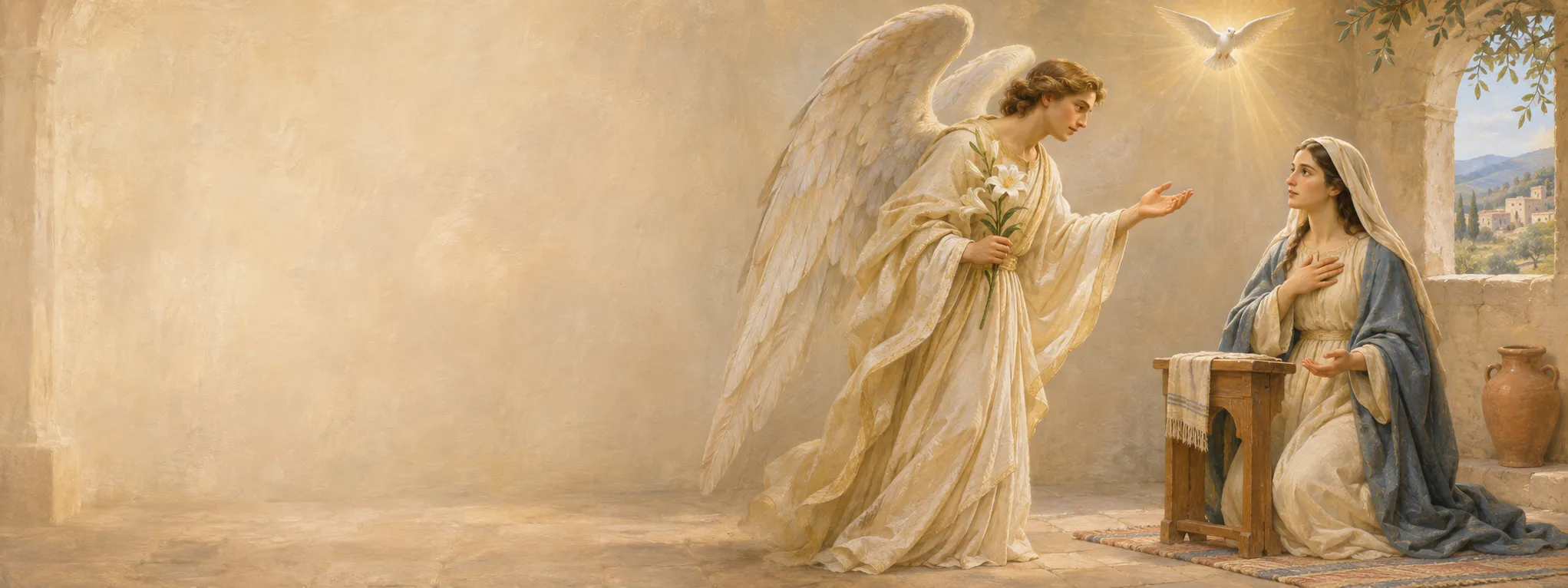
Come to know and love Our Blessed Mother, who leads us always to her Son, Jesus Christ. Discover her in Sacred Scripture, explore what the Church teaches about her, and learn how other faiths regard her. Whether you have loved Mary all your life or are only beginning to know her, you are warmly welcome here.
Mary is the Mother of Jesus Christ, the Son of God, and our loving Mother in heaven. A young Jewish woman from Nazareth in Galilee, betrothed to Saint Joseph, she was chosen by God to bear the Savior of the world.
When the angel Gabriel announced God’s plan, Mary answered with a wholehearted “yes.” She welcomed Jesus with faith, carried him in her womb, and raised him with tender love. From the joy of Bethlehem to the sorrow of Calvary, she remained faithful. At the foot of the cross, Jesus entrusted her to us as our Mother.
We lovingly call her Our Lady and the Blessed Virgin Mary. We honor her above all the saints, while worship belongs to God alone. She draws us close to her Son, teaches us to trust him, and prays for us with a mother’s love. In our joys and sorrows, we turn to her with confidence, knowing that she will always lead us to Jesus.
In Scripture, we encounter Mary’s faithful heart and her love for Jesus. The Church’s teaching and ancient Christian tradition help us contemplate her life more deeply.
Ancient tradition, first found in the 2nd-century Protoevangelium of James, names her parents as Saints Joachim and Anne. The Church celebrates her birth on September 8.
The angel Gabriel greets her as “full of grace” and tells her she will conceive by the Holy Spirit. She consents.
She hurries to help her relative Elizabeth, who calls her blessed among women. Mary responds with her great song of praise, the Magnificat.
She gives birth to Jesus in Bethlehem and lays him in a manger. The shepherds come, and she keeps all these things in her heart.
In the Temple, the old man Simeon tells her that a sword will pierce her own soul.
She and Joseph flee with the Child from King Herod, and later return to Nazareth.
After three days of searching, she and Joseph find the boy Jesus among the teachers.
She tells Jesus the wine has run out, and tells the servants to do whatever he says. He works his first sign at her word.
She stands by her dying Son, who entrusts her to the beloved disciple: “Behold thy mother.” We see ourselves in that disciple.
After the Ascension, she prays with the apostles in the upper room as they await the Holy Spirit.
Having completed the course of her earthly life, she was taken up body and soul into heavenly glory, as Pope Pius XII defined in 1950.
Throughout Scripture, we discover signs of Mary’s place in God’s loving plan. The Gospels reveal her faith, her tenderness, and her devotion to Jesus. Guided by the Church, we also recognize figures and promises in the Old Testament that point toward her, and contemplate her heavenly glory in the Book of Revelation.
Open a section to read every passage. Quotations are from the Douay-Rheims Bible, Challoner revision, and some give only the relevant sentence or phrase. The older wording and spelling are preserved.
These references appear in Matthew’s infancy narrative and in the accounts of Jesus’s family in Matthew and Mark.
The principal accounts of Mary’s life are in Luke 1–2.
John refers to Mary as Jesus’s mother without naming her, and Galatians refers to her motherhood without naming her.
These passages do not name Mary. Their Marian significance comes from their fulfillment in Christ or from Catholic interpretation. The Church explicitly connects Mary with Genesis 3:15, Isaiah 7:14 and the Daughter Zion imagery. The woman of Revelation also represents God’s people and the Church.
These are traditional applications to Mary, not explicit references or undisputed predictions about her. Their original subjects include Eve, Judith, the royal bride, Wisdom and the sanctuary. Verse numbers follow the Douay-Rheims. Sirach 24:24 belongs to the longer Latin text and does not appear in the same form in every modern Catholic translation.
Scripture preserves only a few of Our Lady’s words, yet each reveals her faithful heart and draws us closer to Jesus. They are precious words to treasure, ponder, and carry into our own prayer.
Behold the handmaid of the Lord; be it done to me according to thy word.Luke 1:38
My soul doth magnify the Lord. And my spirit hath rejoiced in God my Saviour.Luke 1:46–47
Whatsoever he shall say to you, do ye.John 2:5
The Church proclaims four dogmas about Our Lady—truths that deepen our love for her and draw us closer to Jesus. Each reveals the wonders of God’s grace in her life and helps us understand more fully the mystery of her Son.
Council of Ephesus, 431
Jesus is one divine Person, true God and true man, so the woman who bore him is truly the Mother of God. In Greek, the title is Theotokos, “God-bearer”.
Second Council of Constantinople, 553
Mary conceived Jesus by the Holy Spirit and remained a virgin before, during and after his birth. The council called her “ever-virgin”.
Pope Pius IX, December 8, 1854
By a singular grace, through the merits of her Son, Mary was preserved from all stain of original sin from the first moment of her conception. She too was saved by Christ.
Pope Pius XII, November 1, 1950
Having completed the course of her earthly life, Mary was taken up body and soul into heavenly glory. She already shares what her Son promises to all who believe.
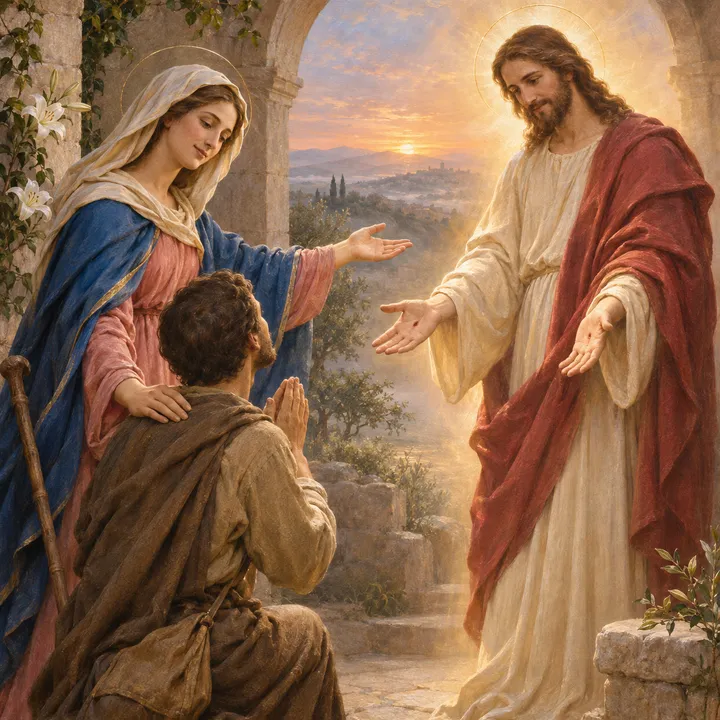
We honor Mary because she is the Mother of God and our loving Mother. Of all the saints, we hold her closest to our hearts. Yet adoration belongs to God alone—to the Father, the Son, and the Holy Spirit. As the Second Vatican Council teaches, our devotion to Mary is essentially different from the worship we offer God.
We turn to her with a child’s confidence, asking her to pray for us and bring our needs to Jesus. At Cana, she noticed what was lacking and turned to her Son. At the cross, Jesus entrusted her to us as our Mother. Her care continues to draw us toward him: her intercession neither replaces nor diminishes Christ’s unique role as our Mediator, but reveals the power of his grace.
Through the centuries, the faithful have called upon Mary by many beautiful names. Each reveals something of her holiness, her loving care for us, and her closeness to Jesus.
Through the centuries, the saints have loved Mary with the tenderness of children toward their mother. Their words invite us to trust her care, imitate her faith, and draw closer to Jesus.
“The knot of Eve’s disobedience was untied by Mary’s obedience.”
Mary’s faithful “yes” helped undo what unbelief had bound. Her example teaches us to place our trust in God, even when we cannot see the way ahead.
Against Heresies, III, 22, 4; quoted in the Catechism, 494.
Mary welcomed Christ through faith in her heart before she carried him in her womb.
Her greatness shines not only in being the Mother of Jesus, but in believing God’s word and giving herself wholly to his will.
Paraphrase of Sermon 215, 4.
“In danger, in distress, in uncertainty, think of Mary, call upon Mary.”
When life becomes troubled, we can turn to Our Lady with confidence. Like a star guiding sailors through darkness, she leads us toward her Son.
Homilies on “Missus est,” II, 17.
“Hail, holy Lady, most holy Queen, Mother of God, Mary who art ever Virgin.”
Francis greeted Our Lady with wonder and reverence. His prayer invites us to rejoice in the beautiful things God has accomplished in her.
A Salutation of the Blessed Virgin Mary.
“The more one is consecrated to Mary, the more one is consecrated to Jesus.”
True devotion to Our Lady draws us ever closer to her Son. To entrust ourselves to her is to let her teach us how to belong more completely to him.
True Devotion to the Blessed Virgin, 120.
“Mary is more Mother than Queen.”
Our Lady’s heavenly glory does not make her distant. We can approach her with the simplicity of a child who knows that a loving mother is near.
Words of St. Thérèse recalled by Vatican City State in its reflection on Mary’s Queenship.
“Never be afraid of loving the Blessed Virgin too much. You can never love her more than Jesus did.”
We can love Our Lady with a child’s wholehearted trust. She teaches us to love Jesus more deeply and to give ourselves generously to others.
Attributed to St. Maximilian Kolbe in the Militia of the Immaculata’s Rosary leaflet.
“Love our Lady. And she will obtain for you abundant grace to conquer in your daily struggle.”
Love for Mary belongs in everyday life—in our work, our worries, and our quiet efforts to be faithful. We can ask for her help in every small beginning.
The Way, 493.
“To recite the Rosary is nothing other than to contemplate with Mary the face of Christ.”
In the Rosary, we join our Mother in pondering the life of Jesus. She helps us look upon him with faith and love, carrying his mysteries into our own lives.
Rosarium Virginis Mariae, 3.
The great masters gave visible expression to the Church’s love for Our Lady. Through luminous paintings and finely carved marble, they invite us to contemplate her faith, tenderness, sorrow, and heavenly joy—and to draw closer to Jesus through her.
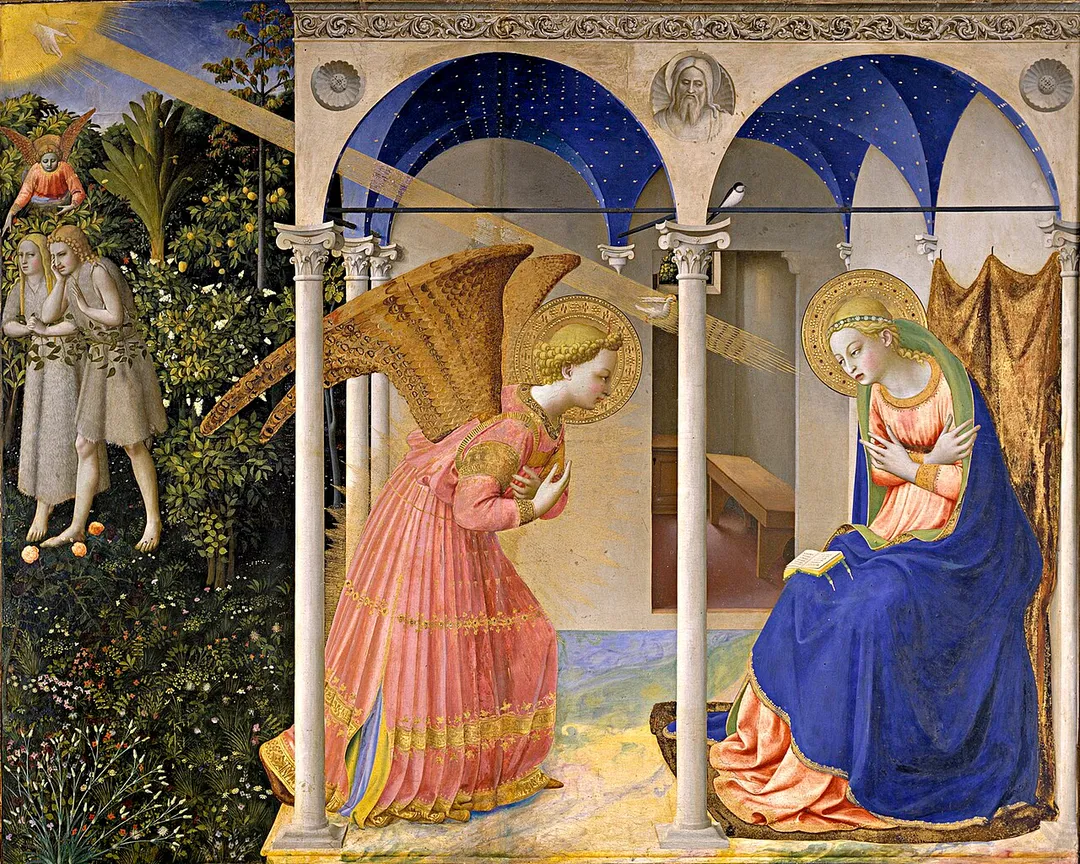
About 1425–1426 · Museo del Prado, Madrid
Beneath a graceful portico, Mary bows before the angel Gabriel as divine light reaches toward her. Nearby, Adam and Eve leave Eden: humanity’s sorrow meets the promise of salvation welcomed through Mary’s faithful “yes.”
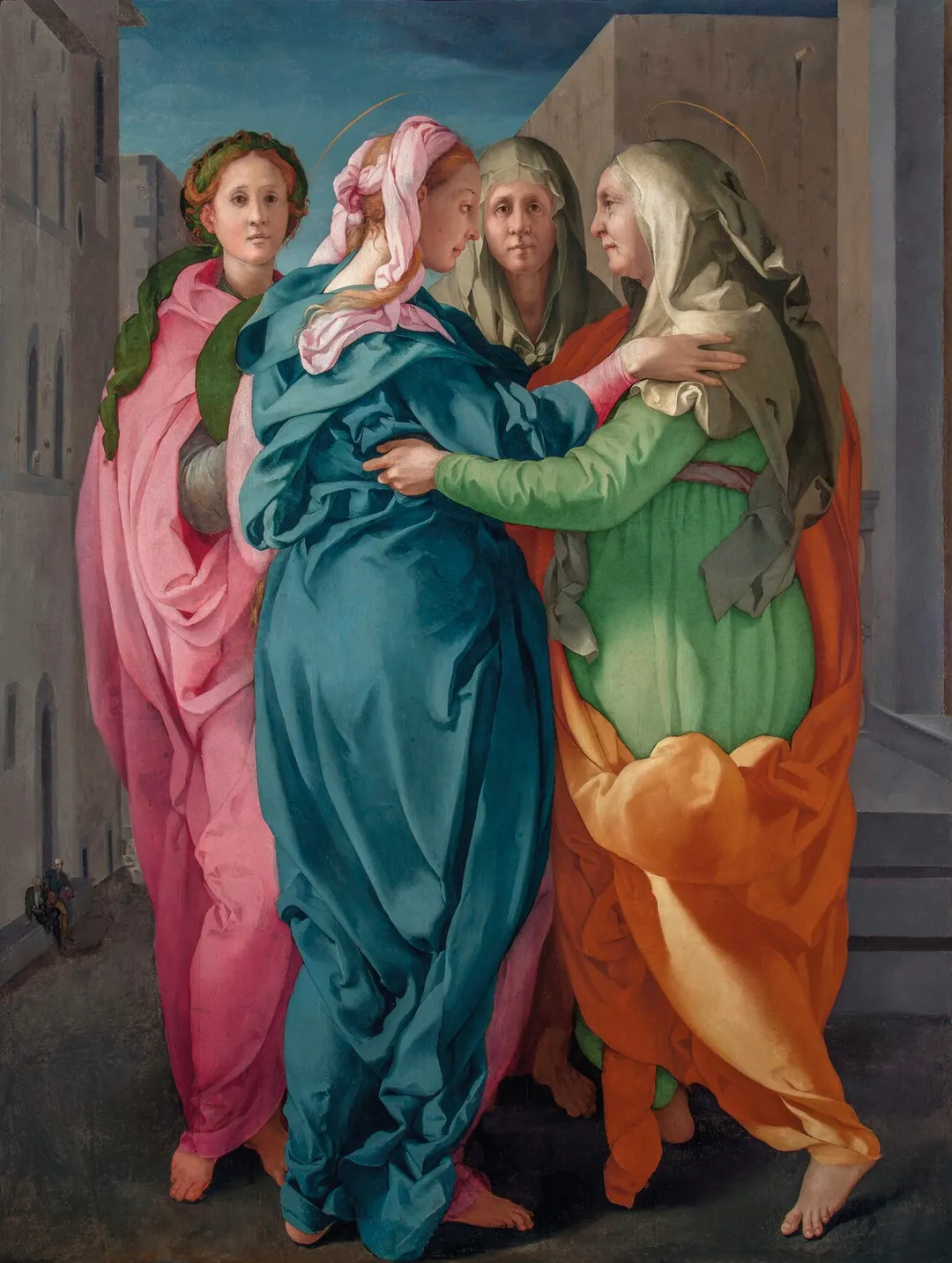
About 1528–1529 · San Michele Arcangelo, Carmignano, Italy
Mary and Saint Elizabeth greet one another with tenderness, their flowing garments glowing in rose, orange, and green. Their encounter invites us to share the joy of God’s presence and to follow Mary’s example of loving service.
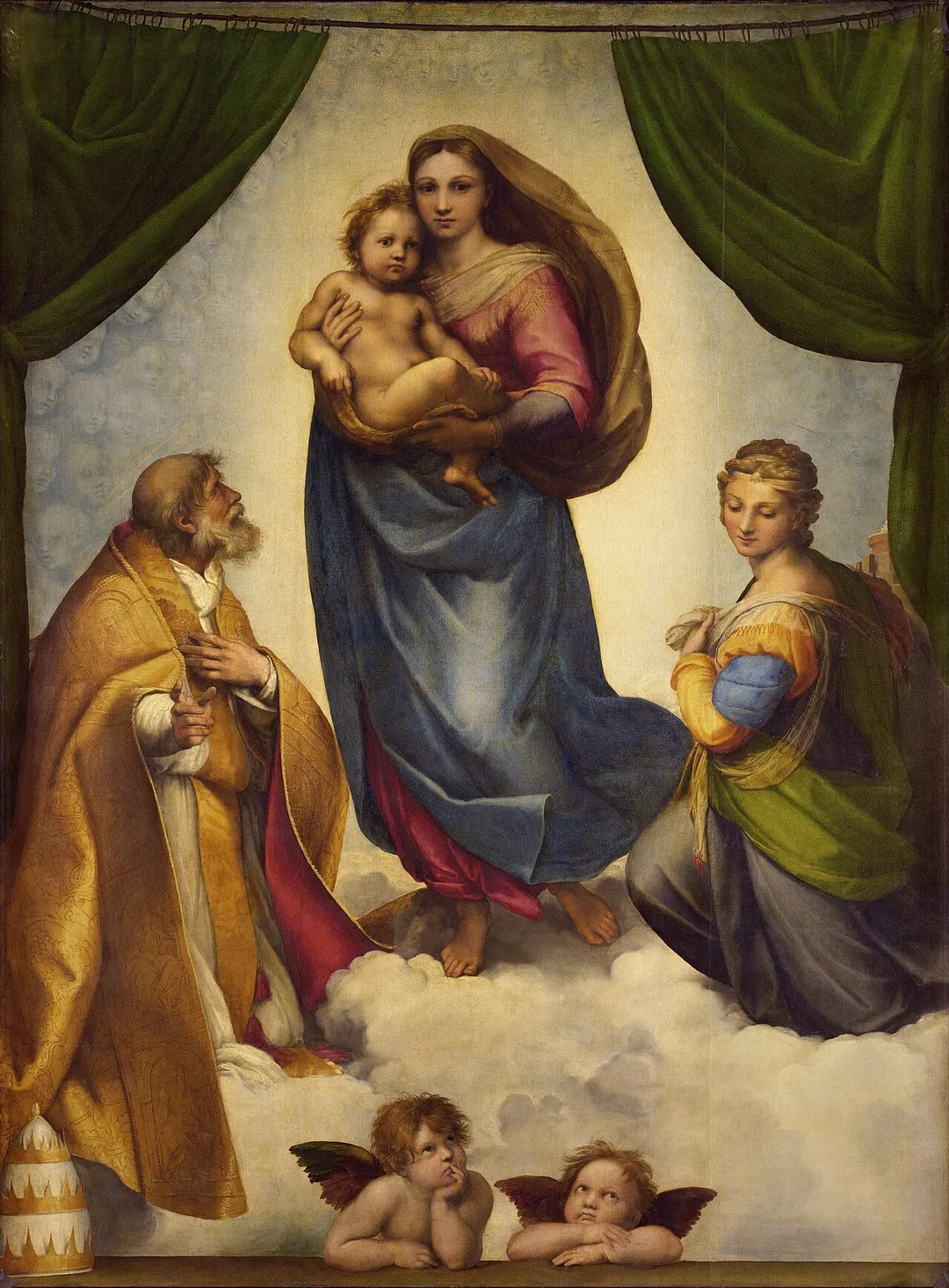
1512–1513 · Old Masters Picture Gallery, Dresden
Mary comes forward through parted curtains, carrying Jesus toward the world. Saint Sixtus and Saint Barbara stand beside her, while two cherubs rest below. Her solemn gaze invites us to contemplate both the gift of her Son and the sacrifice to come.
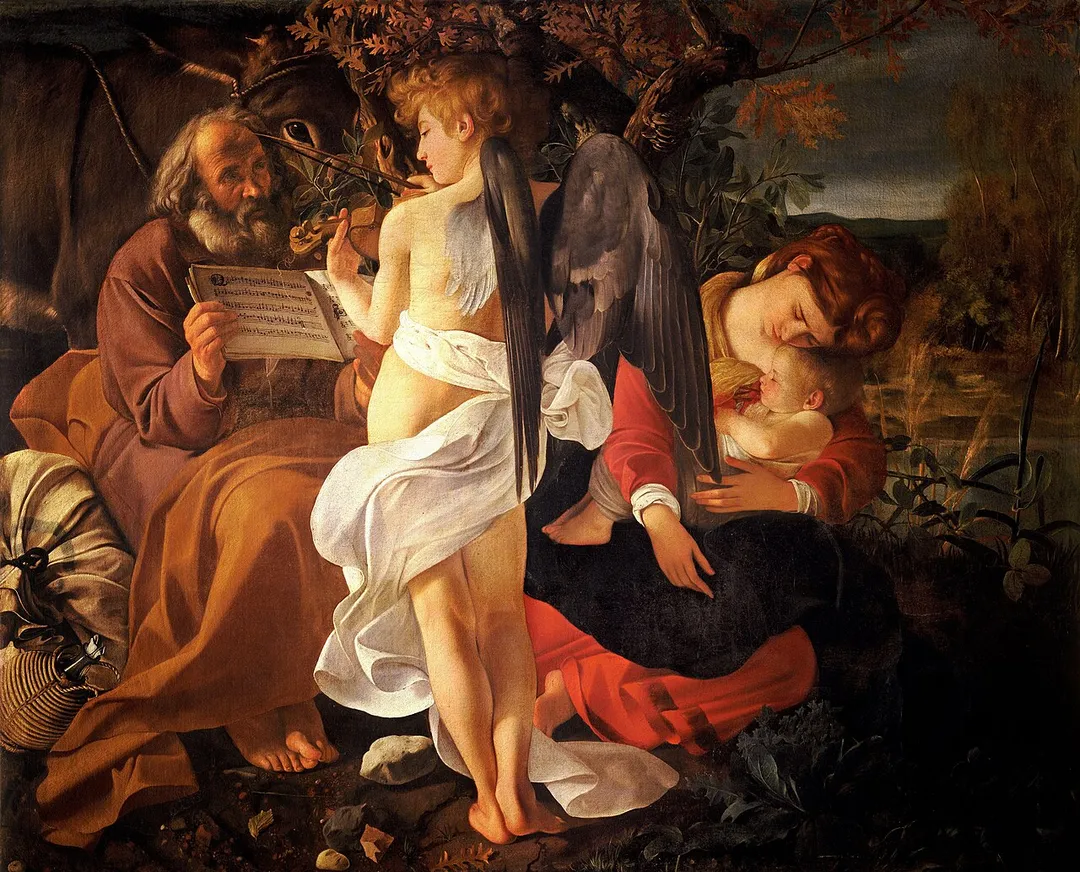
About 1597 · Doria Pamphilj Gallery, Rome
Mary rests with the sleeping Jesus in her arms while an angel plays the violin and Saint Joseph holds the music. This quiet pause during the Holy Family’s journey reveals the tenderness of a mother’s care amid hardship and uncertainty.
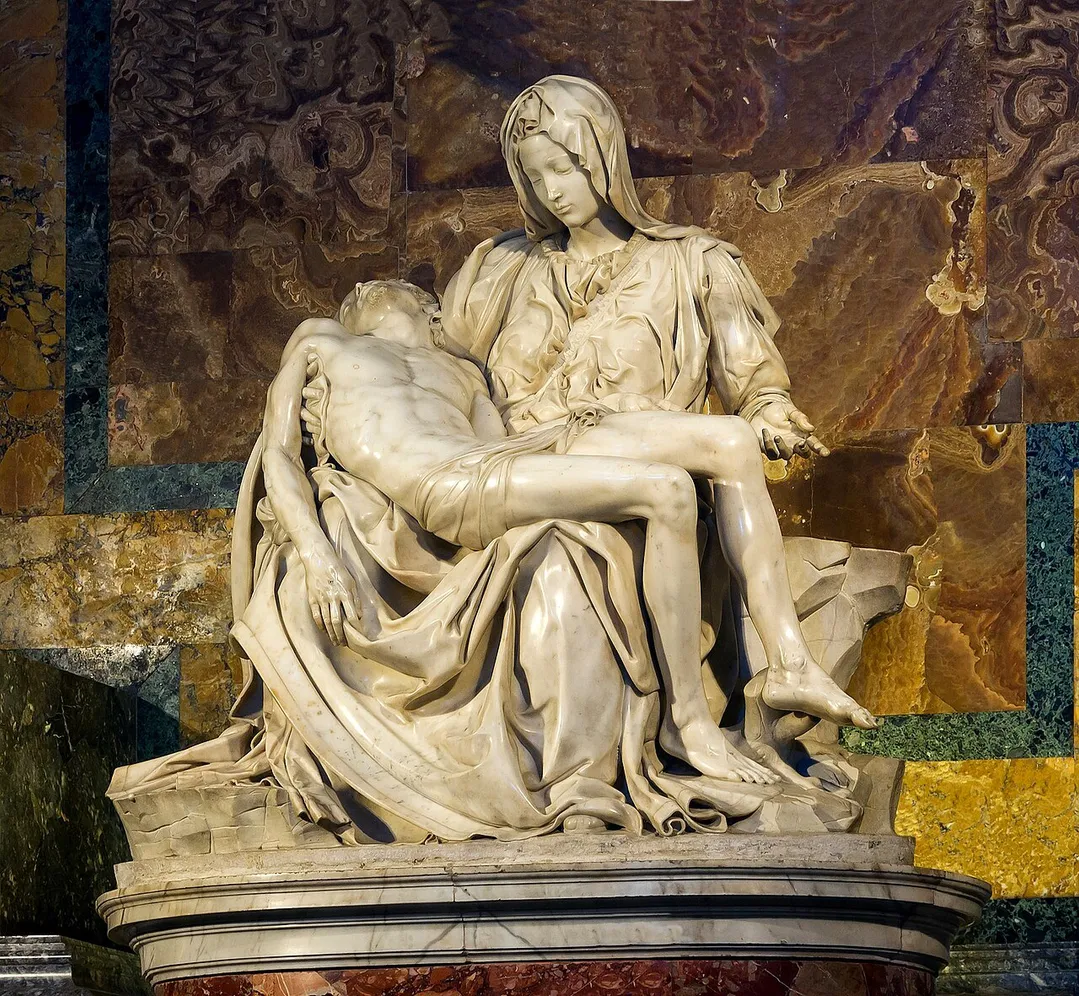
1498–1499 · St. Peter’s Basilica, Vatican City
Mary cradles the body of her crucified Son with sorrowful tenderness. The stillness of the marble draws us into her grief, inviting us to remain beside her and contemplate the love through which Christ gave himself for us.
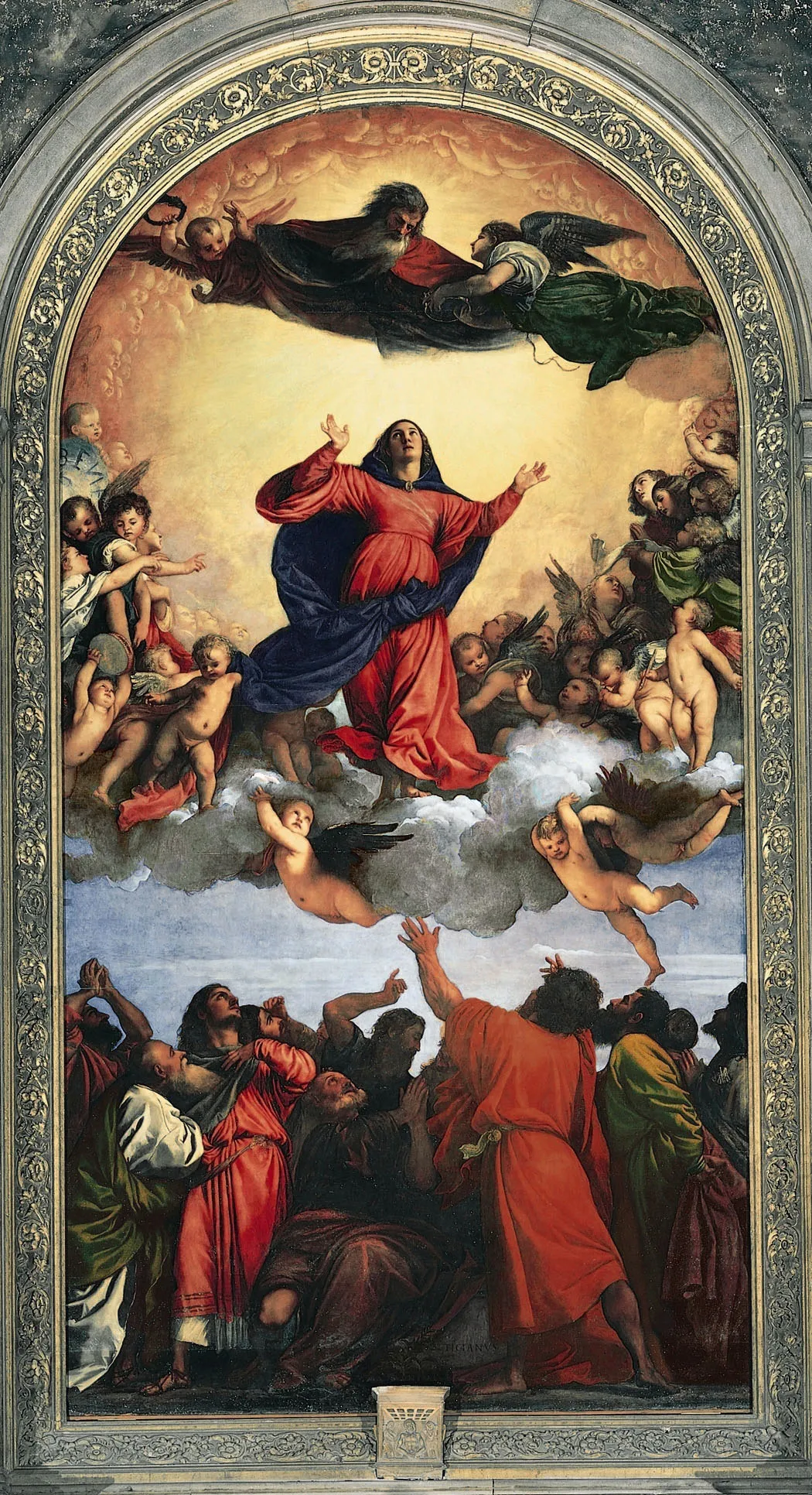
1516–1518 · Basilica of Santa Maria Gloriosa dei Frari, Venice
Clothed in vivid red, Mary rises amid angels toward the golden light above, while the apostles reach upward in wonder. The painting celebrates her Assumption into heaven and turns our hearts toward the promise of eternal life.
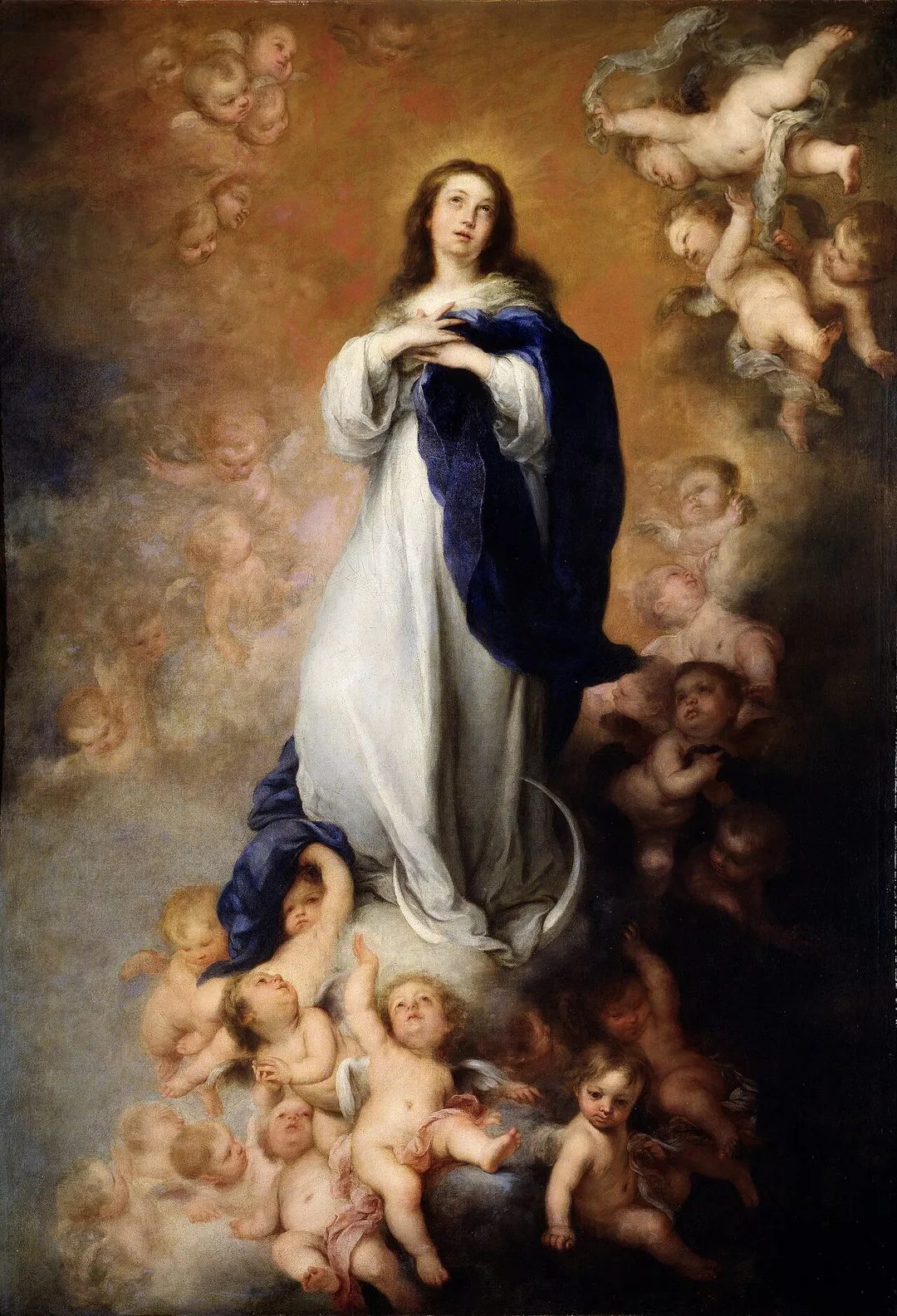
About 1678 · Museo del Prado, Madrid
Dressed in white and blue, Mary lifts her eyes toward heaven, surrounded by angels and warm light. The crescent moon beneath her feet recalls the woman of Revelation. This radiant image celebrates the grace that preserved Our Lady from original sin.
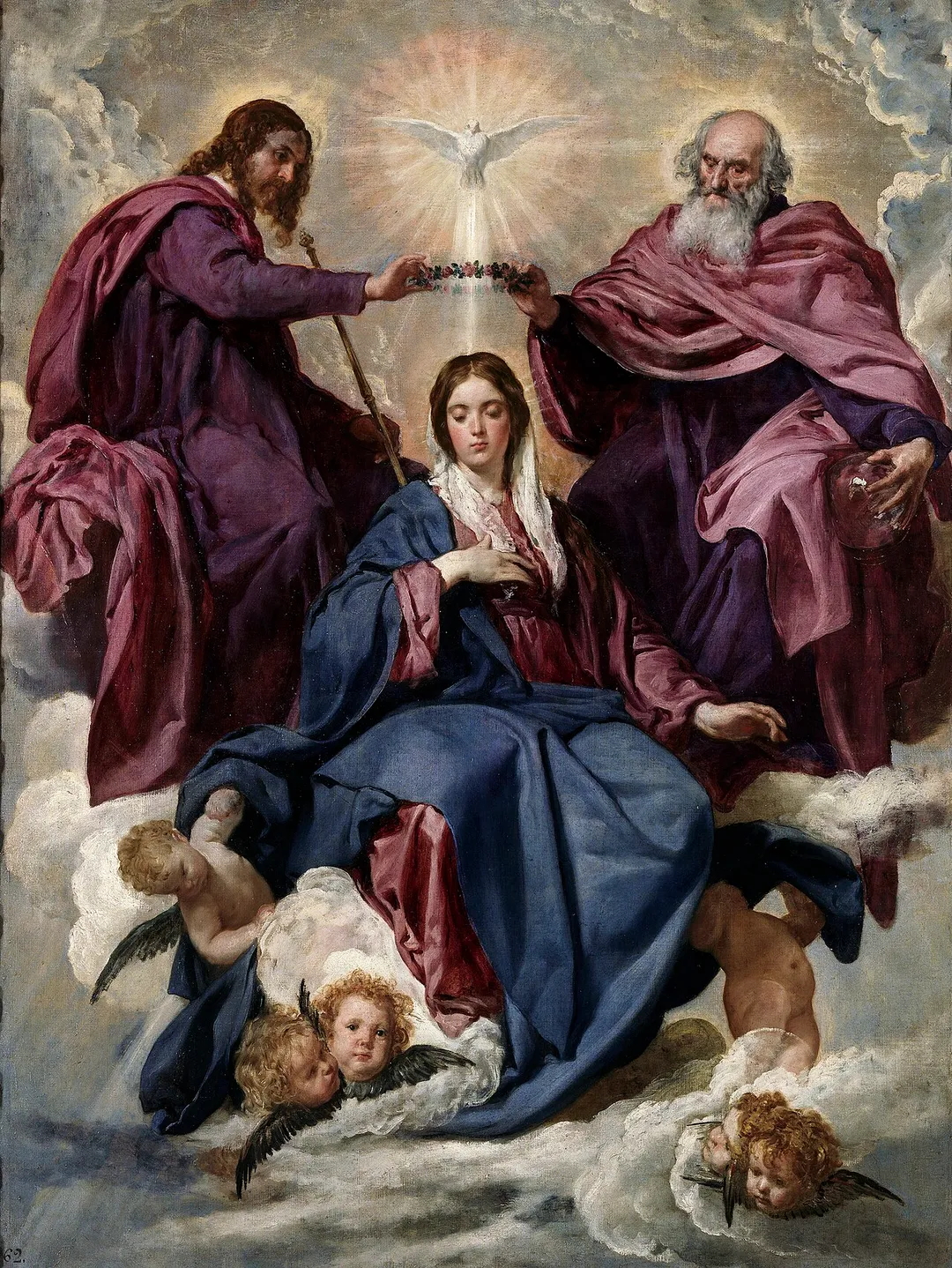
1635–1636 · Museo del Prado, Madrid
The Father and the Son hold a crown above Mary, while the Holy Spirit appears as a dove overhead. With her gaze lowered in humility, Our Lady receives her heavenly crown—a beautiful invitation to contemplate the fifth Glorious Mystery of the Rosary.
Love and reverence for Mary extend beyond the Catholic Church. While our beliefs differ, we can recognize what we share and speak about one another with honesty and charity. These brief summaries describe broad traditions; beliefs and devotional practices vary within them.
Orthodox Christians deeply venerate Mary as the Theotokos, the Mother of God, and the ever-virgin. They seek her intercession and celebrate her Dormition—her falling asleep in death and entrance into heavenly life. Although they honor her exceptional holiness, they do not share the Catholic definition of the Immaculate Conception; differences in understanding ancestral sin form part of this distinction.
The ancient Oriental Orthodox Churches hold Our Lady in profound reverence. In the Coptic tradition, she is honored as the ever-virgin Mother of God through hymns, icons, fasting, and feast days. The faithful ask for her prayers and look to her as an example of wholehearted obedience to God.
Anglican devotion to Mary takes many forms. Some Anglicans honor her through feasts, prayers, and pilgrimages, including visits to the Anglican shrine at Walsingham. Others emphasize her biblical example without seeking her intercession. In 2005, an Anglican–Catholic commission published Mary: Grace and Hope in Christ, exploring shared beliefs and remaining differences; it was a dialogue statement, rather than a binding declaration for every Anglican. Read more
Lutheran teaching honors Mary as the Mother of God because the Son she bore is truly God and truly man. Her faith and humility offer an example for every Christian. Lutheran churches generally distinguish honoring Mary and the saints from invoking them in prayer, directing prayer to God alone.
These overlapping traditions generally affirm the virgin birth of Jesus and respect Mary as a faithful servant of God. They emphasize learning from her trust and obedience, while directing prayer to God through Christ. They generally do not accept the Catholic dogmas of her Immaculate Conception and Assumption, and many do not affirm her perpetual virginity.
Muslims honor Mary as Maryam, a woman chosen by God and an example of purity and faith. The nineteenth chapter of the Quran bears her name and recounts the miraculous conception of Jesus without a human father. Islam reveres Jesus as the Messiah and a messenger of God, but does not confess his divinity; it therefore does not call Mary the Mother of God.
Mary was a Jewish woman whose life was shaped by Israel’s faith, Scriptures, and hope in God’s promises. Remembering her Jewish identity helps Christians understand both her life and the world into which Jesus was born. Mary is not an object of devotion in Judaism; her religious significance belongs principally to Christian and Islamic traditions.
At some Marian shrines, people of different religions come seeking consolation and healing. At Velankanni in India, Hindu and Muslim visitors join Christians in turning to Our Lady of Good Health. These encounters offer opportunities for welcome and friendship, while each person’s religious beliefs remain distinct. Read more
Love for Our Lady grows through prayer, trust, and small acts of faithfulness. We honor her by seeking her prayers and following her example—listening to God, loving generously, and staying close to Jesus. Begin with one simple practice and let it grow.
Walk with Mary through the mysteries of her Son’s life. Begin with a single decade, bringing her your intentions and the people you love.
Celebrate Our Lady throughout the Church’s year. Join in the liturgy, pray with your family, or mark the day with a small act of love.
Explore accounts of Marian apparitions and the Church’s discernment of them. Reflect on their calls to prayer, repentance, and renewed faith in Jesus.
Greet Our Lady with the words of Gabriel and Elizabeth, then ask her to pray for you. Pray slowly, entrusting your joys and worries to her motherly care.
Pause in the morning, at noon, and in the evening to remember Mary’s “yes” and the Word made flesh. During Easter, pray the joyful Regina Caeli in its place.
Wear this Carmelite sign of belonging to Mary and commitment to following Christ. Learn its meaning and ask a priest about enrollment.
Spend a few quiet minutes with the Annunciation, the Magnificat, or the wedding at Cana. Ponder Mary’s faith and ask how you can follow her example today.
Prepare prayerfully to entrust yourself to Jesus through his Mother. Let this commitment take root in daily prayer, the sacraments, and love for others.
Place an image of Our Lady in a quiet corner of your home. Let it remind you to pause, pray, and welcome Jesus into the life of your family.
Follow Mary’s example at the Visitation: notice someone in need and go to them with love. Visit the lonely, help a neighbor, or offer patient care to someone who is struggling.
Questions about Our Lady can help us know her better and deepen our faith in Jesus. Here are some simple answers rooted in the Church’s teaching.
No. We worship God alone—the Father, the Son, and the Holy Spirit. We honor Mary with a special love because she is the Mother of God and our mother in faith. Every authentic devotion to her leads us closer to Jesus.
We can—and should—pray directly to God. Asking Mary for her prayers is another expression of our life together in Christ, just as we ask fellow Christians to pray for us. Her intercession depends entirely on Jesus and never replaces him.
Because the person she bore is Jesus Christ, who is truly God and truly man. This title does not mean that Mary existed before God or gave him his divine nature. It expresses the truth about her Son: he is the eternal Son of God made flesh.
No. The Immaculate Conception refers to Mary herself: from the first moment of her existence, God preserved her from original sin through the saving grace of Jesus Christ. The virgin birth refers to Jesus being born of Mary, who conceived him by the Holy Spirit without a human father.
Yes. Mary herself rejoices in “God my Savior” in the Magnificat. Everything she received came through Christ. Rather than being cleansed from original sin afterward, she was preserved from it from the beginning—a unique gift of his redeeming grace.
The Church teaches that Mary remained ever-virgin and had no other children. It understands the references to Jesus’ “brothers and sisters” as referring to close relations, in keeping with biblical usage. Other Christians interpret these passages differently.
No. Even Church-approved apparitions do not belong to the deposit of faith, and Catholics are not obliged to accept them as an article of faith. They may help us live the Gospel, but they cannot add to or correct God’s definitive revelation in Jesus. The Church’s Marian dogmas, by contrast, are truths Catholics are called to believe.
Look at the fruit it bears. A healthy devotion helps you love Jesus more deeply, participate in the sacraments, turn away from sin, and care for others. Mary’s example always directs us toward faithfulness to her Son.
Yes. You are welcome to visit, sit quietly, and explore at your own pace. You can ask Mary to pray for you even while you are still learning about Catholic faith. Many Marian shrines welcome visitors from different Christian traditions and other religions.
Begin simply: “Mary, Mother of Jesus, pray for me and help me grow closer to your Son.” You can also pray one Hail Mary slowly, bringing her whatever is on your heart. You do not need perfect words to begin.
Images: Wikimedia Commons, public domain or CC0.
Last reviewed: 2026-11-02
Receive information on new pages, new research, Marian feast days, prayers and more.