
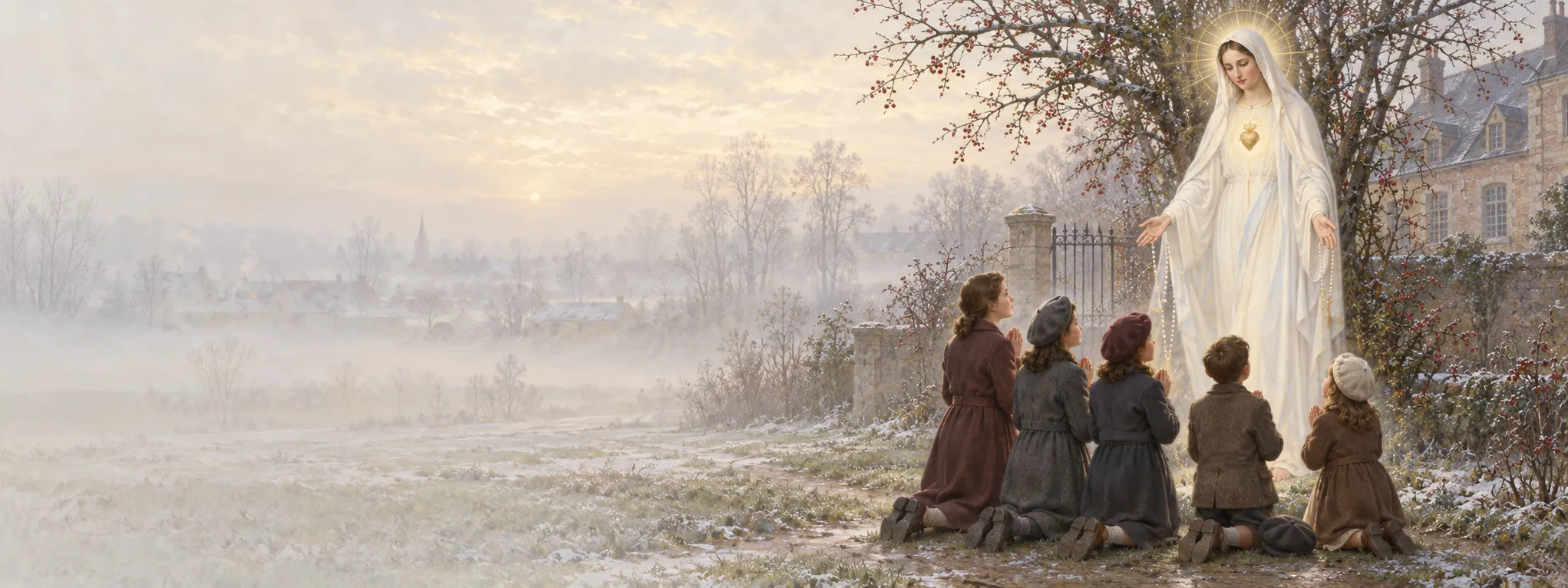
On November 29, 1932, four children were collecting Gilberte Voisin from a convent school in Beauraing when they saw a luminous lady above a nearby railway bridge. Gilberte also saw her when she came outside. The five children returned on the following evenings, and the apparitions became associated with a hawthorn tree in the school garden.
The children described Mary dressed in white, smiling, and surrounded by light. During the final days, she revealed a radiant heart that appeared golden, from which comes the title Our Lady of the Golden Heart. She identified herself as the Immaculate Virgin, asked for a chapel and for pilgrimages, and encouraged persevering prayer and the conversion of sinners.
On July 2, 1949, Bishop André-Marie Charue of Namur formally recognized the supernatural character of the apparitions, with the assent of the Holy See. Beauraing continues to welcome pilgrims seeking prayer, reconciliation, and renewed faith. Its invitation is to respond to Mary’s motherly love by drawing closer to Jesus and letting that love shape daily life.
Church status: Recognized as supernatural by Bishop André-Marie Charue of Namur on July 2, 1949, with the assent of the Holy See. Public devotion had been authorized in 1943, before this formal judgment.
Setting and people
The apparition dates are historical anniversaries, not feasts of the universal Church.
Two families in a small Belgian town
The encounters took place in the garden of the Notre-Dame du Sacré-Cœur boarding school, run by the Sisters of Christian Doctrine of Nancy. The five children belonged to two neighbouring families and often spent time together.
Their first claims met with scepticism, even from adults close to them. The sanctuary’s narrative describes parents and sisters trying to find out whether the children were mistaken or being frightened by someone.
The five witnesses
| Witness | Age at the beginning | Later life |
|---|---|---|
| Fernande Voisin | 15 | Married and became a mother of five; worked in nursing. Died in 1979. |
| Andrée Degeimbre | 14 | Married and had three children; kept a lifelong habit of prayer at the shrine. Died in 1978. |
| Gilberte Voisin | 13 | Became a nursery-school teacher, married, and had two children. Died in 2003. |
| Albert Voisin | 11 | Married, had three children, and worked as a teacher, including after returning from the Congo. Died in 2003. |
| Gilberte Degeimbre | 9 | Married, had two children, and lived for years in Italy before returning to Beauraing. Died in 2015. |
All five eventually married, and their later lives unfolded largely through family responsibilities and ordinary work. Gilberte Degeimbre, the youngest, was the last surviving witness.
The apparition account
This chronology summarizes the sanctuary’s received account. The crowds watched the children and their reactions; they did not share the children’s vision of Mary.
| Date | Reported event |
|---|---|
| November 29, 1932 | The first encounter near the school, with Our Lady seen above the railway bridge. |
| December 1 | The appearances move to the garden and the hawthorn tree. |
| December 2 | Mary speaks for the first time, asking the children to be good. |
| December 17 | She asks for a chapel. |
| December 21 | She identifies herself as the Immaculate Virgin. |
| December 23 | She asks that people come there on pilgrimage. |
| December 29 onward | The radiant golden heart becomes a distinctive feature of the apparitions. |
| December 30–January 1 | Her appeals stress frequent, persevering prayer. |
| January 3, 1933 | The final encounters include words about conversion, Mary’s identity, and love for her Son. |
The thirty-three apparitions do not correspond simply to thirty-three consecutive days; on some evenings there was more than one.
The final encounter with Fernande
On the final evening, Fernande at first did not see what the younger children reported. She remained in prayer and afterwards described a separate encounter in which Mary asked whether she loved Jesus and Mary, followed by a request for self-sacrifice.
The account also records personal communications to the three youngest children. Their contents were never made public.
The message and its meaning
Three brief sayings, translated from the French narrative, carry the central emphasis:
Pray, pray much.
Pray always.
I will convert sinners.
Prayer that becomes a way of life
Beauraing’s call to prayer is persistent and practical. Prayer is meant to continue beyond a pilgrimage and become part of ordinary life: in our families, our work, our decisions, and our difficulties.
Conversion through Mary’s intercession
The promise concerning sinners belongs within the Catholic understanding of Mary’s intercession: she does not save apart from Christ, but intercedes with her Son. In his 1985 homily at Beauraing, St. John Paul II placed Marian devotion within the work of Christ and the Church, describing the shrine as a place of prayer, renewal, and intercession for conversion.
Love expressed through self-giving
The final dialogue joins love for Jesus and Mary to sacrifice. Today, it can be lived through faithful service, generosity, patience, forgiveness, and freely accepted acts of penance.
At Beauraing, Mary calls us to a love that takes shape in daily life. Prayer opens the heart to God; conversion changes our choices; and self-giving allows that love to reach others. Her golden heart invites us to trust her motherly care and respond more fully to her Son.
The golden heart
The radiant heart is the defining image of Beauraing’s devotion. The sanctuary reads its light and gold as signs of Mary’s closeness to God and of the love she communicates. The heart is something the children saw, not a physical object or relic left behind.
What the Church has said
Investigation and early reservations
Approval did not come all at once. Different commissions reached different assessments during the 1930s. A historical account by the sanctuary’s former vice-rector records a favourable leaning in the Namur inquiry, but a 1937 assessment by the commission at Mechelen found that a supernatural origin had not been established. Under Bishop Charue, the file was reopened and examined further.
Public devotion in 1943
Public devotion was authorized before any final judgment on supernatural origin. Bishop Charue’s later letter recalls that this earlier permission kept reservations about the reality and supernatural character of the events. Accounts give different exact dates for the stages of that authorization; 1943 is the year securely documented.
Formal recognition on July 2, 1949
In 1949, Bishop Charue affirmed the supernatural character of the apparitions. His accompanying letter cited the work of the doctrinal commission, lasting spiritual fruits, and two healings judged miraculous. The Diocese of Namur confirms the date and states that the recognition was given with the assent of the Holy See.
Later milestones
| Date | Development |
|---|---|
| August 22, 1946 | The marble statue of Our Lady was inaugurated. |
| 1947–1954 | The votive chapel was built. |
| May 18, 1985 | St. John Paul II visited Beauraing and celebrated Mass. |
| 2013 | The sanctuary’s upper church received the title of minor basilica. |
| July 7, 2024 | The renovated apparition garden was inaugurated during the seventy-fifth anniversary of the recognition. |
These milestones show the shrine’s continuing place in the life of the Church.
Sources and historical questions
Who saw the apparition?
The five children are the principal witnesses to Mary’s appearances. Large crowds gathered around them, but being present did not make everyone an eyewitness to the same vision.
Early records and later summaries
The sanctuary’s present narrative gives pilgrims a coherent account, but it is a later presentation of the events. Bishop Charue’s 1949 letter is especially useful for understanding the grounds and scope of the Church’s recognition. An English translation, citing Don Sharkey’s 1957 book, is available online; for close study it should be compared with the French original.
Reported medical observations
Popular accounts describe doctors testing the children’s reactions during their experiences. These reports belong to the history of the investigation, not to modern experimental proof of an apparition. The Church’s judgment weighed the case as a whole: the testimony, its religious content, its spiritual fruits, and reported healings.
Beauraing and Banneux are separate events
Both belong to Belgium’s Marian history of 1932–1933, but they involve different witnesses, places, and messages. Beauraing has its own distinctive focus: the golden heart, prayer, pilgrimage, and conversion.
Devotion and legacy
The link between prayer and ordinary life shows clearly in the witnesses’ later lives. Andrée Degeimbre kept a long habit of praying the Rosary at the hawthorn, and Gilberte Degeimbre returned to prayer at the shrine in her later years.
St. John Paul II’s visit in 1985 emphasized the shrine’s role in prayer, Christian renewal, and vocations. He presented devotion to Mary as drawing the Church toward Christ, the source of salvation.
Today, the sanctuary joins the promise of conversion to sacramental reconciliation. Its Corridor of Mercy holds confessionals and sacred art to help pilgrims prepare for confession.
The golden heart of Beauraing speaks of a mother’s love that welcomes us and calls us to change. Mary invites us to pray faithfully, return to her Son, and carry His love into the lives of others.
Visiting today
The principal places of prayer are:
- The apparition garden and the hawthorn: where the children’s encounters took place.
- The marble statue of Our Lady: made from the witnesses’ descriptions.
- The votive chapel: built in answer to Our Lady’s request.
- The Corridor of Mercy: with confessionals and devotional art.
- The Rosary crypt and upper basilica: for the shrine’s worship and pilgrimages.
The statue was sculpted by Aurélien Pierroux and inaugurated in 1946. It stands at the apparition site but has been turned to face the pilgrims in the garden.
The shrine offers Mass, Eucharistic adoration, the Rosary, confession, and help with pilgrimages. Check the official timetable and yearly calendar before visiting. Address: 6, rue de l’Aubépine, B-5570 Beauraing, Belgium.
Sources and further reading
| Resource | Best use |
|---|---|
| Official sanctuary: the story of the apparitions (in French) | The received narrative of the apparitions. |
| Diocese of Namur (in French) | The seventy-fifth anniversary of the recognition. |
| Bishop André-Marie Charue: letter of July 2, 1949 | The grounds and scope of the recognition, in an English reproduction. |
| Father Christophe Rouard, former vice-rector (in French) | A historical account of the apparitions and the investigations. |
| St. John Paul II: homily at Beauraing, May 18, 1985 (in French) | Marian devotion within the work of Christ and the Church. |
| Official sanctuary: discover the sanctuary (in French) | The buildings, the statue, and devotional art. |
| Beauraing pilgrimage committee, Diocese of Breda | The later lives of the witnesses. |
