
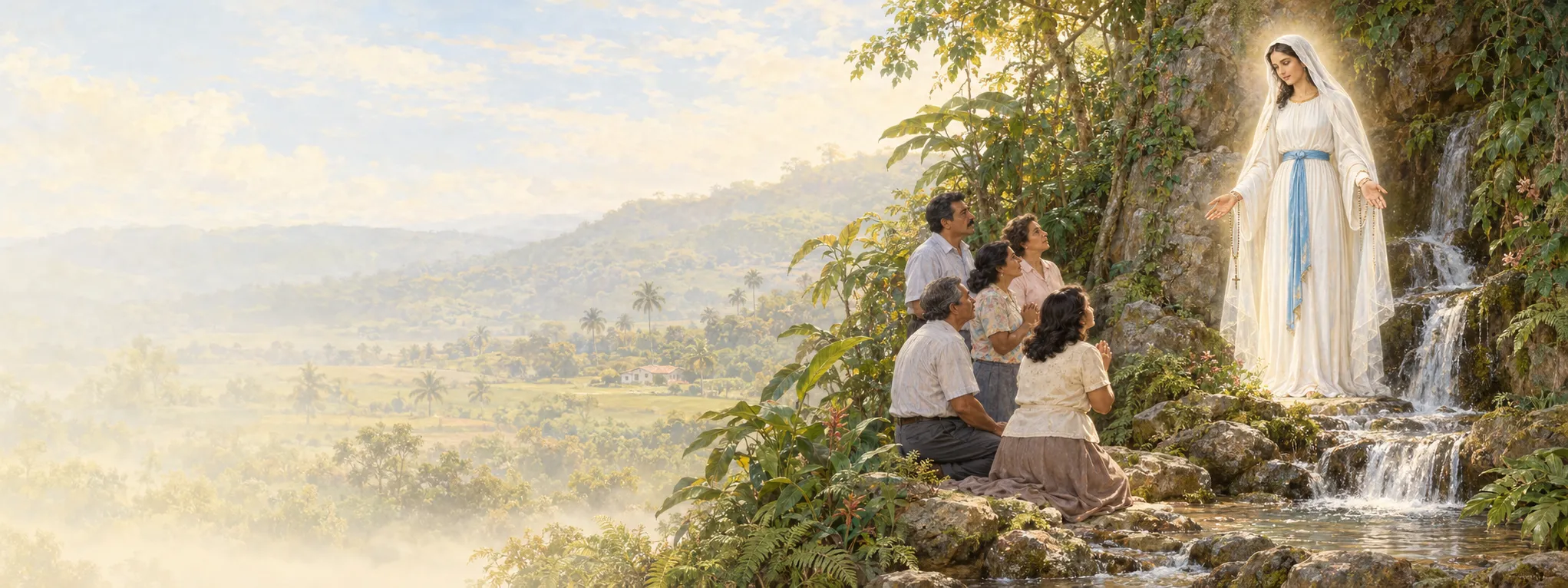
On March 25, 1976, María Esperanza de Bianchini, a Venezuelan wife and mother of seven, saw the Blessed Virgin Mary at Finca Betania, a rural property near Cúa. The encounter took place near a stream and waterfall surrounded by tropical vegetation. According to the account, Mary presented herself as Reconciler of Peoples and Nations, bringing an invitation to conversion and to renewed love for her Son.
The events became widely known on March 25, 1984, when about 150 people gathered at the property for Mass. Members of the gathering reported seeing Mary, and their testimonies prompted a Church investigation. After examining the evidence, Bishop Pío Bello Ricardo of Los Teques recognized the apparitions as authentic and supernatural on November 21, 1987.
Betania’s message centres on reconciliation: returning to God, healing divisions within families, and extending Christian love beyond social and national boundaries. Prayer, conversion, and practical charity give this invitation its meaning. The sanctuary remains a place of pilgrimage where visitors seek peace and a renewed commitment to living the Gospel.
Church status: Recognized by the diocesan bishop. Bishop Pío Bello Ricardo issued a positive judgment on November 21, 1987, and authorized the site for pilgrimage and worship. His declaration explicitly did not authenticate every individual claim of an apparition.
The setting and María Esperanza
The published collection lists thirty-one apparition entries, ending on January 5, 1990, which explains the dates 1976–1990. The bishop’s 1987 judgment does not by itself approve messages reported afterward.
María Esperanza was born in Venezuela on November 22, 1928. She married Geo Bianchini in 1956, and they raised seven children. Her public mission grew within married and family life, an important setting for Betania’s emphasis on reconciliation within the home.
She helped establish the Betania Foundation in 1979 and later travelled internationally to speak about faith, love, and family unity. She died in New Jersey on August 7, 2004, aged seventy-five.
Her cause for beatification and canonization opened in the Diocese of Metuchen on January 31, 2010, and she is now called Servant of God María Esperanza. The opening of the cause is distinct from the recognition of the apparitions: it begins an investigation into her life and holiness; it does not declare her a saint.
The story: a chronology
| Date | Event |
|---|---|
| March 25, 1976 | María Esperanza sees Our Lady for the first time at Betania. |
| 1976–1978 | The published messages describe further encounters stressing prayer, Christian living, obedience, and reconciliation. |
| April 19, 1979 | The Betania Foundation is established, with aims including evangelization, family life, and social service. |
| March 25, 1984 | The principal group encounter. Accounts describe seven appearances during the afternoon. |
| November 21, 1987 | Bishop Pío Bello Ricardo issues his pastoral instruction recognizing the apparitions. |
| August 28, 1989 | About four hectares (ten acres) are donated to the Church for the sanctuary. |
| January 5, 1990 | The final entry in the published collection of thirty-one apparition messages. |
The numbered collection of messages and the count of appearances at the 1984 gathering describe different things; they do not add up to a single total of investigated apparitions.
The message
The published messages repeatedly connect reconciliation with a changed way of living. Their main themes are:
- Conversion: returning to God and letting faith shape daily choices.
- Prayer: especially the Rosary and attentive prayer within the family.
- Family unity: resisting division and strengthening love between generations.
- Service: caring for others, especially those in need.
- Faithfulness to Christ: following His teaching through the life of the Church.
The title Reconciler is understood in relation to Jesus: Mary’s mission draws people toward the reconciliation accomplished by her Son. It does not make her an independent source of salvation.
Betania invites us to begin reconciliation close to home: to seek God’s forgiveness, make peace where relationships have broken down, and turn prayer into acts of love.
What the Church has said
Bishop Pío Bello Ricardo personally conducted the investigation. He reported interviewing about two hundred people and collecting 381 declarations bearing 490 signatures.
His instruction of November 21, 1987, declared the apparitions authentic and supernatural and approved the site for worship. He nevertheless rejected some individual testimonies as unreliable and expressly limited the scope of his judgment. He also explained that accepting these private revelations is not an obligation of divine faith.
The recognition was given by the diocesan bishop; there is no separate papal declaration.
Sources and historical questions
How many people witnessed the 1984 event?
About 150 people attended the gathering, and the bishop recorded 108 signed testimonies from that day. Attendance figures and documented witness statements are distinct.
What do the dates 1976–1990 establish?
They describe the span of the published collection of messages. They do not mean that a single decree examined and approved every entry through 1990.
Extraordinary gifts attributed to María Esperanza
Biographical accounts attribute many mystical gifts to her. These belong to her wider life story as reported experiences; the judgment on the apparitions did not authenticate them, and her cause for canonization is a separate process.
The Eucharistic event associated with Betania
A reported Eucharistic miracle on December 8, 1991, is also associated with the sanctuary. It came after the apparition period described here and has its own history; it was not part of the 1987 recognition.
Devotion and legacy
The Betania movement continues to promote reconciliation through prayer, teaching, charitable works, and family life. Its work includes publications, musical presentations, and works of mercy.
In 2026 the sanctuary marked the fiftieth anniversary of the first apparition, with celebrations centred on prayer, fraternity, forgiveness, and reconciliation. Betania’s continuing significance lies in how its message is lived within homes, communities, and the Church.
Visiting today
The sanctuary lies on the road between Cúa and San Casimiro in Miranda State. A footbridge crosses the Tarma River and leads to the esplanade, the open-air chapel, and the grotto of the apparitions. The wooded surroundings and flowing water remain characteristic features of the site.
Check current visiting arrangements and liturgical schedules with the sanctuary before planning a pilgrimage.
Principal sources
| Resource | Best use |
|---|---|
| Bishop Pío Bello Ricardo: pastoral instruction, November 21, 1987 | The essential source for the investigation, the judgment, and its limits. |
| Official Betania account of the apparitions (in Spanish) | The movement’s history and a description of the site. |
| Published collection of Betania messages | Dated entries running to January 5, 1990. |
| Catholic News Service: the opening of María Esperanza’s cause | A report hosted by the Archdiocese of Baltimore. |
