
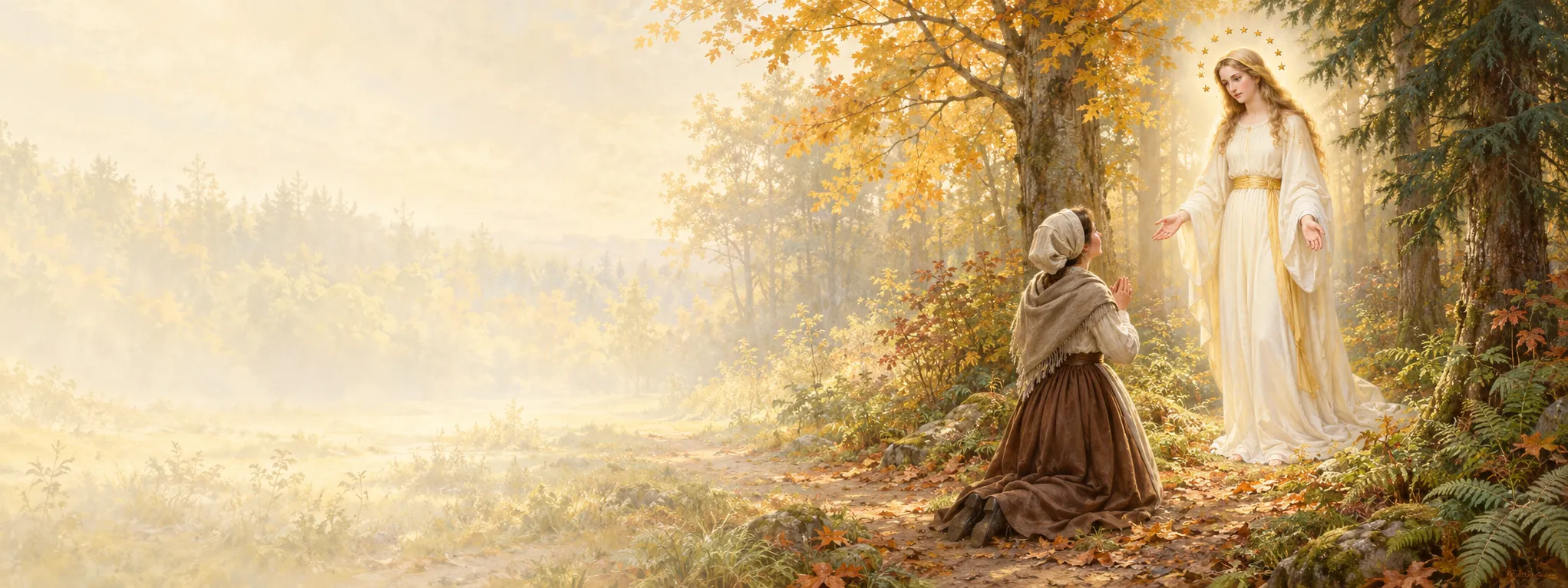
In October 1859, twenty-eight-year-old Adele Brise was carrying grain to a mill near present-day Champion, Wisconsin, when she saw a woman in white standing between two trees. According to the account, the woman appeared again as Adele travelled to Mass and a third time on her journey home. Following her priest’s advice, Adele asked who she was and what she wanted.
The woman identified herself as the Queen of Heaven and asked Adele to pray for the conversion of sinners. She entrusted her with a particular mission: gather the children and teach them the Catholic faith, the Sign of the Cross, and how to approach the sacraments. Despite her limited education, Adele began visiting families, teaching their children, and eventually establishing a school with the help of other women.
On December 8, 2010, Bishop David Ricken of Green Bay declared the apparitions worthy of belief. Today, the National Shrine of Our Lady of Champion continues Adele’s mission through prayer, the sacraments, and religious instruction. Its message invites the faithful to pray for others, pass on their faith, and trust that God can accomplish much through a willing heart.
Church status: Recognized as worthy of belief by Bishop David L. Ricken of Green Bay on December 8, 2010. The judgment concerns the apparitions and messages reported by Adele in October 1859; belief in them is permitted, not obligatory.
The setting and the people
A Belgian Catholic community in Wisconsin
Adele’s family emigrated from Belgium in 1855, joining the Belgian settlement in northeastern Wisconsin. Families faced demanding agricultural work, difficult travel, and limited access to churches and religious instruction.
The Diocese of Green Bay’s historical account identifies this shortage of pastoral care as essential background. Children could grow up with little opportunity to learn their faith, giving Adele’s subsequent teaching mission a concrete local purpose.
Adele Brise
Born in Dion-le-Val, Belgium, on January 30, 1831, Adele lost sight in one eye following a childhood accident. The shrine’s biography describes her as cheerful and deeply religious. As a girl, she hoped to become a teaching sister in Belgium, but her family’s emigration changed that plan.
Although commonly called Sister Adele, she remained a laywoman. She and her companions followed a Franciscan way of life without taking public religious vows. This explains why accounts speak both of a community of “sisters” and of a lay teaching apostolate.
Who witnessed the apparition?
Adele alone reported seeing Mary. Her companions were present during the later encounters but did not see the woman themselves. They were witnesses to Adele’s behaviour and testimony, not additional visionaries.
The apparition account
This chronology follows the account preserved by the shrine.
| Encounter | What the account reports |
|---|---|
| First, early October 1859 | While travelling to a mill, Adele sees a silent woman between two trees, traditionally identified as a maple and a hemlock. |
| Second, traditionally October 9 | On her way to Mass with companions, Adele sees the same woman. After Mass, her priest advises her to ask the visitor’s identity and purpose. |
| Third, on the return journey | Adele asks the questions. The woman identifies herself as the Queen of Heaven, requests prayer for sinners, and gives Adele a mission to teach children. |
The shrine’s narrative keeps October 9 as the anniversary of the final two encounters; the first has no equally certain calendar date. The October 9 solemnity was authorized for the shrine, not established as a feast for the universal Church.
Adele described Mary clothed in a white garment, with a yellow sash, flowing golden hair, and a crown of stars, surrounded by a brilliant light. These details from her vision inspire the shrine’s statues and illustrations.
Adele’s response
Adele began teaching from house to house. The biography maintained by her canonization cause describes her offering to help with household work so that children could have time for religious instruction. Parents sometimes listened as well.
Other women joined her, allowing the work to grow into a school and a more settled community of service. The mission involved financial insecurity and practical hardship, making perseverance a central feature of Adele’s life after the apparitions.
The message and its meaning
Go and fear nothing, I will help you.
These words come to us through the received account of the apparition, not through a written record made by Adele in 1859. The message has two closely connected purposes, conversion and catechesis:
- Prayer for sinners: Adele is asked to pray for others’ return to God and to offer her Holy Communion for their conversion.
- Personal repentance: the account includes a request for a general confession.
- Religious instruction: children are to learn the catechism, the Sign of the Cross, and how to take part in the sacraments.
- Courage in service: Adele’s concern about her own limitations is answered with encouragement to begin the work.
The message is strikingly practical. Its answer to spiritual need is teaching, prayer, and the sacramental life. For us today, it is a call to parents, catechists, and parish communities to help children understand and live their faith.
The received narrative also contains a warning about the consequences of refusing conversion and penance. It belongs alongside the invitation to repentance; it is not a prophecy of particular events.
At Champion, the Queen of Heaven asks a humble young woman to teach children the faith and promises her help. She still asks us to pray for sinners, to pass on what we have received, and to go forward without fear.
Reported signs and healings
The fire of October 1871
On October 8, 1871, catastrophic fires swept northeastern Wisconsin. The disaster commonly called the Peshtigo Fire occurred on the same night as the Great Chicago Fire and devastated communities far beyond Peshtigo itself.
The shrine commemorates the survival of its chapel and of those who sought refuge there. Its account describes Adele and local families praying through the night as fire threatened the surrounding countryside. The event remains central to the annual October 8 observance.
Bishop Ricken’s 2010 decree includes the shrine’s preservation during the fire among the events of its devotional history. The 1859 apparitions and the 1871 fire are nevertheless separate events, twelve years apart; the fire was not another apparition. The church visitors see today is also not the wooden chapel that survived the fire: the present chapel dates to 1942.
Accounts of healing
Pilgrims have reported physical healings, conversions, and other answers to prayer. The shrine publishes some of these testimonies, explaining that the favours on its “Graces Received” page have not been officially investigated and declared miracles by the Church.
They are rightly spoken of as reported healings and testimonies of answered prayer. The approval of an apparition does not by itself authenticate every later healing.
The Church’s response
Investigation and recognition
A formal investigation began in 2009. Bishop Ricken’s decree describes the work of three Marian experts, who examined the available documents and testimony, Adele’s character, the message’s consistency with Catholic teaching, and its lasting spiritual fruits.
On December 8, 2010, he recognized the apparitions as worthy of belief. This was an episcopal judgment by the Bishop of Green Bay, not a papal declaration.
Later developments
| Date | Development | Scope |
|---|---|---|
| December 8, 2010 | Bishop Ricken recognizes the apparitions | Judgment on the reported events and messages of October 1859 |
| March 19, 2016 | National shrine designation | Recognition of the shrine by the United States Conference of Catholic Bishops |
| 2023 | Name changes to National Shrine of Our Lady of Champion | Official naming, keeping continuity with the devotion to Our Lady of Good Help |
| October 9, 2023 | First celebration of the new solemnity | Liturgical celebration authorized for the shrine |
| January 30, 2026 | Adele’s canonization cause formally opens | Investigation of her life and holiness; she receives the title Servant of God |
The recognition of the apparitions, the national shrine designation, the liturgical permissions, and Adele’s cause are distinct acts of the Church. Her title Servant of God does not mean that she has been beatified or canonized.
Sources and historical questions
How the account was preserved
The shrine states that Adele did not learn to read or write and shared her experiences orally. Its present narrative draws on oral tradition, archival documents, and accounts passed on through other people, and it acknowledges variation in some details. The words of the dialogue are therefore those preserved in the shrine’s account, not a verbatim record in Adele’s own hand.
Limits acknowledged in the recognition itself
The 2010 decree acknowledges that early documentation is limited. The bishop nevertheless judged the evidence sufficient, weighing Adele’s testimony together with her character, her sustained mission, and the shrine’s spiritual fruits. The judgment rests on this whole picture, not on independent documentary confirmation of every detail of the narrative.
Names and dates
- Brise and Brice: both spellings appear in official Catholic sources. The canonization cause uses Adele Brice; older accounts commonly use Adele Brise.
- October 1859: the date for the apparitions as a whole. October 9 is the established commemoration of the second and third encounters.
- Good Help and Champion: both titles refer to the same devotion and shrine.
- Sister Adele: a customary title linked to her community life, not a sign that she professed vows in a religious order.
The diocesan historical booklet names Sister M. Dominica’s “The Chapel”: Our Lady of Good Help, a Shrine of Mary on the Green Bay Peninsula as a foundational source for its narrative. It is valuable for further study, though it was written long after the apparitions.
Devotion and legacy
A mission that outlived Adele
Adele died on July 5, 1896. Her educational work continued under others. In 1902, the Franciscan Sisters of Bay Settlement took responsibility for the chapel’s work, and the boarding school continued until 1929. The shrine’s history therefore includes decades of religious education and community service alongside pilgrimage.
The meaning of “Good Help”
The earlier chapel bore the French invocation Notre Dame de Bon Secours, Priez Pour Nous: Our Lady of Good Help, pray for us. The name expresses confident reliance on Mary’s intercession.
The 2023 change to Our Lady of Champion follows the custom of naming apparition devotions after their locations. The shrine’s announcement explicitly keeps its attachment to the historical title Good Help.
Devotional life today
The shrine’s annual October celebrations join the Rosary, the remembrance of the fire, and the anniversary of the apparitions. October 8 includes prayer in thanksgiving for the preservation of the shrine; October 9 celebrates Our Lady of Champion. These pilgrimage customs grew up later and are distinct from Our Lady’s requests in the apparition account.
The shrine today
The National Shrine of Our Lady of Champion is at 4047 Chapel Drive, Champion, Wisconsin. Pilgrims can visit the chapel and the apparition oratory, walk the Rosary and Stations of the Cross paths, explore the History Center, and pray at Adele’s grave. The shrine offers Mass, confession, and opportunities for quiet prayer, and its grounds map also shows the historic schoolhouse and other visitor facilities.
The present chapel is the fourth built on the site. Completed in 1942, it followed the original small family chapel, the larger wooden chapel associated with the 1871 fire, and an 1880 brick church. Check the shrine’s current schedules when planning a visit.
Sources and further reading
| Resource | Best use |
|---|---|
| The shrine: our story | The received narrative, including how the story was passed on. |
| Bishop Ricken’s 2010 decree | The primary document for the Church’s judgment and its reasoning. |
| Diocese of Green Bay: history | Background, chronology, and the shrine’s historical literature. |
| Official biography of Adele | Her life, teaching work, and lay community. |
| The shrine’s history booklet | The chapels, the name change, and the new solemnity. |
| Graces Received | Testimonies, and the shrine’s distinction between reported favours and recognized miracles. |
| Wisconsin Historical Society: the Great Peshtigo Fire | Historical context, and Father Peter Pernin’s account, first published in 1874. |
| Adele’s path to sainthood | Current information about her canonization cause. |
