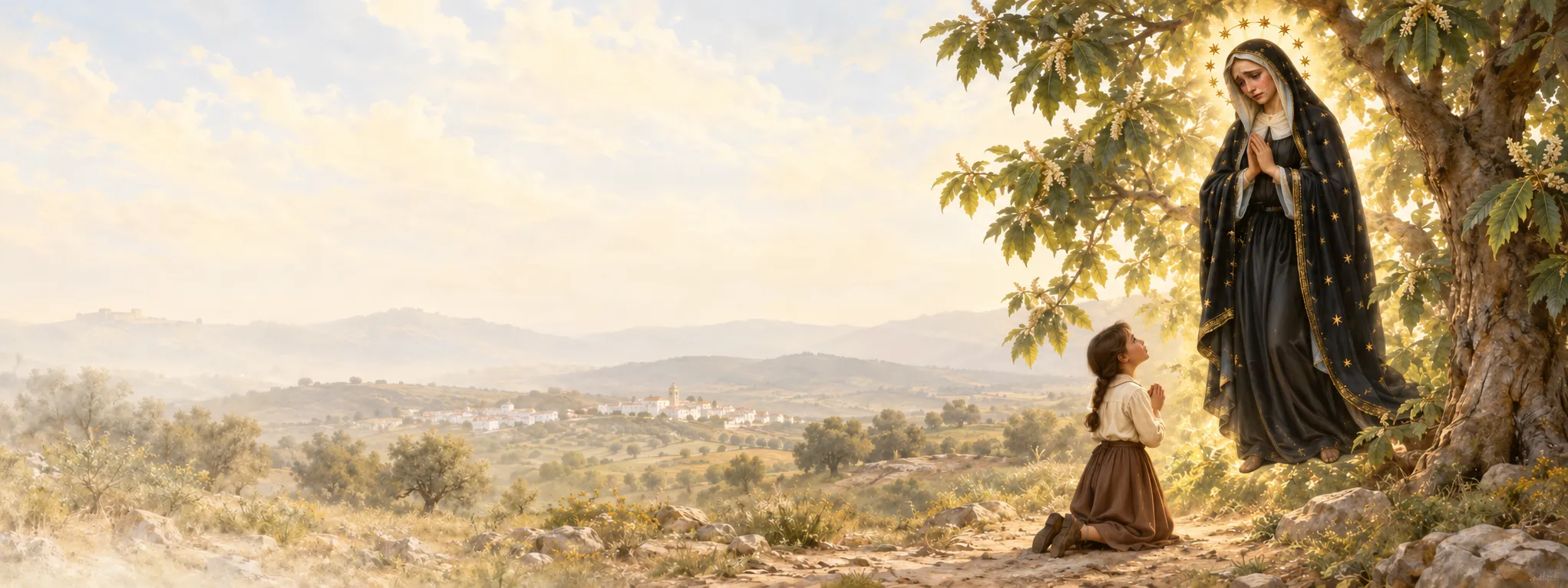
On May 27, 1945, ten-year-old Marcelina Barroso Expósito was travelling near La Codosera when she saw a figure above a chestnut tree. According to her testimony, she recognized Our Lady of Sorrows, wearing a dark mantle adorned with stars. Further experiences followed, and another local young woman, Afra Brígido Blanco, separately reported seeing Mary. Their accounts drew neighbours and visitors from nearby Portugal to pray at Chandavila.
The devotion that grew around these events stresses Mary’s compassionate presence beside those who suffer. Marcelina described an encounter marked by motherly affection and reassurance, and both witnesses later devoted themselves to caring for others. The Vatican’s assessment highlights this link between the consolation they received and the charity they went on to show the sick, the elderly, and orphans.
In August 2024, the Church authorized the devotion with a nihil obstat, recognizing its pastoral value without declaring the apparitions supernatural. The following month, Chandavila was formally established as a diocesan Marian sanctuary. Today, it welcomes pilgrims seeking prayer, reconciliation, and renewed hope in Christ through the intercession of His sorrowful Mother.
Church status: Nihil obstat: the devotion is authorized and its pastoral growth encouraged. Archbishop José Rodríguez Carballo issued the decree on August 24, 2024, with the consent of the Dicastery for the Doctrine of the Faith. The archbishop explicitly distinguished this decision from a judgment affirming or denying the authenticity of the apparitions.
The setting and the witnesses
The chronology rests mainly on the witnesses’ statements and on the archdiocese’s published decisions.
Chandavila lies in a border region where Spanish and Portuguese communities have long been closely linked. The events began amid the hardship that followed Spain’s Civil War. A diocesan account places Marcelina’s journey within the informal trade across the border by which struggling families obtained what they needed. Portuguese people took part in the devotion almost from the start.
Marcelina Barroso Expósito was ten. She later entered the Sisters of the Cross in Seville, taking the religious name María de la Misericordia de la Cruz. The sanctuary’s biography describes her service to the vulnerable.
Afra Brígido Blanco was an adolescent from La Codosera. Her signed declaration gives her age as sixteen, although later accounts usually say seventeen. In her first statement she describes coming out of curiosity before reporting her own experience. Later biographies tell of her hospital work in Madrid and her discreet religious devotion.
The story: the earliest documented events
Two declarations dated June 11, 1945, recorded before the parish priest, give an early foundation for the chronology:
| Date | Reported event |
|---|---|
| May 27 | Marcelina sees Mary near a chestnut tree. Her companion does not see the apparition. |
| May 28 | Marcelina returns with relatives; no apparition is reported. |
| May 29–June 3 | Her statement describes further religious visions and growing gatherings. |
| May 30–31 | Afra first sees shapes like a chapel and a cross, then Our Lady of Sorrows. |
| June 4 | Marcelina approaches the tree on her knees without injury, receives a kiss on her forehead, and hears a request for a chapel. |
| June 11 | Both young women’s early declarations are recorded. |
These are experiences reported in testimony; the presence of crowds does not mean that everyone saw the same thing.
The message
Chandavila’s message is conveyed as much by gestures as by words: reassurance, tenderness, and a sense of being accompanied in suffering. The Vatican’s 2024 letter quotes these words of reassurance:
Do not be afraid; nothing will happen to you.
The letter reads Marcelina’s passage over rough ground on her knees as an experience of trust and protection, not as a call to seek suffering. Its emphasis is on confidence in Mary’s motherly care and the inner peace that followed.
The local Church has also read the devotion in the light of forgiveness, the Cross, and Mary’s share in her Son’s suffering. These themes give the title Our Lady of Sorrows its Christian meaning: accompanying Jesus faithfully and responding with compassion to the suffering of others.
Reported signs and extraordinary experiences
The best-known episode is Marcelina’s passage on her knees over rough ground. The Vatican discusses it in its spiritual assessment, stressing the girl’s experience of protection and dignity.
Later accounts also attribute stigmata and other extraordinary phenomena to Afra. The sanctuary’s biography describes wounds associated with Christ’s Passion, and an archdiocesan report records that bandages connected with those wounds have been preserved.
These claims rest on the accounts. The documents include no separate medical judgment on the supernatural origin of each phenomenon, and the nihil obstat does not authenticate them as individual miracles.
What the Church has said
Public devotion at Chandavila grew over decades before the 2024 decision.
| Date | Development |
|---|---|
| Earlier years | A diocesan history records Bishop José María Alcaraz y Alenda’s support for establishing the sanctuary and worship there. |
| 2020–2022 | A jubilee marked the seventy-fifth anniversary. Extended because of the pandemic, it closed on May 27, 2022. |
| August 22, 2024 | The Dicastery issued its letter “A Light in Spain”, approved by Pope Francis, consenting to the proposed nihil obstat. |
| August 24, 2024 | Archbishop Rodríguez Carballo issued the decree authorizing the devotion and encouraging its pastoral growth. |
| September 15, 2024 | Chandavila was formally made a diocesan sanctuary at a public celebration. This is distinct from the title of international sanctuary. |
Historical record and interpretation
The early declarations are especially valuable because they were recorded close to the beginning of the events. Later devotional summaries sometimes differ on ages, chronology, and where particular conversations belong. Afra’s June 1945 statement, for example, gives her age as sixteen, while the sanctuary’s later biography says seventeen.
The witnesses’ testimony, later devotional traditions, and the Church’s documented decisions are distinct. The 2024 decision concerns the spiritual and pastoral value of the devotion; it does not authenticate every detail of later retellings.
Visiting today
The sanctuary preserves places linked with the accounts, including the site of the chestnut tree, together with spaces for worship and quiet prayer. A route through the grounds links the principal places of devotion.
Afra’s ashes were placed in the sanctuary crypt in 2022, where the sculptor Jenaro Lázaro Gumiel was already buried. The anniversary on May 27 has a special connection with the sick and the elderly, reflected in diocesan celebrations and pilgrimages. Check the official sanctuary website for current Mass times, access, and group visits.
Principal sources
| Resource | Best use |
|---|---|
| Vatican: “A Light in Spain”, August 22, 2024 | The Dicastery’s assessment of the spiritual experience of Chandavila. |
| Archdiocese of Mérida-Badajoz: decree of August 24, 2024 (in Spanish) | The decree, the archbishop’s pastoral explanation, and the establishment of the diocesan sanctuary. |
| Marcelina’s declaration of June 11, 1945 (in Spanish) | The earliest record of her experiences. |
| Afra’s declaration of June 11, 1945 (in Spanish) | The earliest record of her experiences. |
