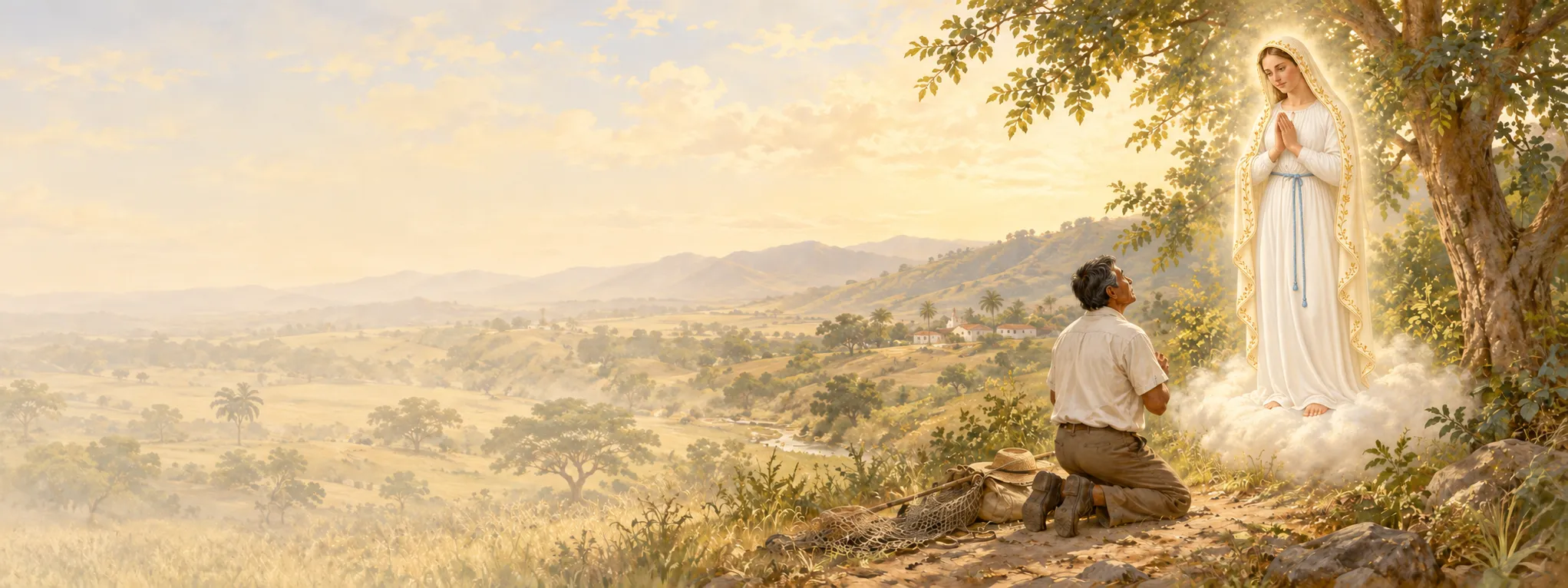
On May 8, 1980, Bernardo Martínez was in the countryside near Cuapa after a fishing outing when he saw flashes of light and a woman standing above a small tree on a brilliant white cloud. According to his account, she identified herself as Mary, the Mother of Jesus. She asked for the Rosary to be prayed daily in families, with attention to Scripture and a commitment to putting God’s word into practice.
Further experiences followed over the coming months, including visions in dreams. Their message returned again and again to forgiveness, personal conversion, and the duty to make peace. In the final encounter, on October 13, Mary urged people to resolve family difficulties through patient conversation rather than violence, and to ask for the faith needed to carry their daily crosses.
Bernardo later became a priest and served as one in the final years of his life. Cuapa grew into a place of pilgrimage, where the faithful continue to remember the encounters and their invitation to prayer and reconciliation. Its lasting message is practical: peace begins when faith changes how we treat one another.
Church status: Recognized locally and supported by Church authorities. Bishop Pablo Antonio Vega’s introduction to Bernardo’s testimony is dated November 13, 1982, and the apparition site was designated a diocesan shrine in 2013.
The setting and Bernardo Martínez
Sources count the encounters differently, because some include preliminary signs, a brief additional encounter in May, and dreams. This page therefore speaks of a series of encounters between May and October 1980.
Bernardo worked the land and helped care for Cuapa’s chapel: cleaning, preparing the church, and supporting community prayer. The account presents him as an ordinary parishioner with personal struggles, including a temper and difficulties with others.
After the chapel’s image of Mary was seen illuminated, he examined his behaviour and publicly asked forgiveness for the arguments he had caused. This change is an important part of the story: the call to reconciliation began with the messenger himself.
At the time of the apparitions, Bernardo was a lay sacristan; he was ordained a priest only in 1995, and he died in 2000. Reports of his funeral record Bishop Bernardo Hombach’s appreciation of his faith and his commitment to peace.
The story: a chronology
| Date | Reported event |
|---|---|
| April 15, 1980 | Bernardo sees the chapel’s image of Mary illuminated, before the encounters in the countryside. |
| May 8 | The first principal apparition: Mary asks for daily family prayer and a life consistent with the Gospel. |
| May 16 | Having hesitated to share the message, Bernardo has another encounter encouraging him to speak to the priest. |
| June 8 | A vision in a dream shows groups of people worshipping God and praying the Rosary meditatively. |
| July | A dream involving an angel, rather than another visible apparition of Mary. |
| September 8 | Bernardo sees Mary as a young girl. The message stresses renewing people’s lives rather than focusing on a proposed building. |
| October 13 | The final encounter stresses forgiveness, faith, perseverance, and the rejection of violence. |
Waking encounters and dreams are distinct; the sources do not describe an unbroken monthly series of identical experiences.
The message
- Prayer that shapes daily life: the Rosary is presented as attentive prayer, supported by Scripture and lived through obedience to God’s word. The request is for family prayer all year round, not only in May.
- Peace requires participation: Bernardo’s testimony joins prayer to fulfilling our responsibilities, loving others, and actively making peace. Bishop Vega stressed this social dimension in his introduction: Christians must take responsibility for building a more peaceful world.
- Faith amid suffering: in the final encounter, the response asked for in hardship is patience, dialogue, and faith. The account does not promise that every difficulty will be removed; it encourages people to face family problems without violence.
- Conversion and sacramental devotion: the testimony also asks for renewal of the devotion of the Five First Saturdays. It contains warnings of further suffering if people refuse to change, including a conditional reference to world war. These are reported warnings calling for conversion, not dated predictions.
Our Lady of Cuapa invites families to pray together, listen to God’s word, forgive one another, and build peace through the ordinary duties of each day.
What the Church has said
The strongest primary document is Bernardo’s published testimony, introduced by Bishop Pablo Antonio Vega, then Bishop-Prelate of Juigalpa, on November 13, 1982.
Bishop Vega explains that distorted versions were circulating, and that he commissioned a faithful account to safeguard the facts and to examine whether the message agreed with the Gospel. His introduction supports the account, though it is not worded as an explicit decree declaring a supernatural character, as at Betania. No separate, definitive approval by the Holy See has been documented.
The later recognition of the site is clearer: on January 13, 2013, Bishop René Sándigo designated it a diocesan shrine.
Sources and historical questions
1982 or 1983?
Some later summaries give 1983, but the digitized introduction explicitly reads November 13, 1982. Different accounts of an “approval” should not be merged.
Did pilgrims see Mary?
The reports distinguish Bernardo’s experiences from the presence of other people. A gathering at the site does not mean that everyone saw the apparition; Cuapa was not a collective vision like Betania’s principal event.
The political background
The devotion grew amid Nicaragua’s deep political divisions. Catholic reporting of the time describes both the Church’s promotion of the devotion and efforts by the Sandinista authorities to discredit the accounts. This context matters, but partisan readings are distinct from the reported message of conversion and peace.
Devotion and legacy
Pilgrimage to Cuapa became an established expression of Nicaraguan Marian devotion. Reporting from 2013 records the participation of bishops and recalls St. Teresa of Calcutta’s pilgrimage in 1986. These visits show the Church’s support for the place of prayer; they do not authenticate every reported detail.
Visiting today
The pilgrimage site is in San Francisco de Cuapa, Chontales. Nicaragua’s tourism directory lists the sanctuary and gives May 8 and October 13 as its principal commemorations.
Confirm current access, opening arrangements, and liturgical schedules with local Church contacts before travelling; older published transport and Mass schedules may be out of date.
Principal sources
| Resource | Best use |
|---|---|
| Bernardo Martínez, Relación sobre los acontecimientos en Cuapa (in Spanish) | The primary testimony, with Bishop Vega’s dated introduction. |
| Hogar de la Madre: the message of Cuapa (in Spanish) | A Catholic narrative that distinguishes the different kinds of encounter. |
| Corazones: account of the encounters (in Spanish) | A devotional compilation, including the additional encounter in May. |
| La Prensa: Bernardo’s funeral and legacy, November 2000 (in Spanish) | Reporting of the time on his later life and how he was received locally. |
