
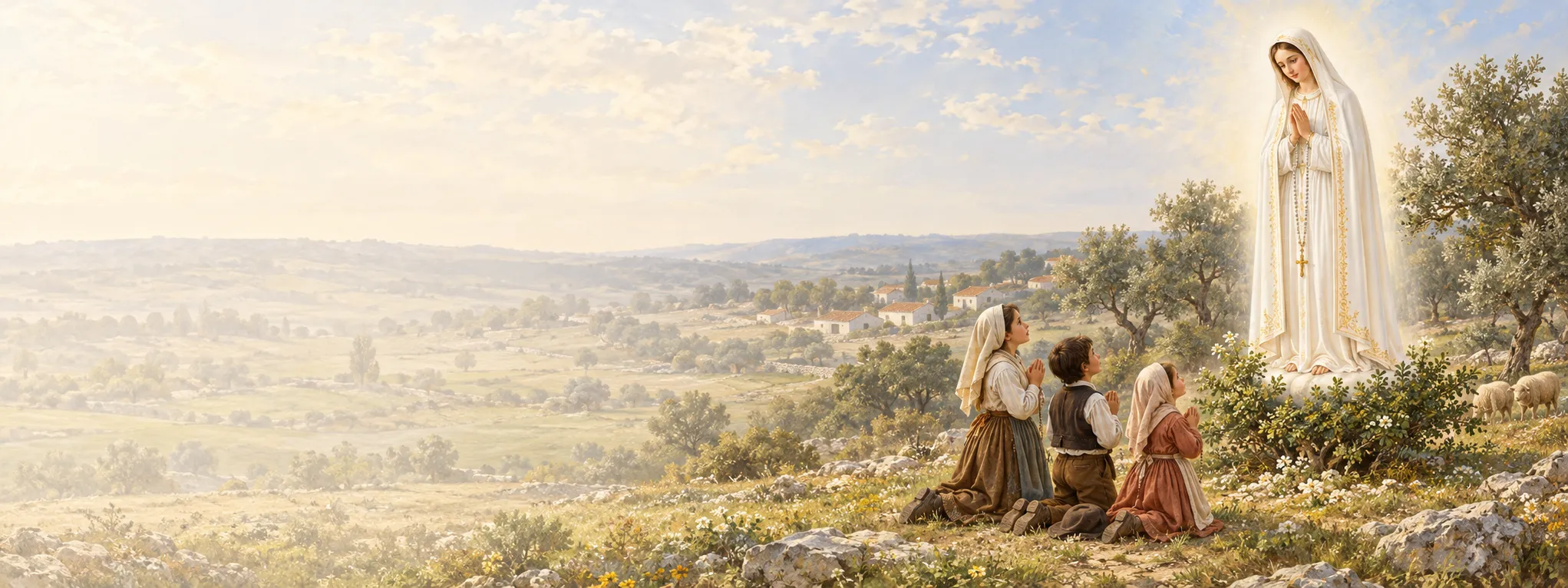
Our Lady of Fátima
Between May and October 1917, Lúcia dos Santos and her cousins Francisco and Jacinta Marto saw the Blessed Virgin Mary near their village of Aljustrel. The Lady asked them to pray, to offer themselves to God, and to return for further meetings. In October she named herself the Lady of the Rosary and asked for a chapel. Their testimony, together with the reports of the final gathering, led to a Church investigation and to recognition in 1930.
Church status: On October 13, 1930, Bishop José Alves Correia da Silva of Leiria declared the children’s visions worthy of belief and authorized devotion to Our Lady of Fátima. Francisco and Jacinta were canonized in 2017. Lúcia is recognized as Venerable.
The setting and the people
Francisco turned nine in June 1917, which is why many summaries give the children’s ages as ten, nine, and seven. Five of the six Marian apparitions took place at Cova da Iria; the August encounter was at Valinhos.
A rural community in a time of conflict
The children came from Aljustrel, a small hamlet in the parish of Fátima, and helped tend their families’ sheep. The events unfolded during the First World War and amid fierce conflict over the place of religion in Portuguese public life. This setting helps explain both the urgency of the appeals for peace and the opposition the children met. Historians also study how Fátima later became woven into Portuguese political and national identity; that later history is distinct from the children’s own testimony.
The three children
| Child | Role in the account |
|---|---|
| Lúcia dos Santos | Spoke with the Lady during the encounters, and as the surviving witness later wrote the fullest accounts. |
| Francisco Marto | According to Lúcia, saw the Lady but did not hear her words; the girls told them to him. |
| Jacinta Marto | Saw and heard the Lady but did not speak with her. |
Their experiences were therefore not identical, and not every word was heard by all three. The crowds who gathered around them stand in a different place again: in his canonization homily, Pope Francis distinguished the children’s vision from the experience of those who came hoping to see Mary.
Before 1917: the Angel of Peace
Lúcia’s later accounts describe three encounters in 1916 with an angel called the Angel of Peace or the Angel of Portugal. They centre on prayer, adoration, sacrifice, and the Eucharist. The sanctuary sees them as a preparation for the Marian apparitions that set the Christ-centred tone of the whole message.
Two places are linked with these encounters: the Loca do Cabeço and the well near Lúcia’s family home, both apart from Cova da Iria. The fullest descriptions come from Lúcia’s memoirs of 1937 and 1941; they are later recollections, not records written in 1916.
The six Marian apparitions
This chronology follows the sanctuary’s received account.
| Date | Place | Principal content |
|---|---|---|
| May 13, 1917 | Cova da Iria | The first encounter; an invitation to offer themselves to God and to return each month. |
| June 13 | Cova da Iria | Emphasis on Mary’s Immaculate Heart and comfort for Lúcia. |
| July 13 | Cova da Iria | The secret in three parts; prayer, conversion, and peace. |
| August 19 | Valinhos | After the children’s detention in Ourém; prayer for sinners remains central. |
| September 13 | Cova da Iria | A renewed call to the Rosary; preparation for October. |
| October 13 | Cova da Iria | She names herself the Lady of the Rosary, asks for a chapel, and the crowd witnesses the solar phenomenon. |
The interrupted August meeting
The municipal administrator, Artur de Oliveira Santos, detained the children, so they could not be at Cova da Iria on August 13. The sanctuary’s chronology includes his own later admission that he took them to Ourém. The fourth apparition is remembered on August 19 at Valinhos, so not all six took place on the thirteenth or in the same place.
The last encounter
In the October account, the Lady says who she is:
“I am the Lady of the Rosary.”
She asks for a chapel and continued prayer. The account links requests for healing with repentance and amendment of life, rather than promising that every cure asked for will be granted.
The message and its meaning
Prayer for peace
The Rosary is asked for again and again across the six apparitions. The sanctuary presents it as contemplation of the mysteries of Christ, a prayer that changes how the believer responds to violence and selfishness. It leads to conversion and a more faithful life; it is not a formula that works mechanically.
Conversion and reparation
The children’s offering of prayer and sacrifice is tied to love for others and sorrow for sin. Reparation means answering wrongdoing with love, repentance, prayer, and faithful action; the sanctuary stresses self-giving for others. Not every practice described in the children’s lives is meant for readers to imitate.
The Immaculate Heart of Mary
The sanctuary understands Mary’s heart as her openness to God and her maternal care for humanity. Devotion to it is a path toward God, marked by trust, conversion, and self-offering. It also frames the secret: its hard images stand within hope in God’s mercy, not despair.
A message centred on Christ
At the canonization of Francisco and Jacinta, Pope Francis spoke of God’s light, hope in Christ, and the children’s lives of prayer. His homily centres Fátima on Christ, not on speculation about future events.
The secret of Fátima
One secret in three parts
The familiar phrase “three secrets” refers more exactly to the three parts of the one secret given in the July 1917 apparition.
| Part | Principal content |
|---|---|
| First | A frightening vision of hell, tied to the urgency of conversion and prayer for sinners. |
| Second | Devotion to Mary’s Immaculate Heart, the consecration of Russia, and warnings of war and persecution, with the promise of final triumph and peace. |
| Third | A symbolic vision of a suffering Church: a ruined city, a mountain and a cross, a bishop dressed in white, and the deaths of clergy, religious, and lay people. |
The shrine reads the three parts together as a call to conversion, prayer, and hope amid human suffering.
When the texts were written
The first two parts were written down in Lúcia’s 1941 memoirs. She wrote the third part on January 3, 1944, and the Vatican published it on June 26, 2000. A revelation dated to 1917 and a manuscript written decades later are different kinds of historical evidence.
How the Vatican reads the third part
Cardinal Joseph Ratzinger’s commentary reads it in relation to persecution, martyrdom, and the suffering of the Church in the twentieth century. St. John Paul II linked it with the attempt on his life on May 13, 1981. In the vision the bishop is killed, yet John Paul II survived; the commentary therefore rejects any idea of unavoidable fate and stresses the power of prayer and human freedom. It gives no timetable of future disasters.
Claims of a hidden additional secret
In 2016 the Holy See published a statement in which Benedict XVI expressly confirmed that the publication of the third part of the secret was complete. This is the Church’s official position; claims of an unpublished supplement remain allegations and are not part of the message.
The Miracle of the Sun
On October 13, a vast crowd gathered at Cova da Iria. Witnesses reported extraordinary changes in the sun’s appearance and apparent movement, an event that became known as the Miracle of the Sun. Contemporary newspaper coverage brought Fátima to national attention.
Many described the sun as “dancing.” The sanctuary reproduces the report by Avelino de Almeida in O Século, published on October 15, so the event was discussed in the press at the time, not only in later devotional writing. Crowd figures are estimates: tens of thousands were present, and about 70,000 is a frequently cited figure.
This page distinguishes:
- the children’s vision of Mary;
- the witnesses’ accounts of what they saw in the sun;
- the understanding of that event as a miracle.
The eyewitness descriptions record what the crowd saw and what it meant to them; they are not an astronomical measurement of the sun. Jeffrey S. Bennett’s academic study traces how the event was received in Portuguese culture and politics. It is useful reading on the growth of the devotion, not a scientific verdict for or against a miracle.
Later revelations to Lúcia
The sanctuary treats these later experiences as a further phase of the Fátima message. They are not counted among the six apparitions to the three children.
| Date | Place | Experience |
|---|---|---|
| December 10, 1925 | Pontevedra, Spain | Mary and the Child Jesus; the devotion of the Five First Saturdays. |
| February 15, 1926 | Pontevedra | A further encounter with the Child Jesus about the devotion. |
| June 13, 1929 | Tuy (Tui), Spain | A vision of the Holy Trinity and Mary, linked with the request for the consecration of Russia. |
The Five First Saturdays
On five consecutive first Saturdays, the devotion includes:
- sacramental confession;
- Holy Communion;
- five decades of the Rosary;
- fifteen minutes of meditation on the mysteries of the Rosary;
- the intention of making reparation to the Immaculate Heart of Mary.
The fifteen minutes of meditation are an additional element, not another name for praying the Rosary. The sanctuary dates the Bishop of Leiria’s approval of the devotion to September 13, 1939.
Consecration and Russia
The Vatican’s 2000 documentation states that Lúcia confirmed that St. John Paul II’s act of March 25, 1984, corresponded to what Our Lady had asked. This is essential context for later disagreements about whether the consecration was fulfilled.
On March 25, 2022, Pope Francis consecrated humanity, especially Russia and Ukraine, to the Immaculate Heart of Mary, as a prayer for peace amid the war in Ukraine.
The Church’s response
Investigation and recognition
The diocesan commission began its work in 1922. Its investigation led to Bishop José Alves Correia da Silva’s pastoral letter of October 13, 1930. The recognition concerns the children’s visions of 1917; it does not cover every later interpretation, publication, or claim linked to Fátima.
Principal milestones
| Date | Development |
|---|---|
| 1922 | Canonical commission established. |
| October 13, 1930 | The Bishop of Leiria declares the visions worthy of belief and permits the devotion. |
| May 13, 2000 | St. John Paul II beatifies Francisco and Jacinta. |
| June 26, 2000 | The Vatican publishes the third part of the secret with a commentary. |
| May 13, 2017 | Pope Francis canonizes Francisco and Jacinta at Fátima. |
| June 22, 2023 | Lúcia’s heroic virtues are recognized, and she is declared Venerable. |
The children after 1917
Francisco and Jacinta
Both children fell gravely ill in the influenza pandemic. Francisco died in 1919; Jacinta died in Lisbon on February 20, 1920. Accounts of their spirituality stress Francisco’s contemplative prayer and Jacinta’s love for those who suffer and for sinners. These portraits come to us largely through Lúcia’s recollections.
Their canonization rested on a separate healing: the recovery of a Brazilian boy, Lucas, after a severe injury. His family’s testimony is published by the Francisco and Jacinta Marto Foundation. It belongs to the history of their canonization, not to the events of 1917.
Lúcia
Lúcia joined the Dorothean sisters in Spain and later became a Discalced Carmelite in Coimbra, entering the Carmel of Saint Teresa on March 25, 1948. She died on February 13, 2005. Her long life made her the principal witness of the detailed Fátima narrative, which makes the difference between early testimony and later recollection especially important.
Sources and historical questions
The principal layers of evidence
| Source | Date or period | What it contributes |
|---|---|---|
| Early questioning of the children | From 1917 | Accounts recorded close to the encounters. |
| Contemporary journalism | Especially October 1917 | Reports on the crowds, public reaction, and the solar phenomenon. |
| Lúcia’s early written account and formal interrogation | 1922 and 1924 | Evidence used in the Church investigation. |
| Lúcia’s first four memoirs | 1935, 1937, and two in 1941 | The fullest later narratives and spiritual recollections. |
| Manuscript of the third part of the secret | 1944 | The written text later published by the Vatican. |
| Recognition decree | 1930 | The diocese’s formal judgment. |
| Vatican publication and commentary | 2000 | Publication and interpretation of the secret. |
The sanctuary keeps the early interviews in its Documentação Crítica de Fátima, and Lúcia’s cause supplies the chronology of her memoirs.
What readers should know
- The narrative was handed down over time: not every familiar dialogue or detail comes from a document written in 1917.
- Prophecies need care: the surviving wording of the warnings about later wars was written down in Lúcia’s memoirs, and a memoir written after an event is not the same as a prediction published before it.
- Recognition and interpretation are distinct: the Church’s acceptance of the apparitions does not make every political reading or private theory an official interpretation.
- The secret is read as a whole: isolating its frightening images from its call to prayer and conversion distorts it.
For deeper study, the best foundation is the sanctuary’s critical documentary collection, read alongside Lúcia’s memoirs and the Church documents themselves.
This page draws on official documents and published scholarship; it is not a fresh study of every original interview, newspaper, or archival manuscript.
The statue and its symbolism
The statue venerated in the Chapel of the Apparitions was carved by José Ferreira Thedim in 1920, in answer to pilgrims’ wish for a visible image of the Lady the children described. It is a devotional work of art, not an image said to have appeared miraculously. Its white robes, prayerful posture, and rosary express the identity of the Lady of the Rosary.
A significant later addition is the bullet from the attempt on St. John Paul II’s life. He gave it to the shrine in 1984, and in 1989 it was set into the statue’s precious crown, in gratitude for his survival and as a sign of his devotion to Our Lady of Fátima.
Devotion and legacy
Fátima’s lasting devotion centres on the Rosary, Eucharistic prayer, conversion, reparation, and entrustment to the Immaculate Heart of Mary. The Five First Saturdays give that spirituality a structured form; pilgrimage and shared prayer give it a public one; and the children’s lives show prayer and self-giving within ordinary circumstances.
Fátima invites us to pray for peace, turn away from sin, and entrust ourselves to God through Mary’s maternal care. Its lasting call is to a life transformed by prayer, offered in love for others, and sustained by hope in Christ.
The shrine today
| Place | Significance |
|---|---|
| Chapel of the Apparitions | Marks the place of five Marian apparitions; the first chapel was built in 1919. |
| Basilica of Our Lady of the Rosary | Dedicated in 1953; the burial place of the three seers. |
| Basilica of the Most Holy Trinity | Dedicated in 2007; holds large liturgical gatherings. |
| Valinhos | Recalls the August apparition. |
| Loca do Cabeço | Linked with the encounters with the angel. |
| Aljustrel | The children’s village and family homes. |
| The well near Lúcia’s home | Another place linked with the angel. |
The first chapel was damaged by a bomb in 1922, restored, and reopened in 1923, an important moment in the shrine’s early history. For current times and visiting arrangements, see the sanctuary’s official website.
Sources and further reading
| Resource | Best use |
|---|---|
| Sanctuary: narrative of the apparitions | The received accounts, quotations, and places. |
| Sanctuary: chronology of the three seers | Events, early interviews, documents, and Church history. |
| Sanctuary: the event of Fátima | The shrine’s theological reading, including the secret. |
| Vatican: The Message of Fátima (2000) | The manuscripts, their publication, the consecration, and the theological commentary. |
| Holy See Press Office: communiqué of May 21, 2016 | The official answer to claims of an unpublished supplement. |
| Pope Francis: canonization homily, May 13, 2017 | Fátima centred on Christ and hope. |
| Pope Francis: act of consecration, March 25, 2022 | The consecration of Russia and Ukraine to the Immaculate Heart. |
| Sanctuary: First Saturdays | The main elements of the devotion. |
| Sister Lúcia’s cause | Her biography and current status. |
| Francisco and Jacinta Marto Foundation | The healing linked with their canonization. |
| Jeffrey S. Bennett, When the Sun Danced (2012) | Academic reading on how Fátima was received in Portuguese culture and politics. |
