
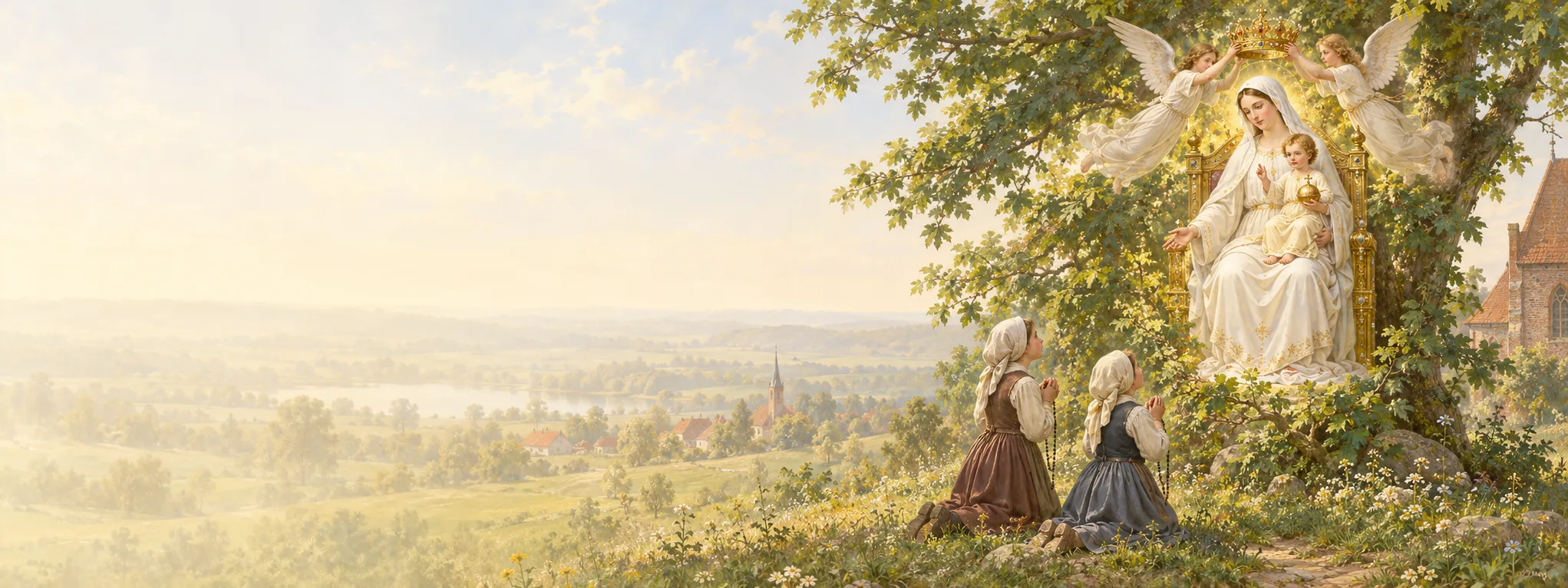
On June 27, 1877, thirteen-year-old Justyna Szafryńska was returning from her examination for First Holy Communion when she saw a radiant lady above a maple tree near Gietrzwałd’s parish church. Twelve-year-old Barbara Samulowska then reported similar encounters. Over the following weeks, the girls described Mary speaking to them in Polish, identifying herself as immaculately conceived, and asking them to pray the Rosary every day.
The encounters took place at a time of restrictions on Catholic life and pressure on Polish language and culture. Their message encouraged conversion, sobriety, and participation in the sacramental life of the Church. Pilgrims came from across the partitioned Polish lands, bringing their prayers and concerns. According to the girls’ account, Mary also blessed a nearby spring, which became associated with prayers for healing.
On September 11, 1977, Bishop Józef Drzazga formally approved the devotion associated with the apparitions. Today, Gietrzwałd’s invitation remains rooted in daily prayer: to turn toward Christ, seek conversion, and entrust our difficulties to God with Mary’s motherly accompaniment.
Church status: Ecclesiastically approved devotion associated with the apparitions. Bishop Józef Drzazga of Warmia issued the formal decree on September 11, 1977. Its precise wording is explained below.
Setting and people
The dates and the two principal witnesses are consistently documented. Published totals for the number of apparitions differ.
Catholic life under pressure
The apparitions occurred during the Kulturkampf, the conflict between the Prussian state and the Catholic Church. Restrictions affected the clergy and parish life, while Germanization put pressure on Polish language and identity.
In this setting, the report that Mary spoke Polish carried meaning far beyond the village. It strengthened religious confidence and helped renew Polish cultural identity in Warmia. These historical effects are distinct from the spiritual message itself.
Justyna Szafryńska
Justyna was born in 1864 and was thirteen when the encounters began. Her first vision came after her preparation for First Holy Communion.
She later entered the Daughters of Charity but left the congregation in 1897. Regional historical accounts record her marriage in Paris in 1899. Her later life is less securely documented, and the date of her death is uncertain.
Barbara Samulowska
Barbara was twelve in 1877. She became a Daughter of Charity, taking the religious name Stanisława, and spent much of her life serving in Guatemala. Her work included hospital care, the formation of sisters, and service to vulnerable children. She died in Guatemala City on December 6, 1950.
She is now Venerable Stanisława Barbara Samulowska: on March 23, 2026, Pope Leo XIV authorized the decree recognizing her heroic virtues. This advances her cause for canonization; it is not a beatification.
Father Augustyn Weichsel
The parish priest recorded the events, questioned the girls, and corresponded with the bishop. His report of August 8, 1877, is a central historical source. The Prussian authorities later prosecuted and imprisoned him in connection with his ministry at Gietrzwałd.
The apparition account
This chronology follows the detailed narrative published by the sanctuary. It describes what the girls reported; not everyone present saw Mary.
| Date | Reported event |
|---|---|
| June 27 | Justyna first sees the radiant lady near the parish church. |
| June 28–29 | The account describes Mary enthroned, accompanied by angels and the Child Jesus. |
| June 30 | Barbara’s first vision, and the request for the daily Rosary. |
| July 1 | Mary identifies herself as the Immaculate Conception. |
Some short summaries place Barbara’s first encounter earlier; the sanctuary’s detailed chronology gives June 30.
A chapel at the apparition site
On July 6, according to the archival account, the girls reported a request for a chapel. A statue was ordered from Munich. Its delivery was delayed until September 12, and it was blessed on September 16, the date of the final apparition.
September 8: the spring
The sanctuary records that the girls, the priests, and a small group went to the spring on parish land that evening. They prayed the Angelus and the Litany of Loreto. During this prayer, the girls reported that Mary blessed the spring and those present.
The account concerns the blessing of an existing spring, not the uncovering of a new one as at Lourdes.
The message and its meaning
I wish you to pray the Rosary every day.
The 1977 decree also recalls Mary’s words that she was immaculately conceived, and her assurance of continuing motherly care. The message gathers around four themes:
- Daily prayer: a faithful practice of the Rosary, not prayer only in moments of distress.
- Conversion: letting prayer change our conduct and our relationships.
- Sacramental life: remaining close to Christ through the Church’s worship and sacraments.
- Sobriety: taking seriously the harm caused by drunkenness and the need for a renewed way of life.
Gietrzwałd invites us to make room for God each day. Through the Rosary, Mary leads us to contemplate the life of her Son and to let that prayer shape our choices, our families, and our care for others.
Prayer for the sick
The shrine’s tradition and testimonies connect healing at the spring with prayer, penance, and Mass for the sick. Reported healings are distinct from miracles individually investigated and formally recognized by the Church, and the water is not a guarantee of recovery.
What the Church has said
The investigation in 1877
Bishop Philipp Krementz requested documentation and appointed a commission on August 18, 1877. Its members examined the girls’ credibility, their statements, reported healings, and the effects on religious life.
The inquiry produced a substantial written report, and physicians also examined the visionaries. These assessments belong to the historical investigation of the time; they are not modern scientific proof of a supernatural event.
The decree of September 11, 1977
Bishop Józef Drzazga approved the devotion, judging it consistent with Christian faith and morals and grounded in credible facts whose supernatural and divine character could not be excluded.
This wording matters. Catholic institutions widely describe Gietrzwałd as a recognized apparition, while the operative sentence of the decree is carefully qualified: it does not claim that every reported event was proved supernatural.
Other milestones
| Date | Development |
|---|---|
| June 1, 1967 | A proper feast, Mass, and Office were authorized for the Diocese of Warmia. |
| September 10, 1967 | Cardinal Stefan Wyszyński crowned the historic image of Our Lady, with Cardinal Karol Wojtyła taking part. |
| February 2, 1970 | Pope Paul VI granted the church the title of minor basilica. |
| September 11, 1977 | Bishop Drzazga issued the decree approving the devotion associated with the apparitions. |
| March 23, 2026 | Barbara Samulowska’s heroic virtues were recognized in her own cause for canonization. |
The crowning of an image, the title of basilica, the approval of devotion linked to the apparitions, and the progress of a witness’s cause for canonization are distinct acts of the Church.
Sources and historical questions
The documentary record
Gietrzwałd has contemporary documentation, including the parish priest’s reports, the commission’s proceedings, correspondence, and accounts by clergy and visitors. Historian Andrzej Kopiczko identifies the principal collections in the Archdiocesan Archive of Warmia. They give a firmer basis for detailed research than later devotional retellings alone.
How many apparitions?
Many accounts give about 160, while a 2023 report by the Polish Press Agency gives 187 and notes days without apparitions. The sources do not clearly reconcile these totals, so this page speaks of repeated apparitions between June 27 and September 16, 1877, commonly numbered at about 160.
The historic image is older than the apparitions
The venerated painting of Mary and the Child Jesus belongs to an earlier history of devotion at Gietrzwałd; it did not appear miraculously during the 1877 encounters. The sanctuary distinguishes this historic image from later artwork depicting the apparitions.
Recognition and later interpretations
The Church’s reception of Gietrzwałd does not authenticate every later prediction, political reading, or extraordinary story attached to it. The core account, the documentary evidence, and later devotional interpretations each have their own place.
Devotion and legacy
Gietrzwałd’s legacy includes the growth of Rosary prayer, pilgrimage, and religious renewal. The 1977 decree also links the apparitions with the inspiration behind Father Honorat Koźmiński’s foundation of the Servants of the Blessed Virgin Mary Immaculate in 1878.
Barbara’s later life is another lasting expression of that legacy. Her significance reaches beyond her childhood visions to decades of practical service among the sick and the poor. The Church’s recognition of her heroic virtues concerns this life of Christian faith and charity.
The invitation of Gietrzwałd is lived in ordinary faithfulness: praying each day, seeking forgiveness, caring for those in need, and remaining close to Christ. Mary’s motherly care encourages a response that reaches beyond the pilgrimage into daily life.
Visiting today
The principal places of prayer are:
- The basilica: with the historic image of Mary and the Child Jesus.
- The apparition chapel: on the site of the maple tree.
- The spring: traditionally linked to Mary’s blessing on September 8, 1877.
- The Rosary avenue and Stations of the Cross: routes for prayer outdoors.
The sanctuary is cared for by the Canons Regular of the Lateran, who took charge in 1945, and pilgrim accommodation is available through the shrine. Important dates are June 27, the beginning of the apparitions, and September 8, the Nativity of Mary and the shrine’s patronal feast; the main September gathering is on the Sunday after September 7.
Mass, confession, and the Rosary are part of the regular schedule. Check the official website for current times and pilgrimage arrangements. Address: ul. Klasztorna 1, 11-036 Gietrzwałd, Poland.
Sources and further reading
| Resource | Best use |
|---|---|
| Official sanctuary (in Polish) | The history of the apparitions, a detailed chronology, the venerated image, and the growth of the sanctuary. |
| Bishop Józef Drzazga: 1977 decree (in Polish) | The decree approving the devotion, reproduced by the Polish Mariological Society. |
| Andrzej Kopiczko: the apparitions in the archives of Warmia | The archival collections of the Archdiocese of Warmia. |
| Holy See Press Office: decree of March 23, 2026 | Barbara Samulowska’s heroic virtues. |
| Dicastery for the Causes of Saints | Venerable Stanisława Samulowska. |
Other sources consulted
- Wikimedia Commons, photograph of the apparition chapel by Leszek S. (CC BY-SA 3.0)
- Miracle Hunter, Gietrzwałd

Last reviewed: November 12, 2026