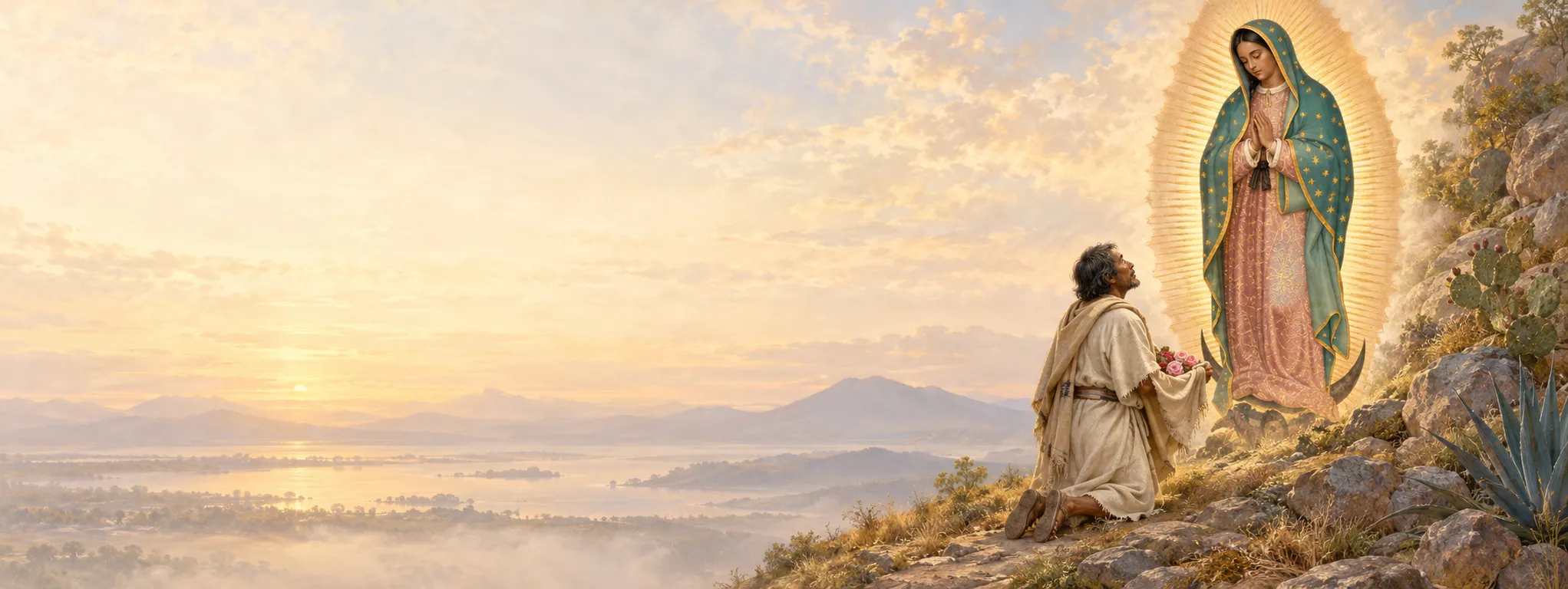
According to the Guadalupan tradition, the Blessed Virgin Mary appeared to Juan Diego, an Indigenous Christian, at Tepeyac near present-day Mexico City in December 1531. She asked for a church where people could come to experience her motherly care and seek comfort in their hardships. Juan Diego brought her request to Bishop Juan de Zumárraga, who asked for a sign.
The account culminates in Mary directing Juan Diego to gather flowers on the hill. When he opened his tilma before the bishop, the flowers fell to the ground, revealing her image on the cloth. The tradition also recounts Mary’s appearance to his sick uncle, Juan Bernardino, who was healed.
Today, the image is venerated in the Basilica of Our Lady of Guadalupe. Her message of maternal tenderness continues to invite pilgrims to draw closer to Jesus, trust in His mercy, and find hope in the loving care of His Mother.
Church status: Long-established Catholic devotion with papal and liturgical recognition. St. Juan Diego was canonized by Pope St. John Paul II on July 31, 2002.
The setting and the people
An encounter in early colonial Mexico
The narrative places the events ten years after the conquest of Mexico-Tenochtitlan. Its opening situates the story amid the establishment of Christian faith in the region. Its Nahuatl language and literary imagery are important: the account expresses Christian themes through an Indigenous cultural and linguistic setting.
Before the Gospel reached them, the peoples of the region lived under the domination of the Aztecs, whose religion offered human sacrifice to its gods. In the first years after the conquest, few adults asked for Baptism, and Bishop Juan de Zumárraga, Mexico’s first bishop, saw little fruit from the missionaries’ labour. He entrusted the future of New Spain to the Queen of Heaven.
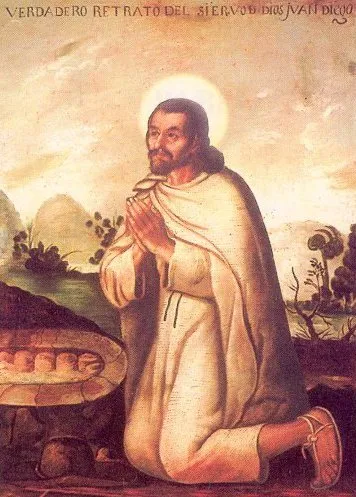
St. Juan Diego
The Vatican’s biography gives Juan Diego’s traditional dates as 1474–1548 and associates his birthplace with Cuautitlán. It also acknowledges that little is known about his life before conversion.
In the Church’s received account, he is an Indigenous Christian whose response to Mary is marked by humility and perseverance. After the events, he is said to have lived near the shrine, caring for it and receiving pilgrims. St. John Paul II beatified him on May 6, 1990, and canonized him on July 31, 2002. Some of these details come to us through tradition, since the written record of his life is uneven.
He was one of the few adults baptized in the first years of evangelization and practised his faith devoutly, walking about six miles each morning to Mass and instruction. After the apparitions, the bishop entrusted the new chapel to him, and he spent the rest of his life there, explaining the message and the meaning of the image to the pilgrims who came.
Read his full life, beatification, and canonization
St. Juan Diego Cuauhtlatoatzin was the Indigenous layman to whom Our Lady of Guadalupe appeared in December 1531. Pope St. John Paul II canonized him on July 31, 2002, at the Basilica of Our Lady of Guadalupe in Mexico City. His feast day is December 9.
One distinction matters most in his cause: the miracle formally accepted for his canonization was the recovery of Juan José Barragán Silva in 1990. The roses, the image on the tilma, and the healing of Juan Diego’s uncle belong to the Guadalupe apparition account; they were not the miracles that qualified him for beatification and canonization. His beatification followed a particular procedure that recognized the long-standing devotion to him. This account draws on the Vatican’s biographies, the papal homilies, the Basilica’s historical material, and the formal decree approving the canonization miracle, published in the Acta Apostolicae Sedis, the Holy See’s official record.
His early life and conversion
According to the tradition adopted in the Vatican’s biography, Juan Diego was born around 1474 in Cuautitlán, north of present-day Mexico City. His Indigenous name, Cuauhtlatoatzin, is commonly translated as “the talking eagle” or “the eagle who speaks”. The Vatican identifies him with the Chichimeca people.
Little is securely known about his childhood. The familiar portrait of a humble, mature Indigenous man is better supported than the elaborate childhood stories found in some popular biographies. If the traditional birth year is correct, he was about 57 at the time of the apparitions.
He was married to María Lucía, and both embraced Christianity as adults through the Franciscan missionaries. His baptism is traditionally placed around 1524, when he would have been about fifty. The Vatican’s English biography names Fr. Peter of Ghent (Pedro de Gante) as the priest who baptized him; its Spanish biography links their conversion more generally to the Franciscans.
According to the Vatican’s Spanish account, María Lucía died in 1529, so Juan Diego was a widower when Our Lady appeared to him. That account stresses his dedication to catechesis, to the Eucharist, and to the duties of his baptism.
Descriptions of his social standing are not entirely uniform. Vatican News calls him a peasant, while a historical study by the Basilica argues that his family lived in more comfortable circumstances. His spiritual humility is central to the Church’s portrait of him; precise claims about his means are less certain.
His life after the apparitions
Juan Diego’s story continued for about sixteen more years. With the bishop’s permission, he settled beside the first chapel where the image was venerated, caring for it and welcoming pilgrims in a life of prayer and service. The Vatican describes him as a hermit, though he remained a layman and was never a priest. He died in 1548, at about 74 by the traditional chronology, and was buried in the first chapel dedicated to Our Lady of Guadalupe.
The Church’s account of his holiness stresses what he did with the grace entrusted to him: faith, charity, obedience, humility, prayer, and detachment from possessions. In his 1990 homily, St. John Paul II presented him as an example for lay Catholics called to pass on the Gospel through their lives. Seeing Our Lady was an extraordinary gift; his faithful response was the substance of his vocation.
The historical investigation of his cause
His cause weighed the sources described under “Sources and historical questions” below, chiefly the Nican Mopohua, the Nican Motecpana, and the Informaciones Jurídicas of 1666, together with images, annals, wills, and other records examined in the modern investigation.
The historical questions were taken seriously during the cause. In 1998 a commission led by Fr. Fidel González Fernández, with Fr. Eduardo Chávez Sánchez and Msgr. José Luis Guerrero Rosado, examined the evidence; the Basilica reports that about thirty researchers took part. Its conclusions supported going ahead with the cause. That was the judgment accepted in the Church’s process; it does not mean that every historian agrees about every early source or biographical detail.
His path to beatification
Juan Diego had been venerated for centuries before the modern cause began, so the process concerned both his life and the evidence of a lasting reputation for holiness.
| Date | Development |
|---|---|
| 1974 | The traditional five-hundredth anniversary of his birth brought renewed petitions for his canonization. |
| January 7, 1984 | Cardinal Ernesto Corripio Ahumada, Archbishop of Mexico, opened the modern canonical process. |
| March 23, 1986 | The diocesan investigation closed. |
| 1989–1990 | The historical and theological documentation was examined in Rome. |
| April 9, 1990 | A decree recognized his holiness of life and the devotion given to him by long-standing tradition. |
| May 6, 1990 | St. John Paul II celebrated his beatification at the Basilica of Guadalupe. |
This was an equipollent, or equivalent, beatification: the recognition of an established cult, that is, of long-standing veneration, rather than the ordinary route through a newly approved miracle. There was therefore no “first miracle” for his beatification, and the 1990 recovery was not a “second miracle”. The canonization letter explicitly distinguishes the recognition of long-standing veneration in April 1990 from the later approval of the healing for canonization.
The miracle accepted for his canonization
The person healed was Juan José Barragán Silva, a young Mexican man of about twenty. On May 3, 1990, he fell about ten metres and was taken to a hospital in Mexico City. Reports at the time describe it as a suicide attempt; the Vatican decree concentrates on his injuries, the invocation of Juan Diego, and his recovery. The decree records severe head injuries:
- Multiple skull fractures.
- Bleeding inside the skull.
- Air inside the cranial cavity, called pneumoencephalus in the decree.
- Leakage of cerebrospinal fluid.
His prognosis was poor. His mother invoked Juan Diego when she saw him fall and went on asking for his intercession. The decree describes an unexpectedly rapid recovery, without the devastating neurological damage that had been feared.
The Basilica’s fuller account adds that the doctors at first expected him to die. It tells of a dramatic improvement on May 6, the day of Juan Diego’s beatification: the young man sat up and ate, astonishing those around him, and later left the hospital walking. These vivid details come from the Basilica’s account; the decree’s essential finding is the exceptionally rapid, complete, and lasting recovery, attributed to Juan Diego’s intercession. May 3 was the day of the fall and May 6 the day of the dramatic improvement; short accounts sometimes place the whole miracle on May 6.
How the Church examined the healing
The investigation asked two separate questions, one medical and one theological: whether the recovery had an adequate medical explanation, and whether it could be attributed to prayer through Juan Diego’s intercession.
| Date | Examination or decision |
|---|---|
| November 20, 1990–March 31, 1994 | The Archdiocese of Mexico gathered testimony and medical evidence. |
| November 11, 1994 | Rome recognized the juridical validity of the diocesan proceedings. |
| February 26, 1998 | The medical consultants examined the recovery; the Basilica reports a unanimous judgment of the five members that it could not be explained medically. |
| May 11, 2001 | The theological consultants approved its attribution to Juan Diego’s intercession. |
| September 21, 2001 | The cardinals and bishops of the Congregation gave their approval. |
| December 20, 2001 | St. John Paul II approved the decree recognizing the miracle. |
The Church concluded that God had granted the healing through Juan Diego’s intercession. The wording matters: a saint intercedes with God and has no power of his own to heal.
The other miracles linked with Juan Diego
| Event | Its place in the story |
|---|---|
| Flowers gathered at Tepeyac in December 1531 | The sign Mary told Juan Diego to bring to the bishop. |
| The image appearing on his tilma | The central miraculous sign of the Guadalupe narrative. |
| The healing of Juan Bernardino | A healing linked with Our Lady’s appearance to Juan Diego’s uncle. |
| Other early Guadalupe miracles | The Nican Motecpana recounts fourteen miracles attributed to Our Lady of Guadalupe. |
| Juan José Barragán Silva’s recovery in 1990 | The healing formally accepted for Juan Diego’s canonization. |
The early events are miracles of Guadalupe, while the modern healing is the canonization miracle attributed to Juan Diego’s intercession.
His canonization and its meaning
After the consistory of February 26, 2002, the canonization took place on July 31, 2002, at the Basilica of Our Lady of Guadalupe. St. John Paul II proclaimed Juan Diego a saint and extended his veneration to the whole Church. In the canonization homily, the Pope called him the first Indigenous saint of the American continent. He stressed that Juan Diego embraced Christ without giving up his Indigenous identity, and linked his witness with respect for Indigenous peoples, their dignity, and their cultural heritage.
For Catholics, his lasting example is deeply personal: an ordinary layman who listened, persevered when doubted, cared for his family, and spent his remaining years serving pilgrims and praying. His love for Our Lady led him into a life centred on Jesus and on service to others.
Key documents
- The Vatican’s biography of Juan Diego.
- The decree approving the miracle: Acta Apostolicae Sedis 94 (2002), pages 488–489.
- The canonization letter Exaltavit humiles, July 31, 2002.
- St. John Paul II’s canonization homily.
- The Basilica of Guadalupe’s account of Juan Diego and his cause (in Spanish).
Juan Bernardino and Bishop Zumárraga
Juan Bernardino, Juan Diego’s uncle, is central to the account of healing and the naming of Guadalupe. Zumárraga receives Juan Diego’s requests and asks for a sign. Within the narrative, their roles differ: the uncle receives an apparition; the bishop witnesses the presentation of the flowers and the image.
The apparition account
The following chronology follows the traditional account preserved by the Basilica. It describes the events as that tradition reports them.
| Date | Event |
|---|---|
| December 9, early morning — first appearance | On his journey toward Tlatelolco, Juan Diego encounters Mary at Tepeyac. She asks him to seek a church there. He approaches the bishop. |
| December 9, later that day — second appearance | Returning without the desired result, Juan Diego asks that a more suitable messenger be chosen. Mary insists that he continue. |
| December 10 — third appearance | After another audience, Juan Diego reports that the bishop wants a sign. Mary tells him to return the following day. |
| December 11 — his uncle’s illness | Juan Diego remains with the seriously ill Juan Bernardino and misses the appointed meeting. |
| December 12 — fourth appearance | Seeking a priest for his uncle, Juan Diego takes another route. Mary meets him, reassures him, and sends him to gather flowers. |
| December 12 — Juan Bernardino | Mary also appears to the uncle, who is healed. He later recounts her instruction concerning the name Guadalupe. |
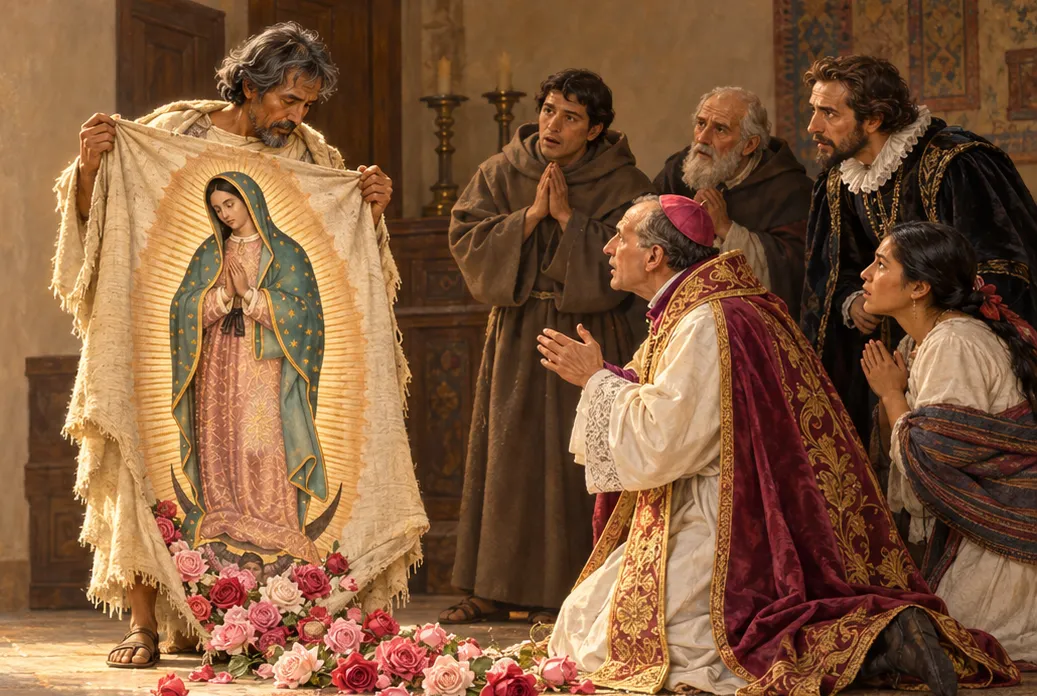
| December 12 — before the bishop | Juan Diego opens his tilma. The flowers fall, and Mary’s image is revealed. |
These dates follow the Julian calendar in use in 1531.
Details that give the narrative its character
The opening encounter includes beautiful birdsong, Juan Diego being called by name, and a landscape transformed by light. Mary identifies herself in relation to the true God and describes a place of consolation for people who suffer.
It was a Saturday, and Juan Diego was on his way to Mass and instruction. Near Tepeyac he heard singing like that of many rare birds coming from the hilltop. Then a woman’s voice called him tenderly by name: “Juanito, Juan Dieguito.” Climbing up, he found a Lady whose garments shone like the sun; the rocks around her glittered like jewels.
She told him that she was the ever-Virgin Holy Mary, Mother of the true God, through whom everyone lives, the Creator, Lord of heaven and earth. She wished a temple to be built there, where she would show all her love, compassion, help, and protection, for she is the merciful mother of all who dwell in that land and of all who love her, call on her, and trust in her.
Later, the account shifts from Juan Diego’s public mission to his private anxiety over his uncle. His concern for a sick relative becomes the setting for Mary’s best-known reassurance.
On December 12, Mary told Juan Diego not to be troubled by his uncle’s illness, because he was already healed. She sent him to the top of the hill to gather flowers as the sign for the bishop. There, in December, on rocky ground where only crags, thistles, and cactus grew, he found Castilian roses in full bloom. He carried them down in his tilma, a coarse cloak woven from agave fibre, called ixtle.
After the presentation of the image, Juan Diego shows where the church is to be built and returns to his uncle, who recounts his own experience. The account therefore binds together the requested sanctuary, the image, and the healing; they are not separate traditions.
When Juan Diego opened his tilma before the bishop, the roses fell to the floor and the image appeared on the cloth; the bishop and everyone present fell to their knees. Juan Bernardino later told how Our Lady had come to him at the very hour she spoke with his nephew: he felt a deep peace come over him, and the fever left him.
The message and its meaning
“Am I not here, I who am your mother?”
These beloved words come from the Nican Mopohua, not from a transcript made in 1531, and English translations vary.
The account emphasizes:
- Mary’s relationship to God: she identifies herself as the mother of the true God.
- Compassion: the requested sanctuary is a place where suffering is heard and consolation is given.
- A personal vocation: Juan Diego’s sense of inadequacy does not disqualify him from his task.
- Trust amid fear: his anxiety over his uncle is met with maternal reassurance.
- A welcome extending beyond one community: the account’s language embraces all who seek her help, from every people.
St. John Paul II’s canonization homily interprets Juan Diego’s life in terms of Christian faith expressed within Indigenous culture. It also connects his recognition with respect for Indigenous peoples and their dignity. It offers the Church’s own key for understanding Guadalupe’s significance today.
The image and its symbolism
The image shows Mary with joined hands and a lowered gaze, wearing a rose-colored tunic and a star-covered mantle. Rays surround her; a crescent moon and an angel appear beneath her.
These features have been interpreted through both Christian iconography and the cultural setting of New Spain. Art historians connect the sun, moon, and stars with the woman in Revelation 12 and with imagery associated with the Immaculate Conception.
| Feature | What it signifies |
|---|---|
| Joined hands and lowered gaze | Present Mary in an attitude of prayer and humility. |
| Sun, moon, and stars | Invite comparison with biblical imagery, especially Revelation 12. |
| Dark sash | Commonly understood in devotion as a sign that she is with child; the Vatican’s biography of Juan Diego uses this interpretation. |
| Clothing, colors, and ornament | Have inspired readings relating the image to Indigenous identity and Christian belief. Each particular reading belongs to the interpreter who proposes it. |
| The tilma | The garment on which the image appears in the traditional narrative, and the material object at the center of the shrine’s devotion. |
A devotional reading explains the image’s meaning; it does not by itself settle how the image came to be.
Miguel Sánchez’s 1648 account already interpreted Guadalupe through Scripture, especially the Book of Revelation. The link between the image and biblical symbolism therefore has a documented history; it is not only a modern explanation.
The symbolism of the image
The Shrine of Our Lady of Guadalupe in La Crosse, Wisconsin, explains the image in an illustrated guide. Its reading of each detail is summarized here, together with further details from the poster “Our Lady of Guadalupe Explained”, published by Steubenville Press and shared by the Archdiocese of Washington, and from the Knights of Columbus poster “The Secrets of Her Image”, adapted from the work of Msgr. Eduardo Chávez, postulator of St. Juan Diego’s cause, and Carl A. Anderson.
- The image as a codex: the image presents the Catholic faith in a way the native peoples understood at once: it is a codex, a kind of picture writing, in which every detail of colour and form carries a theological message. St. John Paul II called Our Lady of Guadalupe the perfect model of inculturation: she came to the native peoples through their own customs, so her image is best read as their wise men, the tlamatinime, read their pictographs. Besides the woman clothed with the sun of Revelation 12, it recalls the new Jerusalem coming down from heaven, where God will dwell with His people and “wipe every tear from their eyes” (Revelation 21:2–4).
- Her face: Our Lady appears as a mestiza, both Aztec and Spanish, showing the two cultures coming together at this point in history: she belongs to both Spaniards and natives, and so to all people. Her face is young, tender, and merciful, and her head is bowed in humility.
- Her hair: parted in the middle and hanging loose, it shows that she is a virgin maiden, for married Aztec women braided their hair and pinned it up at the sides of the head.
- Her joined hands: her hands are joined in prayer, so she is not God: clearly there is one greater than she. Her finger points to the cross on her brooch. She prays in the European manner, yet to the natives she also seemed to hold golden flower-heart glyphs. Their elders had offered hearts to God for harmony in life; this woman, they said, asks us to place our hearts in her hands, without tearing them out, so that she may present them to God. The position of her foot, stepping forward, recalls the native prayer dances.
- The cross on her brooch: a cross at the centre of the medallion at her throat shows her consecration to her Son, whose Cross recalls both His total sacrifice of love and the moment He gave us Mary as our Mother. The same sign of the Cross was seen on the sails of the Spaniards’ ships, and the black cross on her gold brooch matches the one on the banners and helmets of the Spanish soldiers: it told the Aztecs that her faith was the faith the Spaniards had brought. The natives also knew the polished stone set between the neck and chest of their idols, called “the heart of the divinity”, which reflected the face of whoever stood before it. In the cross on her brooch they saw instead the sacrifice of God’s love, a love so deep that, even as He was dying, Christ gave His own mother as mother of the whole world.
- Her garments: her reddish tunic is the colour of the earth, and her star-strewn blue-green mantle stands for the heavens: she is a woman of heaven and earth. The mantle’s colour also shows her royalty, since only the Aztec emperors could wear cloaks of that colour. As Queen of heaven and earth, she points to the truth that God is love and that mankind receives His love. The emperor, the tlatoani, “he who commands”, was the only one allowed a mantle of this colour, so she is an empress; and its blue is the colour of the sky, its green the colour of life. Her salmon-pink robe has reddish-brown and crimson shadows like Mexican soil, its glyphs show mountains and water, and its lower part is folded like the tribute blankets pictured in the Aztec codices.
- The stars: the stars on her mantle show that she comes from heaven, the Queen of Heaven. The Aztecs worshipped the stars as gods, so a Lady clothed in them is greater than they are; yet her bowed head and joined hands show that she is no goddess, but reveres One greater than herself. The shrine’s reading also holds that the constellations appear as they stood before dawn on December 12, 1531, the day of the winter solstice in the calendar then in use. The Knights of Columbus poster counts 46 stars on her mantle.
- The dark ribbon: a dark ribbon above her womb shows that she is expecting the birth of God’s only Son; in Spanish she is encinta, “adorned with a ribbon”. For the Aztecs, this knotted ribbon marked a noble woman with child, and its trapezoid-shaped ends meant the close of one age and the birth of a new one.
- The jasmine flower: over her womb, at the centre of her tunic, is a four-petalled jasmine flower, which for the Aztecs was the sign of the divine and the centre of the cosmic order. Her Child, Jesus, is divine and the true centre of the universe. Another reading calls it the “flower of the quincunx”, one of the Aztecs’ highest symbols: it shows the four movements of the sun, the four seasons and the four directions, joined at a fifth point in the centre that gives them balance. Placed over her womb, it told them that she carries the One who is the author and giver of life.
- The four-petalled flowers: the four-petalled flowers with leaves on her tunic told the Aztecs that the fifth age, the Age of Peace, had begun.
- The eight-petalled flowers: these stand for the day of the new creation. Each blossom has the form of a hill and its stem the form of a river; this “hill and water” meant civilization, and the hill was the highest place of encounter between God and man. Turned upside down, the flower and stem take the shape of a heart, the source of life, which belongs to God and has its origin in Him.
- The hill flowers on her tunic: another reading counts nine hill-shaped flowers (tepetl) on her tunic. Heart-shaped and drawn like the scrolls the Aztecs used for speech, they seem to speak and sing a message for all mankind. They are identified with the Mexican magnolia, yolloxochitl, “heart flower”. Each points in five directions, the four quarters and a highest point, its “nose”, read as Tepeyac, whose name means “nose of the hill”. Joining a hill (tepec) with the glyph for a river, each cluster is how the Aztecs wrote altepetl, a city or civilization. The design also looks like a heart with its arteries, growing from her heavenly mantle across her earthly tunic: divine love coming down from heaven to embrace the whole earth.
- The sun behind her: she stands in front of the sun, which stood for Huitzilopochtli, the greatest Aztec god, called “the Lover of Hearts and Drinker of Blood”. She announces the God who is greater than their sun god. The poster describes the worship she came to end: every major Aztec city had a temple pyramid about a hundred feet high, crowned by an altar where priests cut the beating hearts from living victims and held them up before their eyes; the victims’ limbs were then cut off and thrown to the crowd below, who took them home to cook and eat. It counts some 50,000 human sacrifices a year, and estimates that one child in five fell victim to this ritual. The golden rays around her form a mandorla, an almond-shaped halo, as in European images of the Immaculate Conception. The natives understood her as a woman greater than emperors, who stands before the sun, their giver of life, treads on the moon, and is clothed in the stars that told them when to plant and harvest.
- The moon beneath her feet: she stands on the crescent moon, which the shrine’s reading links with Quetzalcoatl, the feathered serpent, worshipped as a god of night: she has crushed and overcome him, and by standing on the moon she shows herself stronger than the god of darkness. Her shoe, resting on the moon, is simply the bare cloth, without colour. The name Mexico joins metztli (moon), xictli (navel or centre), and co (place): “the place in the centre of the moon”. By eclipsing the sun and darkening the moon, she shows that the Child in her womb, “the sun of justice” (Malachi 3:20), is stronger than the gods to whom they offered sacrifice.
- The clouds: she is shown among the clouds, a sign of her heavenly origin. For the natives, mist and clouds also meant an unknown place and the hidden coffers of heavenly treasure: she comes from heaven bearing a hidden treasure, and through her, God is made visible.
- The angel: an angel with eagle’s wings, the eagle being the “bird of the sun”, holds up the Mother of God as her messenger. The angel wears a tunic of her colour and a brooch like hers, and holds her mantle in one hand and her robe in the other: the Son she bears is from both heaven and earth. The hem of her tunic is edged in gold like her mantle, so the angel joins the two, a sign of the union of heaven and earth. To the Aztecs, only kings, queens, and dignitaries were carried on someone’s shoulders: the angel shows that she is a queen, and carries her to the people as a sign that a new age has come. Its dark face is like a native Mexican’s, and it looks less like a cherub than a young Eagle Warrior, one of the “Soldiers of the Sun”. Some see Juan Diego in it, whose native name, Cuauhtlatoatzin, means “eagle who speaks”. The angel’s receding hairline gives it the wisdom and authority of an Aztec elder, and the colours of its wings stood for directions: blue for the south, white for the west, and red for the east. With the black moon for the north, they make the four points of the universe.
- Her name: she called herself Holy Mary of Guadalupe. Mary is read as “she who illuminates” and Guadalupe, from the Arabic, as “the riverbed”: together, the holy riverbed that carries the Living Water and brings the Light of the World. She is not to be worshipped; her mission is to bring her Son. And since her name joins words from two peoples long at war, it shows that through her intercession, warring cultures can be united.
- What the image has endured: besides the acid and the bomb, the image has been exposed to harsh minerals, dampness, holy water, candle wax and smoke, and the touch of countless faithful hands, and it has remained preserved for centuries.
The Church’s response
The Church’s embrace of Guadalupe grew over centuries.
| Date | Development | What it establishes |
|---|---|---|
| 1556 | Archbishop Alonso de Montúfar publicly encouraged devotion to Guadalupe. A dispute with the Franciscan Francisco de Bustamante led to an investigation. | Early documentary evidence of the devotion, and of disagreement surrounding it. |
| 1666 | Testimony was gathered in the Informaciones Jurídicas, as part of efforts to obtain Roman recognition and privileges. | A substantial record of remembered tradition, gathered long after 1531. |
| 1754 | Benedict XIV confirmed Guadalupe’s patronage of New Spain and approved a proper liturgical office and Mass. | Explicit papal and liturgical recognition. |
| October 12, 1895 | Canonical coronation of the image. | A formal honor given by the Church to the venerated image. |
| 1910 | St. Pius X recognized Guadalupe as patroness of Latin America. | Extension of her patronage. |
| October 12, 1945 | Pius XII delivered a radio message for the fiftieth anniversary of the coronation, hailing Our Lady of Guadalupe as Empress of the Americas. | Strong papal affirmation of the devotion and its significance for Mexico and the Americas. |
| 1999 | In Ecclesia in America, St. John Paul II welcomed the celebration of Guadalupe on December 12 throughout the continent. | Continental liturgical and pastoral significance. |
| July 31, 2002 | Canonization of Juan Diego in Mexico City. | His recognition as a saint of the Catholic Church. |
Each of these acts has its own scope. A patronage decree, a coronation, and a canonization are different acts of the Church, and none of them rules on every later historical or scientific claim.
Sources and historical questions
The account and the record of devotion have different documentary histories.
Evidence that people venerated Guadalupe at a particular date does not, on its own, show that every detail of the familiar apparition narrative was already written down by then.
Principal sources
| Source | Date or period | Why it matters |
|---|---|---|
| Records of the Montúfar–Bustamante dispute | 1556 | Document an established devotion, reported favors, and controversy around the image. |
| Shrine administrative records and Indigenous annals | Sixteenth century | Establish aspects of the shrine’s existence, support, and religious life. The Basilica’s archive identifies a 1562 financial record and the annals of Juan Bautista among its early holdings. |
| Miguel Sánchez, Imagen de la Virgen María | 1648 | The first published full Spanish apparition narrative, combining history and biblical interpretation. |
| The Huei tlamahuiçoltica, containing the Nican Mopohua | 1649 | The central published Nahuatl account, issued by Luis Lasso de la Vega. |
| The Nican Motecpana | 1649 | Published in the same volume: material on Juan Diego’s later life and family, and fourteen miracles attributed to Our Lady of Guadalupe. |
| Francisco de Siles’s Latin narrative | Copied in 1663 | Part of the history of the effort to present Guadalupe’s cause in Rome. |
| The Informaciones Jurídicas | 1666 | Testimony about inherited memories and traditions, including accounts handed down through earlier generations. |
Who wrote the Nican Mopohua?
Its title, Nican Mopohua, means “Here it is recounted”. The Basilica and the Vatican attribute it to the Indigenous scholar Antonio Valeriano and place its composition in the sixteenth century, traditionally around 1556. Other scholars are more cautious, suggesting that the 1649 publication may derive from a lost mid-sixteenth-century history by Valeriano.
Traditionally attributed to Antonio Valeriano, the Nican Mopohua was first printed in 1649; its composition and transmission remain subjects of scholarly discussion.
Why do historians disagree?
The debate concerns the scarcity and interpretation of early documents, the relationship between oral tradition and later texts, and the historical evidence for Juan Diego. Defenders of the tradition emphasize Indigenous ways of handing down history and the loss of records. Critical historians question whether the surviving sources show that the familiar narrative goes back to the sixteenth century. Stafford Poole’s scholarship is an important example of the critical position; the historical defense published in L’Osservatore Romano represents a contrasting approach.
A Latin account in the Vatican Library
A Latin account copied in 1663 survives in the Vatican Library’s Chigi collection. Research discussed by Notre Dame’s Church Life Journal connects it with a petition to Rome. It enriches the history of how the Church received Guadalupe, although it is not a contemporary record of 1531.
The Codex Escalada
The Codex Escalada bears the date 1548. The Basilica regards it as authentic, but its provenance and the differing assessments of it need more study than the date written on it can settle, so it is not treated here as decisive evidence.
Signs and questions about the tilma
The foundational signs in the apparition account are the flowers, Juan Bernardino’s healing, and the appearance of the image. They belong to the traditional narrative described above.
Later claims about the tilma’s material properties are a separate matter.
Catholics venerate the image as a sign of Mary’s maternal presence and, in the Guadalupan tradition, as miraculously given. Its materials, execution, and conservation history have also been studied and debated. Popular claims about extraordinary physical properties should be weighed one by one against identifiable research.
What a Catholic review of the popular claims found
The Knights of Columbus, drawing on Mexican Guadalupan scholarship, has reviewed the claims most often repeated about the tilma, marking each as true, false, or unproven. Its findings are summarized here, with the researchers and records it cites.
Claims the review finds true
- The cloth: the tilma is woven from agave popotule fibre from the ixtle plant, not from maguey as is often said. It has holes, imperfections, and a rough seam running down the middle, and it was given no preparation for painting.
- The colours: the colours pass through the cloth from front to back. The image seems to make use of the fabric’s defects: some holes create shadows, and a knot in the thread forms Our Lady’s lower lip.
- How the image was made: studies have not discovered the origin of the colouring or how the image was fixed on the cloth, and no brush marks have been detected. In his 1756 book Maravilla Americana, the painter Miguel Cabrera thought he saw oil, tempera, watercolour, and carved tempera, but there is no convincing proof of this. Our Lady’s shoe, resting on the moon, is simply the bare cloth, without colour.
- The eyes: Mexican ophthalmologists, among them Dr. Manuel Torroella, Dr. Enrique Graue, Dr. Rafael Torrija, and Dr. Jorge Antonio Escalante, reported reflections in Our Lady’s eyes like those in a living human eye. Using digital enlargement, José Aste Tönsmann identified thirteen tiny figures forming two scenes in both eyes, which measure only 7 and 8 millimetres across, among them Bishop Zumárraga and Juan Diego opening his tilma.
- The bomb of 1921: on the morning of November 14, 1921, Luciano Pérez Carpio, an employee of the president’s private secretariat, set off a bomb hidden among flowers at the foot of the image. The blast was heard a kilometre away and bent the bronze candlesticks and the altar crucifix, yet the image was untouched. The twisted crucifix is displayed in the Basilica today.
- The acid spill of 1795: in 1795, nitric acid was accidentally spilled on the left side of the image. A notarized report of 1820 records that the cloth suffered no harm; a faint stain remains, visible especially from the back. The review notes that the acid did no significant damage to the image or the fabric.
- The copies that did not last: in 1787, Dr. José Ignacio Bartolache had two careful copies made on similar cloth and placed them at Tepeyac, one in El Pocito and one in the sanctuary. Neither lasted even ten years, while the original has endured for nearly five centuries.
- The woman of Revelation: the image portrays the great sign of Revelation 12:1–2: a woman clothed with the sun, with the moon under her feet, who is with child.
- With child: the dark ribbon tied above Our Lady’s waist is read as a sign that she is expecting a child; in Spanish, cinta is a ribbon and encinta means pregnant.
- The name: the first Spanish Franciscan missionaries, including Brother Jerónimo Diego de Santa María, who came from the Guadalupe monastery in Spain, tried to have the Virgin of Tepeyac called by another name.
Claims the review finds false or unproven
- A constant body temperature: the claim that the tilma stays at 98.6 °F (37 °C) has never been proven.
- Colours floating above the cloth: no experiment with a laser ever showed the colours hovering above the fabric; they are in the cloth itself.
- Colours that vanish up close: it is not true that the colours disappear when seen from ten centimetres away.
- A figure in the bishop’s eye: the reflected figure of the bishop has never been enlarged, so the claim that Juan Diego appears inside the bishop’s own eye cannot be proven.
- A heartbeat: no doctor has ever heard a heartbeat beneath the ribbon; no such test has been made.
- Acid damage healed in thirty days: the cloth was not miraculously rewoven after the 1795 spill; what is remarkable is that the acid did so little harm.
- “She who crushes the serpent”: Guadalupe is not a Nahuatl word with this meaning. It is a Spanish place name of Arabic origin, Wadi al-Lub, the river channel that carries the water, made famous by the monastery of Guadalupe in Extremadura. Devotion sees a fitting image in it: Mary is the channel who leads us to her Son, the Living Water.
These findings come from devotional and Guadalupan research, and other scholars weigh some of them differently. Our love for the image does not depend on any of them: it rests on Mary’s maternal presence, which the tilma has signified to her children for nearly five hundred years.
Devotion and legacy
Guadalupe’s significance extends across religious life, art, and cultural identity. The image has been reproduced in paintings, sculptures, prints, and public art, with different communities expressing their love for Mary through it.
Art-historical research shows that these reproductions also document the growth of the devotion: they reveal changing emphases and the interplay between written narratives and visual representations.
For the Church, Guadalupe’s significance is centered on Christ. In Ecclesia in America, St. John Paul II connects her with the encounter between the Gospel and the peoples of the Americas, and calls for her December 12 celebration across the continent.
The first chapel and a tide of conversions
As Our Lady had asked, the bishop had a chapel raised at Tepeyac, and the image was carried there in procession before the end of 1531. Tradition tells that during the festivities a stray arrow struck and killed a young man; he was laid at the feet of the image, and while the people prayed, he opened his eyes and rose healed. It is remembered as the first miracle attributed to Our Lady of Guadalupe after the apparitions.
News of the apparitions spread quickly, and the slow trickle of conversions became a flood. The few missionaries could hardly keep up with the crowds asking for instruction and Baptism: whole families came out of their villages to meet them. Accounts describe people filing past one priest to receive the oil of catechumens and on to a second at the font, holding lighted candles and singing, while husbands and wives then made their marriage vows together. The Flemish Franciscan Peter of Ghent is credited by contemporary writers with baptizing an immense number with his own hands.
Empress of the Americas and protectress of life
In 1945, Pius XII hailed Our Lady of Guadalupe as Empress of the Americas, confident that Mexico and the Americas are safe while they honour her as Queen and Mother. Many Catholics also invoke her as protectress of the unborn, since the image shows her with child; in Ecclesia in America, St. John Paul II entrusted to her the cause of life.
Guadalupe invites us to recognize Mary’s maternal care, to trust Christ amid fear, and to honor the dignity of those whose voices are easily overlooked.
Our Lady of Guadalupe, mystical rose, make intercession for holy Church, protect the Sovereign Pontiff, help all those who invoke you in their necessities; and since you are the ever-Virgin Mary and Mother of the true God, obtain for us from your most holy Son the grace of keeping our faith, sweet hope amid the bitterness of life, burning charity, and the precious gift of final perseverance. Amen.
The shrine today
The image is venerated in the modern Basilica at Tepeyac. It was transferred there on October 12, 1976. The older church, built between 1695 and 1709, remains part of the historic sanctuary complex. The modern building was raised to welcome the growing numbers of pilgrims.
By common estimates, around twenty million pilgrims come each year to pray before the tilma, making Tepeyac one of the most visited Marian shrines in the world.
Sources and further reading
| Resource | Best use |
|---|---|
| Basilica: synthesis of the apparitions | Traditional chronology and the five appearances. |
| Basilica: the apparition narrative | The Nican Mopohua and its translations. |
| Basilica: historical documents | The shrine’s presentation and defense of the historical evidence. |
| Huei tlamahuiçoltica (1649), digitized copy | The 1649 printing that contains the Nican Mopohua. |
| Vatican: biography of St. Juan Diego | His traditional dates, life, and the meaning of the image. |
| Vatican: Juan Diego’s canonization homily | The canonization and its theological and pastoral meaning. |
| Vatican: Ecclesia in America | Guadalupe’s significance for the whole continent, especially section 11. |
| Notre Dame: the 1663 Vatican manuscript | Further evidence about the seventeenth-century petition to Rome. |
| Stafford Poole, Our Lady of Guadalupe | Substantial critical historical scholarship; further reading rather than a substitute for the documents themselves. |
Other sources consulted
- Wikimedia Commons, photograph of the original image in the Basilica (public domain)
- Jeanette Favrot Peterson, “Creating the Virgin of Guadalupe” (The Americas, 2005)
- Shrine of Our Lady of Guadalupe (La Crosse), Our Lady of Guadalupe image infographic
- Wikimedia Commons, St. Juan Diego by Miguel Cabrera (public domain)
- Steubenville Press, Our Lady of Guadalupe Explained (Archdiocese of Washington)
- Knights of Columbus, The Secrets of Her Image (poster)
- Knights of Columbus, Claims about the Tilma and the Image
- Wikipedia, Our Lady of Guadalupe
- Miracle Hunter
- GCatholic


Last reviewed: November 7, 2026