
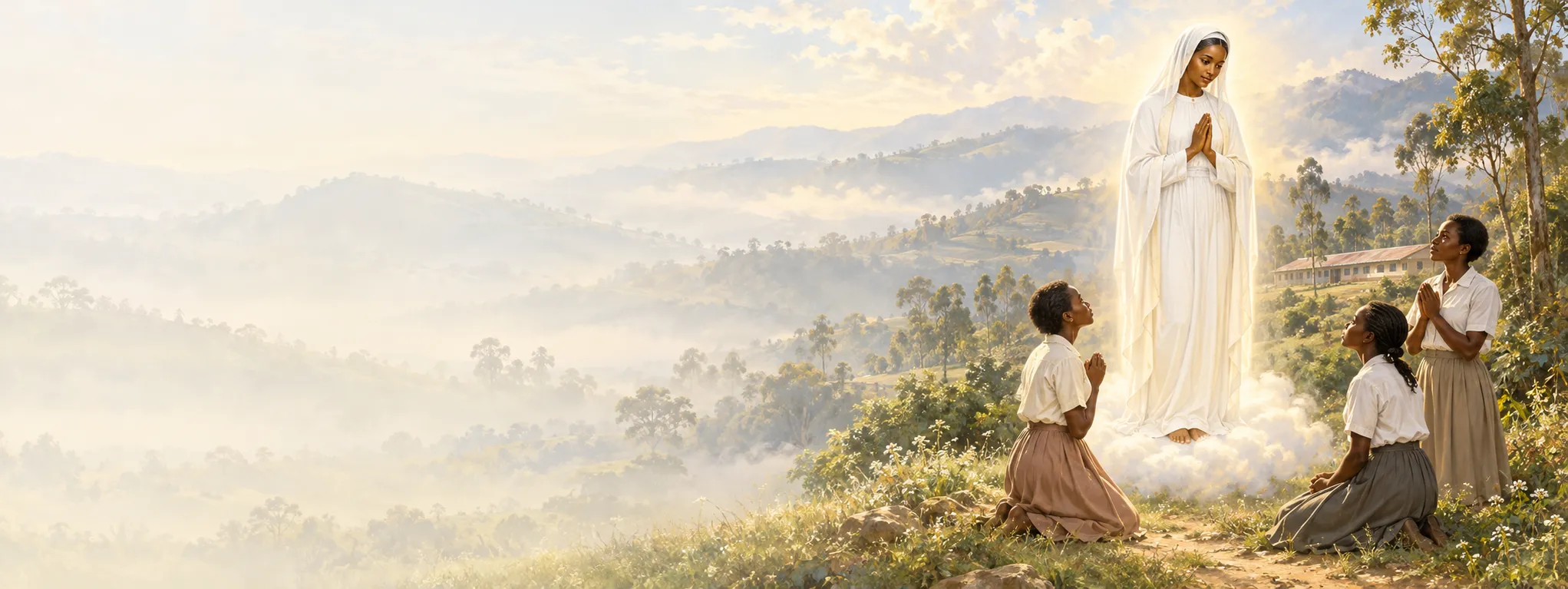
On November 28, 1981, Alphonsine Mumureke, a student at a girls’ school in Kibeho, saw a woman of extraordinary beauty who introduced herself in Kinyarwanda as Nyina wa Jambo, Mother of the Word. Her account was at first met with disbelief. Two other students, Nathalie Mukamazimpaka and Marie Claire Mukangango, then reported encounters with Mary. Marie Claire had previously been an outspoken critic of Alphonsine’s claims.
The messages called for conversion, prayer, and a renewed relationship with Christ. Through Marie Claire, particular attention was given to the Rosary of the Seven Sorrows, inviting the faithful to meditate on Jesus’ Passion together with His Mother. The encounters also included disturbing visions of violence, especially on August 15, 1982, later understood by many as warnings of the devastation Rwanda would suffer.
After a long investigation, Bishop Augustin Misago recognized the apparitions to these three young women on June 29, 2001. The recognition did not extend to everyone who claimed visions at Kibeho. The sanctuary’s mission remains centred on conversion, reconciliation, and compassion: an invitation to turn away from hatred and follow Christ with a renewed heart.
Church status: Recognized by Bishop Augustin Misago of Gikongoro on June 29, 2001. The Holy See Press Office published an official summary explaining the judgment and its limits.
The setting and the three visionaries
The years 1981–1983 are the principal period; Alphonsine’s later public encounters continued until 1989.
The encounters began at a girls’ secondary school run by the Benebikira Sisters. Kibeho was a small parish community, and the school grounds later became part of the sanctuary.
| Visionary | Place in the account |
|---|---|
| Alphonsine Mumureke | The first visionary, aged sixteen in November 1981. Her public encounters continued longer than those of the other two. |
| Nathalie Mukamazimpaka | Her encounters began on January 12, 1982. Her testimony stressed prayer and suffering united with Christ. |
| Marie Claire Mukangango | Her experiences began in March 1982. Once sceptical, she became especially associated with repentance and the devotion to the Seven Sorrows. |
Marie Claire married in 1987. She and her husband were killed in 1994; Radio Maria Kibeho’s biography notes that the circumstances remain unclear.
The story: a chronology
| Date | Event |
|---|---|
| November 28, 1981 | Alphonsine’s first encounter with the Mother of the Word. |
| January 12, 1982 | Nathalie’s encounters begin. |
| March 1982 | Marie Claire’s experiences begin, with instruction on the devotion to the Seven Sorrows. |
| 1982 | Medical and theological commissions are set up. |
| August 15, 1982 | The visionaries describe Mary in sorrow and frightening scenes of violence. |
| September 15, 1982 | Marie Claire’s public apparitions end. |
| December 3, 1983 | Nathalie’s apparitions end. |
| August 15, 1988 | Public devotion associated with Kibeho is authorized. |
| November 28, 1989 | Alphonsine’s final public apparition. |
| June 29, 2001 | Bishop Misago issues the recognition. |
| May 31, 2003 | The sanctuary church is consecrated. |
The authorization of public devotion in 1988 and the recognition of the apparitions in 2001 were separate decisions.
The message
- Return to Christ: the title Mother of the Word directs us to Jesus, the Word made flesh. As the sanctuary’s rector explains, Mary’s purpose is to bring people to her Son and to renew their response to the Gospel.
- Repent sincerely: Kibeho’s call to conversion concerns the heart and daily conduct. Prayer goes together with a readiness to acknowledge sin, seek forgiveness, and change.
- Pray faithfully: the ordinary Rosary and the Rosary of the Seven Sorrows both have their place in the devotion. The latter was renewed at Kibeho, not invented there, and does not replace the ordinary Rosary.
- Remain close to Christ in suffering: meditation on Mary’s sorrows leads to Jesus’ Passion and to compassion for others. The diocese links this prayer with repentance and the strength to live differently.
The Rosary of the Seven Sorrows
This devotion is especially associated with Marie Claire. Its seven meditations accompany Mary through:
- 1. Simeon’s prophecy.
- 2. The flight into Egypt.
- 3. The loss of the child Jesus in Jerusalem.
- 4. Meeting Jesus on the way to Calvary.
- 5. Jesus’ crucifixion and death.
- 6. Receiving Jesus’ body.
- 7. Jesus’ burial.
The Diocese of Gikongoro provides a prayer guide explaining its purpose and practice. Its emphasis is thoughtful meditation, repentance, and renewed love for Christ.
What the Church has said
The 2001 judgment recognizes Alphonsine, Nathalie, and Marie Claire. Other claimants, including those who reported appearances of Jesus, were not included.
The declaration gives particular weight to the public encounters and to the decisive period of 1982–1983. Here “public” means that other people were present, not that everyone present saw Mary.
It also explains that the recognition is not an infallible judgment or a new article of faith, and that Catholics remain free regarding this private revelation. The Holy See Press Office published an official summary of the judgment.
The warnings and Rwanda’s later suffering
On August 15, 1982, the visionaries described Mary weeping, and scenes of people killing one another, of bodies, and of rivers filled with blood. These reports took on great significance in the light of Rwanda’s later violence.
The visions as reported are distinct from their later interpretation. They conveyed a grave warning and an urgent appeal to conversion; they are not a precise timetable naming the perpetrators, victims, and dates of the 1994 genocide against the Tutsi.
Nor do they mean that the victims were responsible for their suffering because they failed to pray. The response of faith is repentance for hatred, compassion for those harmed, and commitment to reconciliation.
Sources and historical questions
Were all the Kibeho claims approved?
No. Many other claimants appeared. The investigation distinguished the three recognized young women from the others, rather than treating everything associated with the place as one authenticated account.
Why do sources give different end dates?
The three women’s public experiences ended at different times. The central period closed in 1983, while Alphonsine’s continued until 1989.
Did the crowds share the visions?
The public gatherings included people who watched the visionaries and heard their spoken responses. They were not crowds collectively seeing Mary: the declaration describes individual encounters, not simultaneous group ecstasies.
Devotion and visiting today
The sanctuary includes the church dedicated to Our Lady of Sorrows, the Chapel of the Apparitions, and paths for prayer and meditation. The church was consecrated in 2003; the Chapel of the Apparitions occupies a former school dormitory.
Pilgrims take part in Mass, the Rosary, meditation on the Seven Sorrows, and the Stations of the Cross. Check current arrangements with the diocese or the sanctuary before travelling.
Kibeho invites us to listen to Christ, reject hatred, and seek reconciliation. Accompanied by Mary, Mother of the Word, we learn to meet suffering with faith and one another with compassion.
Principal sources
| Resource | Best use |
|---|---|
| Holy See Press Office: official summary of the 2001 judgment (in French) | The principal reference for the recognition and its scope. |
| Bishop Misago’s declaration, in English translation | The investigation, the message, and pastoral directives. |
| Diocese of Gikongoro: the Rosary of the Seven Sorrows | The official explanation and prayer guide. |
| Radio Maria Kibeho: the three recognized visionaries | Biographies and dates. |
| Radio Maria Kibeho: interview with the sanctuary’s rector | The meaning of the message and the history of the sanctuary. |
