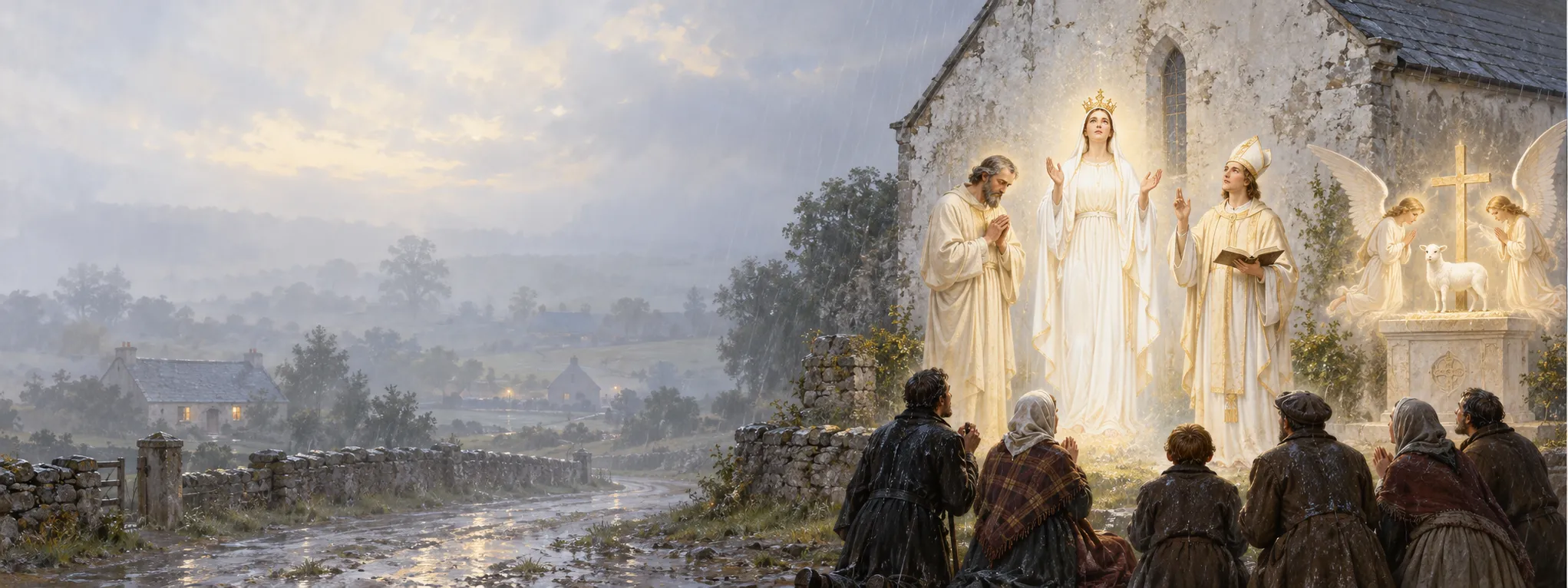
On a rainy evening in August 1879, people in Knock saw luminous figures outside the parish church. Mary McLoughlin at first thought they were statues. Returning with Mary Byrne, she stopped to look more closely, and neighbours were called to the scene. The witnesses identified the figures as the Blessed Virgin Mary, St. Joseph, and St. John the Evangelist. Beside them appeared an altar with a lamb and a cross.
The apparition was silent. Witnesses described Mary dressed in white, wearing a crown, with her hands raised and her eyes turned toward heaven. The villagers prayed in the rain as the scene continued for about two hours. Fifteen people later gave testimony to a Church inquiry, although their accounts differed in the details they noticed.
The Church’s investigations found the witnesses credible, and Knock grew into an important place of pilgrimage. St. John Paul II visited in 1979, and Pope Francis in 2018. In 2021, Knock became an International Shrine of Special Eucharistic and Marian Devotion. Its lasting invitation is to enter prayerful silence, draw close to Christ, and find hope in Mary’s motherly presence.
Church status: An established Catholic apparition devotion, supported by favourable Church inquiries and later papal recognition. The findings of the inquiries and the shrine’s later honours are explained below.
Setting and people
The feast (August 17) and the anniversary (August 21) are different dates. The fifteen witnesses are those whose testimony was officially collected; not all of them described every feature of the apparition.
A village and its parish church
The apparition was seen at the south gable of Knock’s parish church. The church, built in 1828, remains part of the shrine. The event arose from ordinary village life: people were visiting neighbours, going home, and finishing their work when their attention turned to the illuminated scene.
The fifteen official witnesses
The shrine publishes statements under these names: Mary McLoughlin, Mary Byrne, Margaret Byrne, Margaret Byrne Jr., Dominick Byrne Sr., Dominick Byrne Jr., Patrick Byrne, Judith Campbell, John Curry, John Durkan, Patrick Hill, Mrs. Hugh Flatley, Catherine Murray, Bridget Trench, and Patrick Walsh.
Several witnesses are especially important to the account:
- Mary McLoughlin: the parish priest’s housekeeper, noticed the figures before the larger gathering formed.
- Mary Byrne: later Mary O’Connell, described the figures in considerable detail.
- Patrick Hill: gave a detailed account of the lamb, the cross, and the angels.
- Bridget Trench: went up to the apparition and tried to embrace Mary’s feet, but felt only the wall.
- Patrick Walsh: saw an unusual light from a distance rather than the figures close at hand.
The parish priest
Archdeacon Bartholomew Cavanagh was told about the scene but did not go out to see it, as Mary McLoughlin’s statement records. He later helped investigate the event but was not himself an eyewitness.
The apparition account
The first observations
Mary McLoughlin noticed unusual figures at the church while walking toward the Byrne home. At first she wondered whether the priest had obtained new statues. When she returned with Mary Byrne, both women stopped to look at the scene, and family members and neighbours were called.
The figures
Mary Byrne described the Blessed Virgin standing slightly above the ground, dressed in white, with a crown and raised hands. St. Joseph stood beside her, his head inclined toward her.
The third figure held an open book and raised a hand as though teaching. Mary Byrne recognized him as St. John the Evangelist from a statue she had seen before, and she acknowledged that this identification was her own.
Patrick Hill described a lamb standing on a plain altar, with a cross behind it and angels around it. He also said the figures seemed solid and lifelike, although no voice was heard.
Prayer in the rain
People gathered and prayed the Rosary. Witnesses came and went at different times, so the total duration of about two hours is longer than any one person’s observation.
Bridget Trench said that the ground beneath the figures stayed dry despite the rain. This is an eyewitness claim preserved in the testimony, not a measured weather record.
The message and its meaning
A silent apparition
At Knock, Mary spoke no recorded words. The meaning of the apparition is understood through the scene the witnesses described and the Church’s later reflection. Pope Francis expressed this in 2021:
The message from Knock is the great value of silence for faith.
He connected that silence with contemplation of Christ’s self-giving love, represented by the Lamb.
Eucharistic and biblical symbolism
These are theological interpretations, not further words given during the apparition:
| Element | Christian meaning |
|---|---|
| The lamb and altar | Christ’s sacrificial love and the Eucharist |
| The cross | The Passion and redemption |
| Mary in prayer | A model of worship, trust, and intercession |
| St. Joseph | Faithful presence and reverence |
| St. John with an open book | Witness to Christ and the proclamation of the Gospel |
| Angels and heavenly light | Worship reaching beyond the visible congregation on earth |
The shrine’s official Eucharistic and Marian designation reflects this Christ-centred reading, and Pope Francis’s 2021 message explicitly connects the apparition’s silence with Jesus’ sacrifice for humanity.
At Knock, Mary offers no spoken instruction. Her presence invites us to stand with her before Christ, the Lamb of God. In a world filled with noise and anxiety, this silent scene encourages prayer, adoration, and confidence in the love of God.
What the Church has said
The first inquiry: 1879–1880
Archbishop John MacHale of Tuam set up a Church inquiry in October 1879. Its investigators heard testimony from fifteen witnesses and reached a favourable judgment on their collective credibility.
The shrine’s history notes that the archbishop did not issue a public statement immediately on receiving the report. The commission’s favourable finding was not a dated papal decree declaring the apparition supernatural.
The second inquiry: 1935–1936
Archbishop Thomas Patrick Gilmartin convened a second inquiry, which heard sworn evidence and examined the surviving witnesses Mary Byrne O’Connell and Patrick Byrne. Its findings again upheld the witnesses’ integrity and testimony.
John Curry, the youngest witness, then living in New York, was examined separately there; the shrine’s chronology dates that examination to 1937.
Papal recognition and the growth of the shrine
| Date | Development |
|---|---|
| December 8, 1954 | The processional statue of Our Lady of Knock was canonically crowned. |
| 1976 | The new Church of Our Lady, Queen of Ireland, opened. |
| September 30, 1979 | St. John Paul II visited in the centenary year, and the new church received the title of basilica. |
| August 26, 2018 | Pope Francis visited the Apparition Chapel and prayed at Knock. |
| March 19, 2021 | Knock’s elevation to an International Shrine of Special Eucharistic and Marian Devotion was celebrated with a papal message. |
These acts show the Church’s lasting acceptance and support of the shrine. Knock has no single “Vatican approval date”; its recognition rests on the inquiries and on this record of papal support.
Sources and historical questions
The testimonies are not identical
The surviving accounts show both agreement and differences. For example:
- Mary Byrne said she did not see a cross, while Patrick Hill described one.
- Mary Byrne explained how she came to identify St. John.
- Bridget Trench described motionless figures, while Patrick Hill reported some movement.
- Patrick Walsh’s evidence concerns a light seen from a distance.
Neither complete uniformity nor complete contradiction fairly describes the testimony.
Early evidence and later recollection
The 1879 statements are the principal sources for what people first reported. The later inquiry records what surviving witnesses remembered decades afterward. Knock Museum preserves and presents material on the apparition, including testimony, early photographs, and objects from the parish and the pilgrimage, which helps separate the early record from later retellings.
What historical research can establish
The documents establish that witnesses reported an extraordinary event and that Church inquiries found them credible. Historical study can compare those statements, their circumstances, and how they were handed down; it cannot by itself demonstrate a supernatural cause. What the witnesses reported, the Church’s judgment, and devotional interpretation are distinct.
A later healing: Marion Carroll
Knock’s tradition of healing includes Marion Carroll’s recovery during a pilgrimage in 1989. In September 2019, Bishop Francis Duffy and Archbishop Michael Neary publicly acknowledged the healing and stated that it had no medical explanation at that time. This healing is a separate event from the 1879 apparition.
Devotion and legacy
Devotion to Our Lady of Knock spread through Irish families, pilgrims, missionaries, and emigrant communities. Lay organizers played an important part: Judy and Liam Coyne founded the Knock Shrine Society in 1935 to promote the shrine and improve care for pilgrims, especially the sick.
The shrine’s spiritual life has grown around the Eucharist, confession, prayer, and care for those carrying illness or sorrow. In his 1979 homily, St. John Paul II described Knock as a place where people came to renew their faith in salvation through Jesus and to receive comfort through Mary’s intercession.
During his 2018 visit, Pope Francis prayed for families, encouraged the family Rosary, and entrusted survivors of abuse to Mary’s care, emphasizing truth, justice, and the duty to prevent further harm.
Knock invites us to bring our lives before Christ without needing to find perfect words. With Mary and the saints, we can remain in His presence, entrusting our joys, suffering, and unanswered questions to the Lamb of God.
Visiting today
The principal places to visit are:
- The Apparition Chapel: at the site of the original apparition.
- The parish church: preserving the historical setting.
- Knock Basilica: with its large mosaic of the apparition.
- The Chapel of Reconciliation: dedicated to the sacrament of confession.
- Knock Museum: on the witnesses, the documentary history, and village life.
- The grounds and gardens: with space for quiet prayer.
The liturgical feast is August 17, and August 21 marks the anniversary of the apparition. Check the shrine’s current programme for the annual novena, pilgrimage ceremonies, Masses, confession, and opening hours. Address: Knock Shrine, Knock, Claremorris, County Mayo, F12 Y226, Ireland.
Sources and further reading
| Resource | Best use |
|---|---|
| Knock Shrine | The historical timeline, the commissions of inquiry, the statements of the fifteen witnesses, and the announcement on Marion Carroll’s healing. |
| Knock Museum | Documents and objects related to the apparition. |
| St. John Paul II: homily at Knock, September 30, 1979 | Knock as a place of faith in Christ and of Mary’s intercession. |
| Pope Francis: Angelus at Knock, August 26, 2018 | Prayer for families and for survivors of abuse. |
| Pope Francis: message for Knock’s international shrine designation, March 19, 2021 | The value of silence for faith, and the Lamb. |
Other sources consulted
- Wikimedia Commons, photograph of the Apparition Chapel by Knock Shrine (CC BY-SA 4.0)
- Wikipedia, Knock Shrine
- Miracle Hunter

Last reviewed: November 12, 2026