
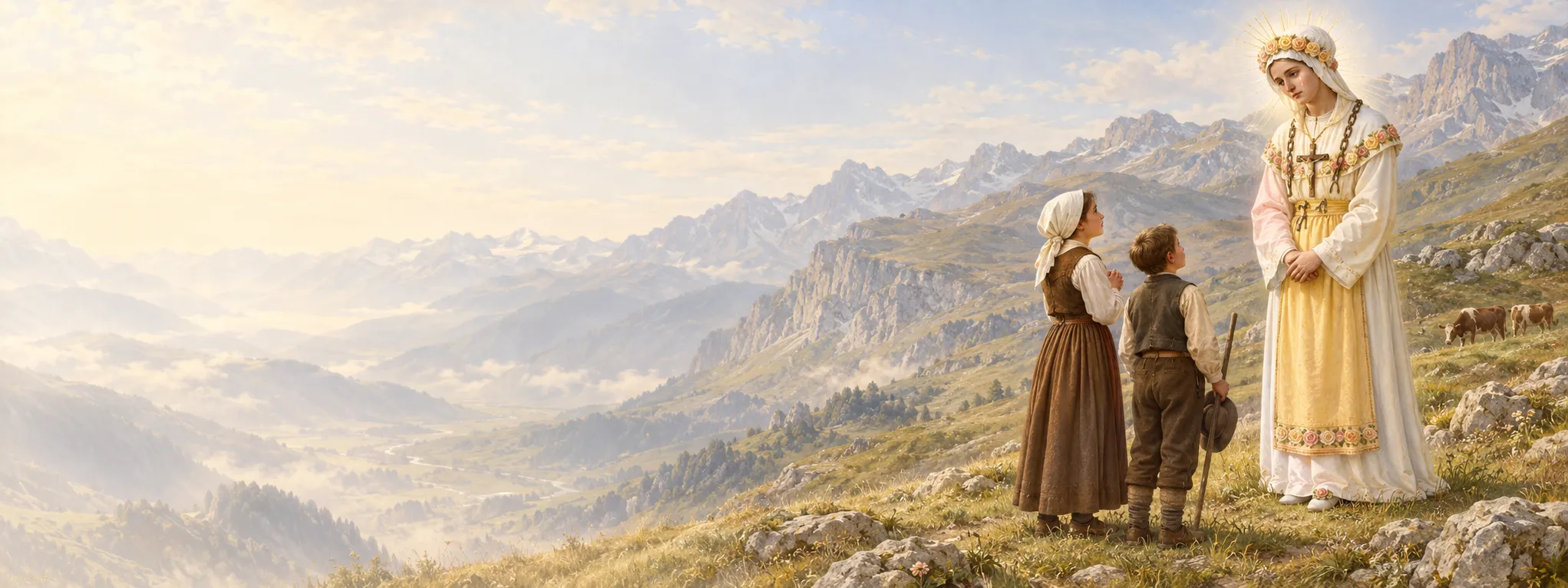
According to their testimony, eleven-year-old Maximin Giraud and fourteen-year-old Mélanie Calvat encountered the Blessed Virgin Mary on September 19, 1846, while tending cattle above La Salette-Fallavaux. They first saw her seated with her face in her hands, weeping. Surrounded by light, she rose and invited them to approach without fear. A crucifix rested on her breast, from which the children said the light radiated.
Speaking first in French and then in their local dialect, Mary expressed sorrow over the neglect of prayer, Sunday worship, and reverence for her Son’s name. Her message drew on the hardships of their rural world, including failed harvests and hunger, to call people back to God. She encouraged daily prayer and entrusted the children with making her message known.
After five years of investigation, the Bishop of Grenoble recognized the apparition in 1851. Today, the mountain sanctuary welcomes pilgrims seeking forgiveness, consolation, and renewed faith. Mary’s tears are remembered as an expression of motherly concern and an invitation to reconciliation with Christ, whose mercy offers hope to all who return to Him.
Church status: The apparition was formally recognized by Bishop Philibert de Bruillard of Grenoble on September 19, 1851. This recognition is distinct from the separate history of the children’s secrets and the later publications attributed to Mélanie.
The children and their world
Maximin Giraud was born in Corps on August 26, 1835. His mother died when he was a baby, and his father worked as a wheelwright. Mélanie Calvat, born in Corps on November 7, 1831, came from a large, poor family and worked tending livestock.
Their limited schooling and religious formation matter to the account: these were working children describing an unexpected encounter in the words they had.
The apparition took place amid serious agricultural distress. Crop failures and hunger were already affecting Europe; the La Salette Missionaries’ chronology dates the developing famine to 1845. Its mention of spoiled potatoes and wheat therefore speaks to a crisis already under way, not to a disaster unknown before the apparition.
What the children saw and heard
A woman in tears
After eating and resting, the children went to check on their cattle. They then noticed an extraordinary light in a small hollow. Within it, they saw a woman seated with her elbows on her knees and her face in her hands.
She rose and spoke to them. The encounter is traditionally estimated at about half an hour, although its length was never measured.
A conversation they could understand
The woman first spoke in French, then in the local dialect. She spoke of prayer, Sunday observance, misuse of her Son’s name, and failed harvests.
The account includes a striking personal detail: she recalled a day when Maximin and his father examined spoiled wheat near Coin, and how his father gave him bread and worried about the next year’s food. Maximin said he then remembered it.
A final instruction
The children said that each received a private communication. The public encounter ended with an instruction to make the message known.
The woman crossed the stream, climbed the slope, and disappeared into the light. The children then told local adults and the parish priest what had happened.
The message
The public message joins a grave warning about turning away from God with simple invitations to return to Him. Its principal requests are:
- Pray regularly: the children were encouraged to pray morning and evening, at least an Our Father and a Hail Mary when they could manage no more.
- Honour Sunday: the account laments neglect of worship and treating Sunday as just another working day.
- Respect the name of Jesus: blasphemy is named as a sign of disregard for Him.
- Recover a penitential life: the message challenges religious indifference, including disregard for Lent.
- Respond through conversion: its warnings come with a promise of abundance, pictured in wheat and potatoes.
- Share the invitation: the children were entrusted with passing the message on.
How to understand the severe language
The image of Mary holding back her Son’s arm can be hard for modern readers. It belongs within the Christian proclamation of Christ’s saving love.
In his 1996 anniversary letter, St. John Paul II read La Salette in the light of the Cross, mercy, and reconciliation. He explained that Christ’s arm receives the repentant sinner into new life. Mary’s tears express both the seriousness of rejecting God and the enduring love of the Redeemer.
The same letter stresses hope: broken relationships can be healed, and the darkness of sin can give way to God’s mercy. In this light, La Salette is a call to hope, not a message of threats or predictions of catastrophe.
At La Salette, Mary weeps for her children and points to her crucified Son. Her tears invite us to pray, to keep holy the Lord’s Day, and to return to Him who receives every repentant heart.
Mary’s appearance and its meaning
The children described clothing like that worn by local women, a long dress, apron, shawl, and bonnet, transformed by extraordinary brightness.
A large crucifix rested on her breast, with a hammer and pincers. They said the light radiated from the crucifix. Chains and roses were also part of her appearance. These details explain the distinctive look of La Salette statues and paintings.
The crucifix is the heart of the image: Mary directs our attention to her crucified Son. St. John Paul II linked her sorrow with compassion for suffering humanity and with grief over separation from Christ and His Church.
Signs, healings, and spiritual fruits
The spring
La Salette tradition links the apparition with a nearby spring that used to dry up in certain seasons. The Missionaries report that it kept flowing after the apparition and that many cures were attributed to its waters. The shrine’s history preserves these accounts; they are not presented here as scientifically documented cures.
Pilgrimage and conversion
Pilgrimage began quickly. The Missionaries’ chronology records large gatherings in 1847 and a growing confraternity by 1849. Its lasting fruits include a sanctuary, religious communities, and a worldwide ministry of reconciliation.
Early Catholic histories also record cures, alongside strong opposition and investigation. They are noted here without claiming a modern medical certification that the sources do not provide.
What the Church has said
| Date | Development |
|---|---|
| 1847 | A canonical commission examined the account as part of the bishop’s inquiry. |
| September 19, 1851 | Bishop Philibert de Bruillard recognized the apparition and authorized public devotion. |
| May 25, 1852 | The foundation stone of the church was laid, and the missionary community serving La Salette took shape. |
| 1855 | Bishop Jacques Ginoulhiac confirmed his predecessor’s recognition. |
| 1879 | The sanctuary church was raised to a basilica. |
| May 6, 1996 | St. John Paul II wrote a letter for the 150th anniversary, affirming its message of conversion and reconciliation. |
These milestones show the bishop’s recognition and the Church’s continued support. The original decision was the Bishop of Grenoble’s.
History and debate
The early record
The Missionaries date the first written account to September 20, 1846, the day after the apparition. Further questioning, reports, and Church examination followed. This gives researchers an early record, distinct from accounts written decades later.
Recognition did not end disagreement. Opposition came from secular critics and from Catholics, including clergy. The disputes concerned the reliability of the children, the meaning of their statements, and charges of deception. The Church’s decision came through that controversy, not from unanimous acceptance.
The public message and the secrets
Three bodies of material are distinct:
| Material | What it is |
|---|---|
| The 1846 apparition and public message | The central account recognized by the Bishop of Grenoble. |
| The children’s written secrets of 1851 | Private communications written for the Pope; not the same as the public message. |
| Mélanie’s expanded publication of 1879 | A much longer, later text that calls for separate historical and Church treatment. |
A reflection published by the La Salette Missionaries states that the secrets were not part of the bishop’s 1851 approval. It also distinguishes the writings sent to the Pope in 1851, rediscovered in 1999, from Mélanie’s much longer publication of 1879.
What the Holy Office restricted
Two original Vatican documents clarify an often-confused part of this history:
- December 21, 1915: the Holy Office restricted discussion and spreading of the so-called secret of La Salette. The decree expressly stated that it did not forbid devotion to Our Lady under the title of La Salette.
- May 1923: the Holy Office condemned a particular 1922 edition of a booklet reproducing Mélanie’s published text.
The distinction matters both ways: recognition of La Salette does not make every later text an authenticated message from Mary, and the restrictions on those publications do not revoke the recognized apparition or its devotion.
Devotion and legacy
La Salette spirituality centres on reconciliation with God and with one another. The sanctuary’s pastoral work connects conversion with prayer, Christian worship, compassion, and care for others.
This spirituality lives on through the Missionaries of Our Lady of La Salette, the Sisters, lay associates, and pilgrim communities, who give the message practical form through preaching, spiritual accompaniment, hospitality, and service.
The witnesses’ later lives belong to the history as well. Maximin died in Corps on March 1, 1875; Mélanie died in Altamura, Italy, in 1904. Their personal histories and later writings are distinct from the Church’s judgment on the original apparition.
Visiting today
The sanctuary stands about 1,800 metres above sea level, overlooking an Alpine landscape. Visitors can see the basilica, the apparition site, the museum, and places for prayer. The sanctuary also holds contemporary sacred art, including works by Arcabas.
The main yearly gatherings are on August 15, the Assumption, and September 19, the anniversary of the apparition. Lodging and meals are available at the sanctuary, with retreats and pilgrimages. Check the official website for current arrangements and access before travelling.
Sources and further reading
| Resource | Best use |
|---|---|
| Official sanctuary: the history | The shrine’s account of the event and the bishop’s decision. |
| Missionaries of La Salette: the apparition | The received account and the public message. |
| Missionaries: history of the congregation | The inquiry, the sanctuary, and the growth of the community. |
| John Paul II: letter for the 150th anniversary, May 6, 1996 (in French) | Christ, mercy, and reconciliation. |
| Missionaries: “Call to Integrity” | The 1851 secrets and the expanded 1879 publication. |
| Acta Apostolicae Sedis 1915, page 594 | The Holy Office decree of 1915 (in Latin). |
| Acta Apostolicae Sedis 1923, pages 287–288 | The Holy Office decree of 1923 (in Latin). |
| Missionaries: bibliography of La Salette | Longer studies, including Jean Jaouen’s A Grace Called La Salette. |
