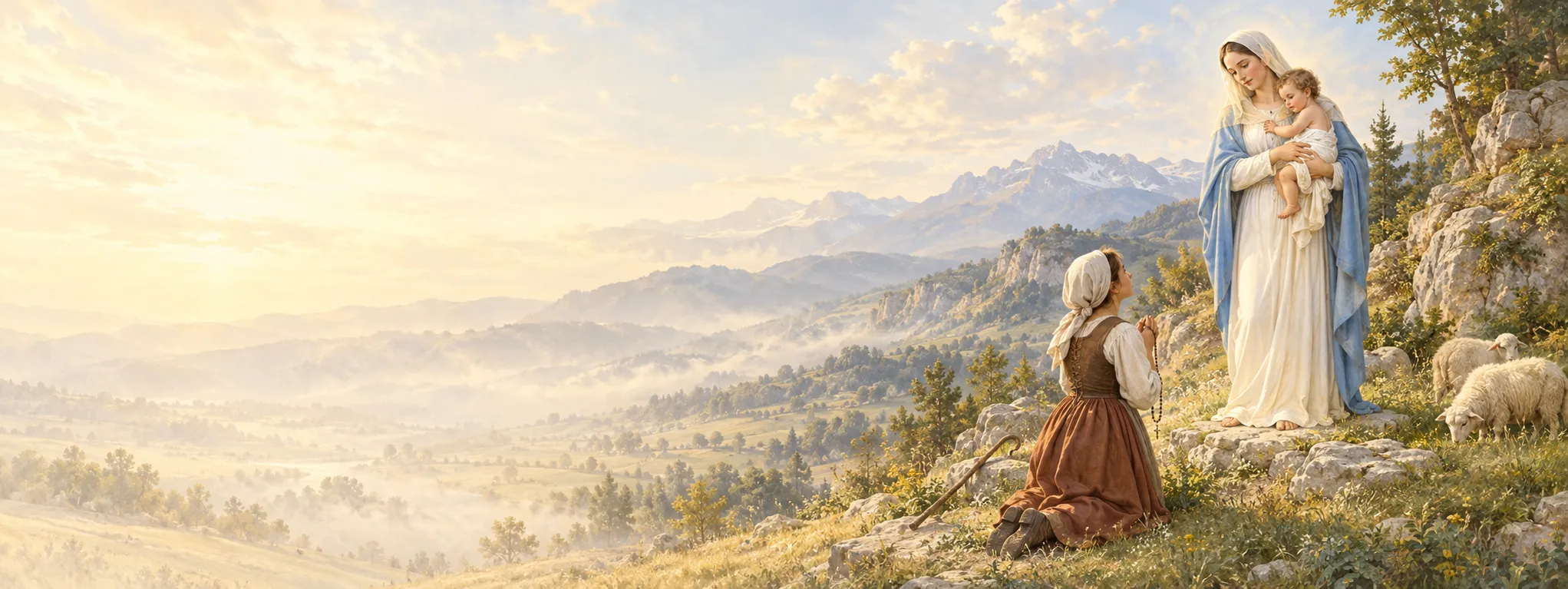
According to the Laus accounts, the Blessed Virgin Mary began appearing to sixteen-year-old Benoîte Rencurel in 1664 while she tended sheep near Saint-Étienne-le-Laus. The first encounters took place at the Vallon des Fours, where Benoîte saw a beautiful woman accompanied by a child. Over the following months, Mary gradually prepared the young shepherdess for a mission devoted to the conversion of sinners.
Later that year, Mary directed Benoîte to the small chapel of Bon-Rencontre at Laus, which she found by following a beautiful fragrance. There, Mary asked for a church and accommodation for priests who would welcome pilgrims and hear their confessions. Benoîte dedicated the rest of her life to receiving visitors, encouraging repentance, and helping people approach the sacrament of reconciliation. The reported apparitions continued until her death in 1718.
Formally recognized by the Bishop of Gap and Embrun in 2008, the apparitions place reconciliation at the heart of the sanctuary’s mission. Laus invites pilgrims to return to Christ with confidence, seek His mercy, and allow Mary’s gentle guidance to lead them towards renewed faith and peace.
Church status: The supernatural origin of the apparitions and events experienced and reported by Benoîte Rencurel between 1664 and 1718 was formally recognized by Bishop Jean-Michel di Falco Léandri on May 4, 2008. Benoîte was declared Venerable in 2009; that recognition is separate from the approval of the apparitions.
Benoîte Rencurel
Benoîte was born in 1647 at Saint-Étienne d’Avançon, now Saint-Étienne-le-Laus, into a family of modest means. Her parents were Guillaume and Catherine Rencurel, and she grew up with two sisters.
Her father died when she was seven. She eventually worked as a shepherdess to help support the household. Accounts of her childhood describe devotion to the Rosary, concern for sick neighbours, and a willingness to share her food with children poorer than herself.
She could neither read nor write, so the surviving records of her experiences were written by others who knew her. Later she joined the Third Order of St. Dominic: the title “Sister Benoîte” does not mean that she was a cloistered nun. The Vatican identifies her as a lay Dominican tertiary.
The apparition account
May–August 1664: the Vallon des Fours
The first Marian encounters are placed in May 1664, at the Vallon des Fours, near Benoîte’s village. The accounts describe a beautiful woman accompanied by a child.
The early encounters included long silences before conversation developed. Their emphasis is on Benoîte’s gradual spiritual formation: learning to listen, becoming more patient, and preparing to serve others. Vatican Radio’s account of the recognition confirms the May beginning and the appearance of Mary with a child.
The sanctuary also preserves an account of an earlier encounter with St. Maurice, who told Benoîte that she would see the Mother of God. This belongs to the wider mystical narrative surrounding the Marian apparitions.
August 29, 1664: Mary identifies herself
The accounts place Mary’s identification on August 29. François Grimaud, a local magistrate who investigated the events, recorded the name “Dame Marie.”
Other writers hand down longer versions identifying her as the Mother of God or the mother of Jesus. The historian Marcel Bernos notes these differences, which matter when long quotations are presented as Mary’s exact words.
September 29, 1664: the direction to Laus
After an interval without the earlier encounters, Benoîte saw Mary at Pindreau. The sanctuary dates this event to September 29.
Mary directed her toward the hamlet of Laus and a small chapel that she would recognize by its fragrance. This encounter marks the passage from Benoîte’s personal preparation to her mission at the future sanctuary.
September 30, 1664: the Chapel of Bon-Rencontre
The sanctuary dates Benoîte’s arrival at the chapel to the following day. According to its account, she found Mary waiting there, standing above the altar.
Mary asked for a church where people would come to conversion. The existing Chapel of Bon-Rencontre became the centre around which the larger church was built between 1666 and 1669.
The following decades: a continuing mission
The story of Laus extends well beyond its first encounters. Benoîte welcomed pilgrims, encouraged repentance, and helped people approach the sacrament of reconciliation.
The accounts attribute to her a particular insight into people’s consciences. Her role was to prepare and encourage them; sacramental confession and absolution remained the ministry of the priests.
The fifty-four-year span does not mean fifty-four years of daily apparitions. Bernos distinguishes the frequent early encounters from later appearances at varying intervals, and there is no securely established total number of apparitions.
The message
“I asked my Son for this place for the conversion of sinners, and He granted it to me.”
The central themes are:
- Conversion: acknowledging sin and returning to God with hope.
- Reconciliation: receiving forgiveness and seeking restored relationships.
- Prayer for others: especially for those struggling to return to the faith.
- Welcome: helping people approach God without humiliation or despair.
- Mission: letting an encounter with mercy become service to others.
At the 2008 recognition, the Church’s presentation of Laus emphasized prayer, conversion, and mission. The bishop also described reconciliation with God as the foundation for reconciliation with others and within oneself.
At Laus, Mary leads us toward the mercy of her Son. Through Benoîte’s patient welcome, the invitation becomes practical: return to prayer, make an honest confession, seek reconciliation, and trust that God’s forgiveness can begin a new chapter in your life.
Signs and healings
The fragrances
Beautiful fragrances are part of the founding account: they help Benoîte identify the chapel to which Mary has sent her. The sanctuary understands them as part of the experience of encounter and spiritual consolation. The accounts tell of these fragrances; they do not promise that every visitor will notice them.
The oil of the sanctuary lamp
A distinctive devotion at Laus involves oil from the lamp near the tabernacle in the Chapel of Bon-Rencontre.
The sanctuary cites Pierre Gaillard’s account connecting its prayerful use with Mary’s intercession and healing. Its current explanation stresses that this is ordinary oil, used as an expression of faith and trust in God. It receives testimonies of physical relief, spiritual healing, and other graces.
It is a devotional practice, not a promise of cure, and it is not the sacrament of the Anointing of the Sick.
The healing of Catherine Vial — 1665
An important early account concerns Catherine Vial, who had reportedly been unable to use her legs for about six years.
A published transcription of the investigation records her recovery at Laus on September 18, 1665, during a visit by Antoine Lambert, the vicar general of Embrun. The report names witnesses and describes her examination after the recovery.
This gives the episode a documentary basis beyond an unnamed healing story. It is a historical testimony, not a modern medical investigation.
Christ’s Passion and Benoîte’s trials
The Laus tradition includes experiences beyond the Marian apparitions.
Beginning in 1669, Benoîte reported encounters with the crucified Christ at the Croix d’Avançon. The sanctuary recounts five appearances associated with this cross. They are presented as a revelation of Christ’s love for sinners and of the suffering He endured for their salvation.
The Chapel of the Precious Blood now keeps the memory of these events and the associated cross.
Accounts also describe periods of physical and spiritual suffering, opposition from some clergy, and restrictions on her contact with pilgrims. The French bishops’ Nominis account places an improvement in her circumstances in 1712, when the missionaries of Notre-Dame de Sainte-Garde arrived.
Benoîte died on December 28, 1718.
What the Church has said
1665: authorization of the pilgrimage
The pilgrimage received ecclesiastical authorization in September 1665. This allowed the devotion to grow, but it was not the same as the later formal declaration of the supernatural origin of the apparitions.
1855 and 1892: further recognition of the sanctuary
The image of Our Lady of Laus was crowned on May 23, 1855, with authorization from Pope Pius IX. The church was raised to the rank of minor basilica on March 18, 1892. These acts recognized the sanctuary and its devotion.
2005–2008: investigation and formal recognition
During work on Benoîte’s cause for beatification, the authorities noticed that there had never been an explicit formal recognition of the apparitions.
Bishop Jean-Michel di Falco Léandri consulted the Congregation for the Doctrine of the Faith. The process involved theological, historical, and scientific commissions. According to the diocese, the bishop acted with the Congregation’s assent.
On May 4, 2008, during a Mass at the sanctuary, he promulgated the decree recognizing the supernatural origin of the apparitions and events experienced and reported by Benoîte between 1664 and 1718. Unlike cases where “approval” means only permission for devotion or the crowning of an image, Laus has an explicit recognition of supernatural origin.
2009: Benoîte declared Venerable
On April 3, 2009, Benedict XVI authorized the decree recognizing Benoîte’s heroic virtues. This concerns her personal holiness and her cause for sainthood, and it is distinct from the 2008 apparition decree. She is therefore Venerable Benoîte Rencurel; her beatification is still pending.
History and the sources
The Manuscripts of Laus
The principal collection of documents comes from four men who knew Benoîte:
| Author | Connection to Benoîte and the sanctuary |
|---|---|
| François Grimaud | Magistrate who investigated the early events |
| Jean Peytieu, also spelled Peythieu | Priest and theologian who lived alongside her ministry for twenty years |
| Pierre Gaillard | Vicar general of Gap and principal compiler of the sanctuary’s history |
| François Aubin | Hermit and confidant who helped preserve the records |
The sanctuary describes a collection of about 1,800 pages. The manuscripts were hidden during the French Revolution, rediscovered in 1824, and systematically copied in 1850.
What these records establish, and their limits
These are valuable records written by people close to Benoîte, not accounts first composed centuries after her death. They document her life, the growing pilgrimage, and what she reported.
They are not all independent eyewitness accounts of Mary herself. Bernos also notes that educated clerical writers sometimes expressed Benoîte’s words in more developed theological language. Direct quotations therefore need attribution, and differing versions should not be quietly merged into one supposedly word-for-word speech.
For this reason, this page does not call these the longest apparitions in history, gives no exact total of appearances, and does not say that every reported healing has been individually declared a miracle.
Visiting today
The sanctuary offers several connected places through which visitors can follow the story:
| Place | Significance |
|---|---|
| Vallon des Fours | Site associated with the first Marian encounters |
| Pindreau | Where Mary directed Benoîte toward Laus |
| Basilica and Chapel of Bon-Rencontre | Heart of the sanctuary and its ministry of reconciliation |
| Benoîte’s tomb | Place of prayer linked to her continuing spiritual legacy |
| Chapel of the Precious Blood | Commemorates her encounters with the crucified Christ |
| Benoîte’s room and other devotional sites | Help visitors understand her daily life and service |
The sanctuary provides walking and spiritual itineraries connecting its principal sites. Its present ministry includes Mass, confession, Eucharistic adoration, retreats, and spiritual accompaniment. A 2026 broadcast from the sanctuary describes priests, religious sisters, and lay people continuing its work of welcome and prayer.
The local feast is May 1. For current Mass and confession times, see the sanctuary’s schedule.
Sources and further reading
| Resource | Best use |
|---|---|
| Diocese of Gap and Embrun: Notre-Dame du Laus | The 2008 decree of recognition and the sanctuary’s mission. |
| Official sanctuary history | Chronology and how the manuscripts were handed down. |
| Vatican Radio, April 4, 2009: decrees of the Congregation for the Causes of Saints | Recognition of Benoîte’s heroic virtues. |
| Marcel Bernos, “Benoîte Rencurel et les pèlerins du Laus au XVIIe siècle,” 1995 | Scholarly analysis of the records and the pilgrimage. |
| Sanctuary: the oil of Laus | The sanctuary’s explanation of the oil devotion. |
| Nominis: Venerable Benoîte Rencurel | Her life, trials, and death, from the French bishops’ site. |
