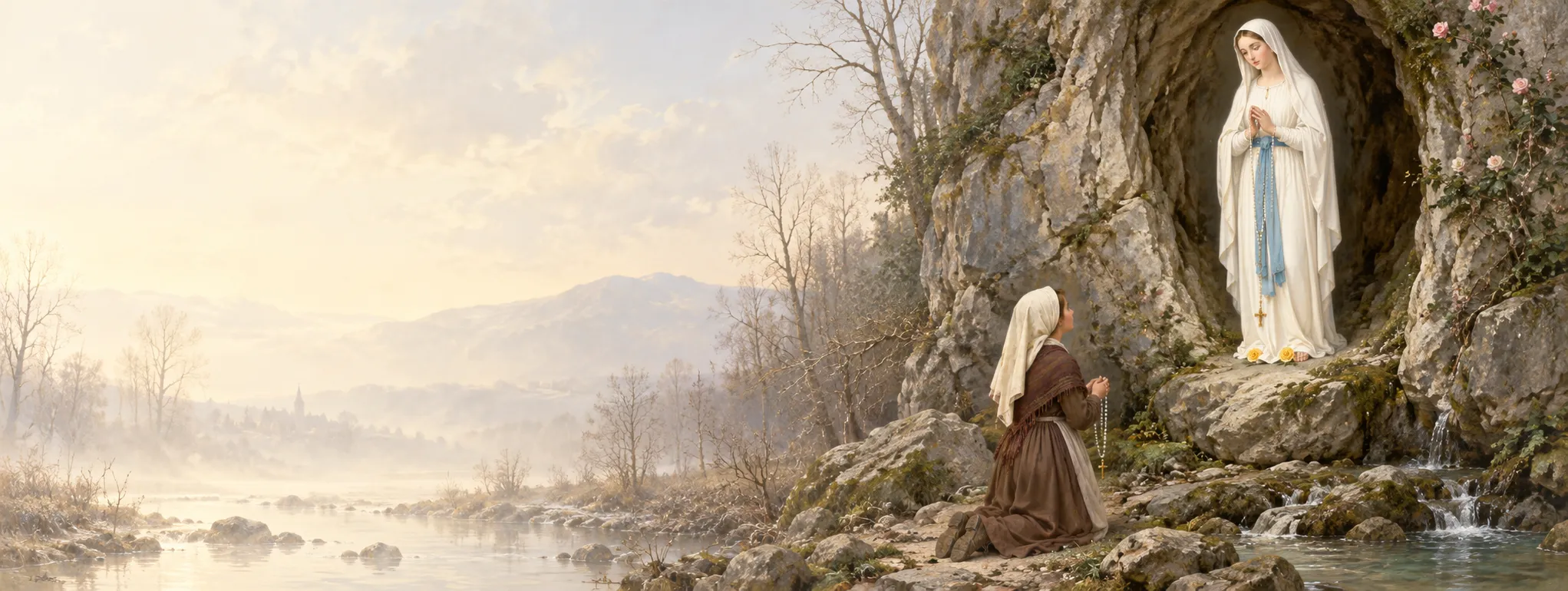
On February 11, 1858, fourteen-year-old Bernadette Soubirous was gathering firewood near Lourdes when she saw a beautiful lady in the Grotto of Massabielle. According to her account, the lady wore white with a blue sash and a yellow rose on each foot. Bernadette knelt and prayed the Rosary. This encounter marked the beginning of eighteen apparitions, continuing until July 16.
During the encounters, Mary called for prayer and penance for sinners. She directed Bernadette to drink from a spring at the grotto and asked that a chapel be built and that people come in procession. On March 25, she revealed her identity in Bernadette’s local dialect: “I am the Immaculate Conception.” The spring became closely associated with the pilgrimage and reports of healing.
Following an investigation, the Bishop of Tarbes formally recognized the apparitions on January 18, 1862. Today, Lourdes welcomes pilgrims from around the world, with a special place for those experiencing illness or disability. Its enduring invitation is to draw closer to Christ through prayer, conversion, and trust in God’s love, accompanied by Mary’s motherly care.
Church status: The apparitions were formally recognized as supernatural by Bishop Bertrand-Sévère Laurence of Tarbes on January 18, 1862. Bernadette was canonized on December 8, 1933.
The setting and the people
Those who went with Bernadette saw her and what happened around her; the testimony about the apparitions themselves comes from Bernadette.
Bernadette and her family
Bernadette was born on January 7, 1844, at the Boly Mill in Lourdes. Her parents were François Soubirous and Louise Castérot. The family’s situation worsened after the mill failed, and by 1857 they were living in the cramped former jail known as the Cachot.
She had suffered serious illness, including cholera, and had received little schooling. She also spent time tending sheep at Bartrès. When the apparitions began, she was preparing for her First Communion, which she received on June 3, 1858.
Her community at Nevers describes a childhood marked by poverty, interrupted schooling, and constant ill health. This helps explain the imbalance between Bernadette and the officials who questioned her: she was a poor girl suddenly required to explain an extraordinary experience to powerful adults.
The principal people involved
| Person | Role |
|---|---|
| Bernadette Soubirous | Saw and heard the Lady. |
| Her sister and a friend | Went with her on the first visit to Massabielle. |
| Abbé Dominique Peyramale | Parish priest of Lourdes; received the request for a chapel and procession and asked the Lady’s name. |
| Police commissioner Jacomet | Questioned Bernadette during the events. |
| Bishop Bertrand-Sévère Laurence | Set up the Church investigation and issued the decree of recognition. |
The early response included questioning and scepticism as well as growing popular interest. Recognition came after an investigation, not as an immediate answer to Bernadette’s first report.
The eighteen apparitions
This short chronology follows the sanctuary’s official account. All dates are in 1858.
| Apparition | Principal event |
|---|---|
| 1 · February 11 | First encounter; Bernadette prays the Rosary. |
| 2 · February 14 | She brings holy water; the Lady smiles. |
| 3 · February 18 | First spoken words; an invitation to return for fifteen days. |
| 4 · February 19 | Bernadette brings a lighted candle. |
| 5 · February 20 | The Lady teaches her a personal prayer. |
| 6 · February 21 | An encounter followed by police questioning. |
| 7 · February 23 | A private communication is entrusted to Bernadette. |
| 8 · February 24 | A call to penance and prayer for sinners. |
| 9 · February 25 | Bernadette uncovers the spring. |
| 10 · February 27 | A silent apparition; the penitential gestures continue. |
| 11 · February 28 | Prayer and penance before a growing crowd. |
| 12 · March 1 | An apparition at the time of the first reported healing. |
| 13 · March 2 | The request for a chapel and processions. |
| 14 · March 3 | The Lady smiles when asked her name. |
| 15 · March 4 | The last apparition of the fortnight she had asked for. |
| 16 · March 25 | She names herself the Immaculate Conception. |
| 17 · April 7 | The candle flame that did not burn Bernadette’s hand, as witnesses reported. |
| 18 · July 16 | The last encounter, seen from across the river. |
The first encounter
Bernadette went to Massabielle with her sister and a friend to gather firewood. She described a Lady in the grotto, and the encounter was one of prayer rather than an immediate spoken message.
On a later visit she brought holy water as a precaution. The detail matters: the early account does not show her as already understanding what she was experiencing.
The spring and the penitential gestures
On February 25, Bernadette scraped at the ground and found muddy water before the spring began to flow freely. Her actions, including washing and penitential gestures, bewildered some onlookers. The sanctuary reads this episode in the light of conversion, purification, and the life of Christ.
The request to the priests
The request for a chapel and a procession brought Bernadette face to face with the parish clergy. Peyramale wanted to know who was asking and did not simply accept the request at once. The question of the Lady’s identity became central to what followed.
The identification on March 25
On the feast of the Annunciation, Bernadette reported these words:
“I am the Immaculate Conception.”
The sanctuary keeps the words both in Bernadette’s language and in translation. They became the defining expression of Lourdes.
The message and its meaning
Prayer and conversion
The message centres on prayer, repentance, and love for sinners. The sanctuary presents Bernadette’s penitential acts as expressions of conversion and intercession.
Penance means turning back to God, through prayer, repentance, and a willingness to change one’s life. The unusual gestures in the account belong to their historical setting; they are not instructions for visitors to copy.
Hope beyond suffering
During the third apparition, the Lady spoke of happiness beyond this world. The account does not promise Bernadette an easy life on earth. Lourdes therefore carries a particular spirit: its message offers hope amid suffering, alongside the accounts of physical healing.
What “Immaculate Conception” means
The Immaculate Conception concerns Mary’s own conception: the Catholic teaching that, by the grace of God and the merits of Jesus Christ, she was preserved from original sin from the first moment of her existence.
Blessed Pius IX defined this doctrine in 1854, four years before the apparitions. Lourdes did not originate the doctrine; Catholics understand the Lady’s words in the light of a teaching the Church had already proclaimed.
A chapel and a pilgrim community
The request for a chapel and processions gives the message a shared dimension. Bernadette’s experience leads to a place of worship and to a people gathered in prayer.
At Lourdes, Mary’s invitation leads us toward Christ through prayer, conversion, and care for one another, especially for those who are sick, vulnerable, or overlooked.
The spring and its meaning
The spring is central to Lourdes, but the sanctuary states plainly that its water has no special healing properties. Its religious meaning comes from its place in the apparitions and from the prayer of pilgrims. The sanctuary also notes that the water becomes holy water only through a priest’s blessing. It is available freely at the sanctuary.
The spring at Massabielle recalls Mary’s invitation to Bernadette to drink and wash. Pilgrims come to its water as a sign of purification, prayer, and trust in God. The Church attributes miraculous healing to God’s action, not to any medicinal property of the water.
Not every recognized Lourdes healing involved bathing in the water. The sanctuary’s register also includes people who never travelled to Lourdes. No particular physical act is required for a healing linked to this devotion.
The Church’s response
The investigation
Bishop Laurence set up a commission on July 28, 1858, shortly after the last apparition. It examined Bernadette’s testimony, the witnesses, reported recoveries, the spring, and the circumstances of the events, and it sought medical and other scientific advice. After nearly four years, the bishop issued his judgment recognizing the apparitions.
Important milestones
| Date | Development |
|---|---|
| July 28, 1858 | Commission of inquiry set up. |
| January 18, 1862 | Bishop Laurence formally recognizes the apparitions. |
| April 4, 1864 | The grotto statue is inaugurated during an official procession. |
| 1883 | The Medical Bureau is founded to examine claimed cures systematically. |
| December 8, 1933 | Bernadette is canonized. |
| July 2, 1957 | Pius XII publishes Le Pèlerinage de Lourdes for the centenary of the apparitions. |
| 1992–1993 | St. John Paul II establishes the World Day of the Sick, first observed on February 11, 1993. |
Healings and recognized miracles
The current record
As of this review, the sanctuary lists more than 7,000 reported healings and 72 healings recognized as miraculous by the Church. These are different categories: a reported recovery does not automatically become a recognized miracle.
How a healing is assessed
| Stage | What happens |
|---|---|
| Initial report | A person reports a recovery to the Medical Bureau. The medical history and supporting records are gathered. |
| Medical investigation | Doctors examine the diagnosis, treatment, recovery, and follow-up. |
| Specialist assessment | The International Medical Committee of Lourdes judges whether the recovery remains unexplained by current medical knowledge. |
| Church judgment | The case goes to the bishop of the healed person’s diocese, who decides whether to recognize a miracle. |
The sanctuary’s published criteria require a serious, objectively documented disease; no treatment that could account for the recovery; and a recovery that is sudden, complete, and lasting. Follow-up may last for years.
Doctors assess the medical evidence; the bishop makes the religious judgment. “Medically unexplained” and “recognized as miraculous” do not mean the same thing.
Selected cases
- The first recognized group, 1862: when Bishop Laurence recognized the apparitions, he also recognized seven cures as miraculous, before the permanent Medical Bureau existed.
- John “Jack” Traynor, recognized in 2024: the Archbishop of Liverpool recognized his 1923 recovery as the seventy-first miracle on the Lourdes register, after a renewed study of his medical records. His case shows how far apart the date of a recovery and the date of its recognition can be.
- Antonia Raco, recognized in 2025: she recovered during a 2009 pilgrimage from primary lateral sclerosis. After years of medical review, including a committee vote in November 2024, Bishop Vincenzo Carmine Orofino of Tursi-Lagonegro proclaimed the miracle on April 16, 2025. It is the seventy-second listed by the sanctuary.
Weighing the evidence fairly
A peer-reviewed historical study, The Lourdes Medical Cures Revisited, found wide variation in the quality of records and diagnostic standards across periods. Early accounts cannot simply be treated as equal to modern clinical files. The study weighs medical claims and makes no theological judgment about miracles. This page takes the same care: what the records support, where their limits lie, and what kind of conclusion is drawn.
Bernadette after the apparitions
Bernadette chose religious life with the Sisters of Charity of Nevers. She arrived at their motherhouse, Saint-Gildard, on July 7, 1866, and made her religious profession in 1867. She worked as an assistant nurse, while her failing health increasingly limited what she could do. Her community describes prayer and service as the heart of her life there. She died on April 16, 1879, aged thirty-five.
Her later life matters: it keeps her from appearing only as the child in the grotto. She lived more than twenty years after the first apparition, making choices about vocation, community, illness, and service.
Her writings belong to the history too. The Nevers community lists personal notes from 1873–1874, other short writings, and letters to her family. These later writings are distinct from her testimony about the events of 1858.
The statue and its symbolism
The familiar statue of Our Lady of Lourdes was made by Joseph-Hugues Fabisch and inaugurated in 1864. It is a work of art based on Bernadette’s descriptions. The sanctuary names the white clothing, blue sash, roses at the feet, and rosary as details taken from them.
Bernadette did not find the finished statue a true likeness, and the sanctuary itself recounts her disappointment. It is a faithful attempt to represent the Lady, not an exact portrait of what she saw.
Sources and historical questions
Lourdes has documents tied to the events and their immediate investigation. Different sources, however, answer different questions.
| Source | What it can establish | Its limits |
|---|---|---|
| Bernadette’s testimony | What she saw, heard, and did. | Her experience was not visible to the crowd around her. |
| Witness testimony | Her behaviour, the setting, the crowds, and related events. | Watching Bernadette is not the same as seeing the apparition. |
| The bishop’s inquiry and decree | How the Church investigated and judged the case. | A Church judgment is not a laboratory test. |
| Medical records | Diagnoses, treatment, recoveries, and follow-up. | Their completeness and precision vary by period. |
| Later biographies and devotional accounts | How the devotion was received, understood, and spread. | Dialogue and details should be checked against earlier evidence. |
The sanctuary’s historical collections include administrative and photographic archives and the papers of researchers such as René Laurentin and Léonard Cros. Laurentin’s Lourdes: dossier des documents authentiques is a major resource for deeper study.
This page therefore:
- attributes Mary’s words to Bernadette’s account and names the translation;
- presents the April 7 candle incident as witnesses reported it, not as a tested physical phenomenon;
- keeps the recognition of the apparitions, the recognition of individual healings, and later devotional readings distinct.
This page draws on official accounts and published scholarship; it is not a fresh study of every original deposition or medical file.
Devotion and legacy
Lourdes became known for welcoming the sick and helping them take part in pilgrimage. Its gifts include prayer, companionship, practical service, and respect for the dignity of those who depend on others for care. The sanctuary sets these alongside its accounts of healing.
February 11 is also the World Day of the Sick. Established by St. John Paul II in 1992 and first celebrated in 1993, it joins Lourdes to the whole Church’s care for those who suffer and those who look after them.
Pius XII’s 1957 encyclical presents the Lourdes pilgrimage as an invitation to renewed Christian life, reaching beyond the extraordinary signs alone.
The shrine today
| Place | What visitors find |
|---|---|
| Grotto of Massabielle | The place of the apparitions, with the spring and the statue in the niche. |
| Basilica of the Immaculate Conception | The upper basilica, consecrated in 1876. |
| Basilica of Our Lady of the Rosary | Consecrated in 1901, known for its mosaics of the mysteries of the Rosary. |
| Basilica of St. Pius X | The large underground basilica, consecrated in 1958 for the centenary. |
| Water points | Where pilgrims draw water and take part in the sanctuary’s water devotions. |
| Saint-Gildard, Nevers | A separate pilgrimage linked to Bernadette’s religious life. |
For current visiting arrangements and times, see the official sanctuary websites.
Sources and further reading
| Resource | Best use |
|---|---|
| Sanctuary: the apparitions to Bernadette | Dates and the sanctuary’s account of each encounter. |
| Sanctuary: recognition of the apparitions | The inquiry and the bishop’s judgment of 1862. |
| Sanctuary: the message of Lourdes | The sanctuary’s theological reading. |
| Sanctuary: the water of Lourdes | The meaning of the spring and what is said about the water. |
| Sanctuary: miraculous healings | The register, the current count, and how a miracle is recognized. |
| Sanctuary of St. Bernadette, Nevers | Her religious life, her writings, and the sanctuary. |
| François, Sternberg, and Fee, The Lourdes Medical Cures Revisited | Peer-reviewed analysis of the historical medical evidence. |
| Pius XII: Le Pèlerinage de Lourdes (1957) | Papal teaching on the pilgrimage and its spiritual purpose. |
| René Laurentin, Lourdes: dossier des documents authentiques | The collected original documents. |
