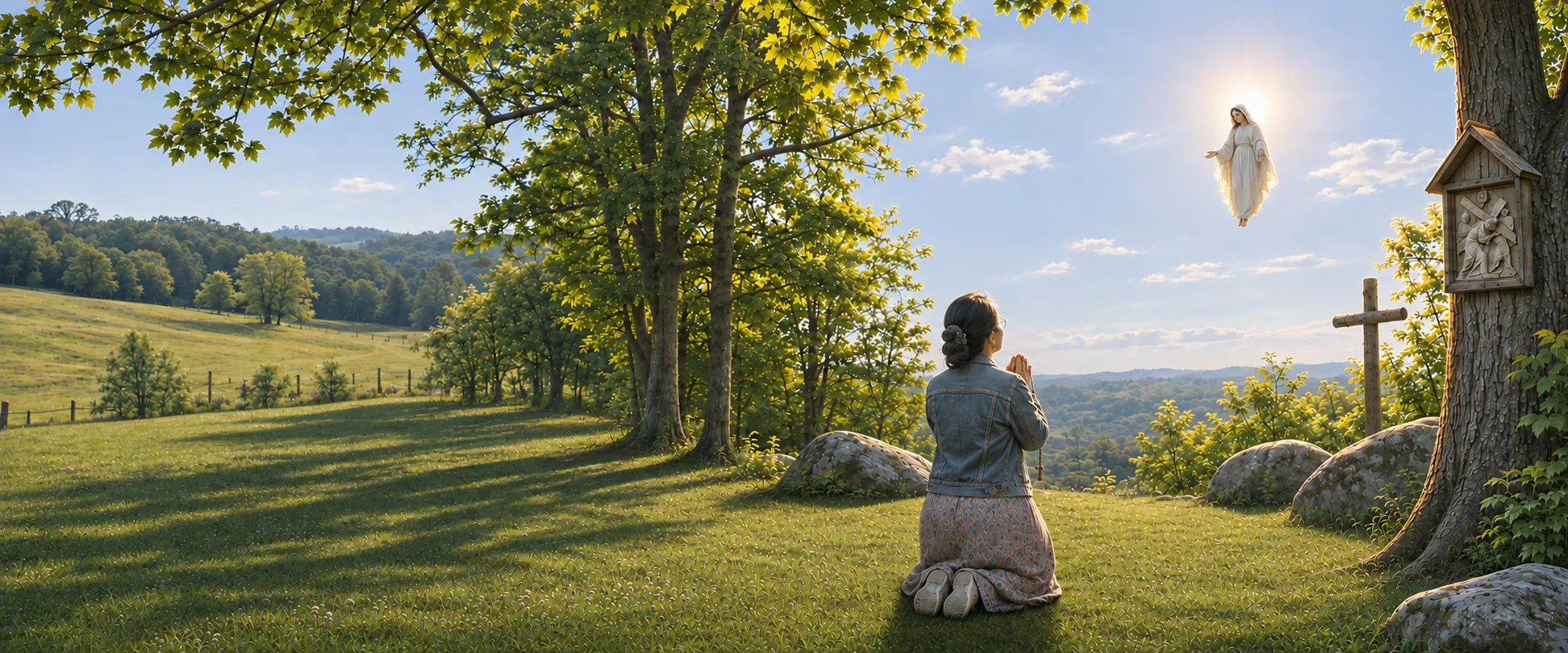
After a family pilgrimage to Medjugorje, John and Shelagh Greensides set up an outdoor Way of the Cross on the wooded hill of their farm near Marmora, Ontario. A reunion of fellow pilgrims in June 1991 grew into regular prayer gatherings. From 1992, visitors reported seeing Our Lady, along with signs in the sun and other experiences they understood as marks of her presence.
Several children and adults became associated with the accounts. The best known is Dory Tan, whose published messages urge the Rosary, confession, the Mass, and love of neighbour. According to her collection, on December 8, 1993, the Lady called herself the Queen of Peace and accepted the name Our Lady of Marmora.
For many pilgrims, Marmora has been a place of prayer, consolation, and renewed Christian life. Its history also includes extraordinary claims and predictions that call for careful discernment, so this page presents the apparitions as reported testimony.
Church status: Reported apparitions. No Church approval, nihil obstat, or condemnation has been published. Marmora lies within the Archdiocese of Kingston, which has not issued an official judgment on the events, and the devotional website itself acknowledges that they have not been approved.
The farm and its origins
An earlier recollection: Karl Clemens’s prayer
A devotional account connects the hill with Karl Clemens, who is said to have lived on the property as a boy. After seeing a film about Our Lady of Fátima, he reportedly climbed the hill and asked Mary to make herself known there too. Karl Clemens, a native of Marmora, later became a priest. His childhood prayer is a cherished recollection rather than a documented event.
The Greensides family
The Greensides family bought the farm in the early 1970s. John Greensides’s interest in Medjugorje grew through the writings of Wayne Weible, and after the family’s pilgrimage they wished to continue praying as they had there.
A friend, Eleanor Lynch, gave them fourteen Stations of the Cross, which the family placed on trees around the hillside. They invited fellow pilgrims to a reunion in June 1991. Requests for further gatherings followed, and the numbers grew. In time the farm also gained a Rosary Trail, a Peace Path, and a Lourdes grotto, so its devotional life centred on Christ’s Passion and on Marian prayer.
The story: significant dates
These dates describe what the sources report. They do not establish that the experiences were supernatural.
| Date | What the sources report |
|---|---|
| June 1991 | The family begins hosting prayer reunions after its Medjugorje pilgrimage. |
| June 24, 1991 | Shelagh Greensides later associated this day with signs in the sun during a gathering. |
| June 1992 | Veronica Garcia visits and reports Marian experiences. |
| August 3, 1992 | Dory Tan’s first reported experience of Our Lady at the farm. |
| August 23, 1992 | Marci Guinto, then eleven, reports a vision of Our Lady. |
| May 30, 1993 | Tan’s collection records a request to make the spring water available, with a reported healing. |
| July 27, 1993 | Her first public message attributed to Mary. |
| September 1993 | Messages encourage First Saturday gatherings with the Rosary and the Stations of the Cross. |
| December 8, 1993 | The titles Queen of Peace and Our Lady of Marmora appear in Tan’s collection. |
| December 8, 1994 | A request for a crucifix and chapel at the Tenth Station. |
Other reported witnesses
Devotional compilations name further people who reported experiences at the farm, among them Branca Cepo, Véronique Demers, Steven Ley, Emma de Guzman, and Eddie Virrey, besides Dory Tan, Marci Guinto, and Veronica Garcia. Their individual dates and accounts have not all been independently confirmed, and a speaker’s visit to the farm does not mean that the visitor reported an apparition there.
The reported message
The familiar themes of Dory Tan’s published messages are deeply Catholic:
- Daily prayer, especially the Rosary.
- Repentance and frequent confession.
- Faithful participation in Holy Mass.
- Forgiveness, family reconciliation, and practical charity toward others.
Her collection also contains warnings about coming events, the Antichrist, and the “three days of darkness.” The presence of sound Catholic themes does not authenticate the predictions and extraordinary claims that accompany them. Her supporters have also described appeals for help for poor communities in the Philippines.
Whatever the Church may one day judge about Marmora, the call to pray the Rosary, walk the Way of the Cross, go to confession, and love our neighbour is the Gospel itself, and it is always worth answering.
The expectations around the year 2000
The millennium became an important focus of Dory Tan’s sharings. In December 1999, followers were asked to prepare with confession, Communion, family prayer, candles, holy water, and food supplies. A sharing of February 5, 2000, acknowledged the disappointment of some followers when nothing happened on New Year’s Eve, and attributed the absence of trouble to prayer.
The archive documents these expectations and the explanation that followed. It does not show that a predicted catastrophe was prevented, nor do these texts amount to a single dated prediction of the end of the world.
Reported signs, objects and healings
Devotional accounts describe signs in the sun, unusual photographs, stigmata, fragrances, healings linked to the spring water, and objects believed to have received special blessings. Some also tell of experiences involving St. Pio of Pietrelcina and the souls in purgatory.
These are claims, not recognized miracles or relics. No independent medical or laboratory documentation has been published for them. Researchers who studied the pilgrims’ photographs found that devotees themselves read the images in different ways: the pictures expressed their faith, but did not prove a supernatural event.
What the Church has said
Marmora belongs to the Archdiocese of Kingston. No approval, nihil obstat, or condemnation of the reported apparitions has been published, and historical reports describe the archdiocese as having made no official pronouncement. The devotional website likewise acknowledges that the apparitions are not approved.
Remarks by individual clergy who visited or supported the site, such as Bishop Roman Danylak, show personal pastoral attitudes, but they do not replace a judgment by the competent Church authority. Catholics may pray at Marmora as they would at any place of prayer, while waiting on the Church’s discernment about the apparitions themselves.
It is not their role to improve or complete Christ’s definitive Revelation, but to help live more fully by it in a certain period of history.
Questions about the sources
Much of what circulates about Marmora comes from devotional books and online compilations. Some details in them need care:
- Dates: Relative wording such as “about 45 years ago,” copied from older accounts, cannot fix an event in a particular year.
- The property: Sources give either 1971 or 1972 for the purchase of the farm.
- Attendance: Figures such as 20,000 visitors or forty-five buses come from the accounts that report them and have not been counted independently.
- Other messages: Material from other claimants should be kept separate from Dory Tan’s messages.
- Teaching: Words attributed to Mary in these collections are not Church teaching, and their health advice should not be followed as medical guidance.
Visiting today
Greensides Farm lies just outside the village of Marmora, about halfway between Toronto and Ottawa. Pilgrims come to pray along its wooded paths, the Stations of the Cross, and the Rosary Trail. The farm is private property, so confirm access and arrangements before travelling.
For Mass and the sacraments, visit the local parish, Sacred Heart of Jesus Church in Marmora, which is separate from the websites that promote the apparitions.
Sources and further reading
| Resource | Best use |
|---|---|
| Marmora devotional website (mostly in French) | Dory Tan’s messages and sharings, 1993 onward. |
| Emily F. Porth: Healing Through the Holy Spirit (McMaster University, 2005) | An anthropological study of the pilgrimage and its visionaries. |
| GCatholic: Sacred Heart of Jesus Church, Marmora | The local parish and its archdiocese. |
| Catechism of the Catholic Church, 67 | The place of private revelations in the life of faith. |
Other sources consulted
- Marmora devotional website
- Emily F. Porth, Healing Through the Holy Spirit (McMaster University, 2005)
Last reviewed: November 17, 2026