
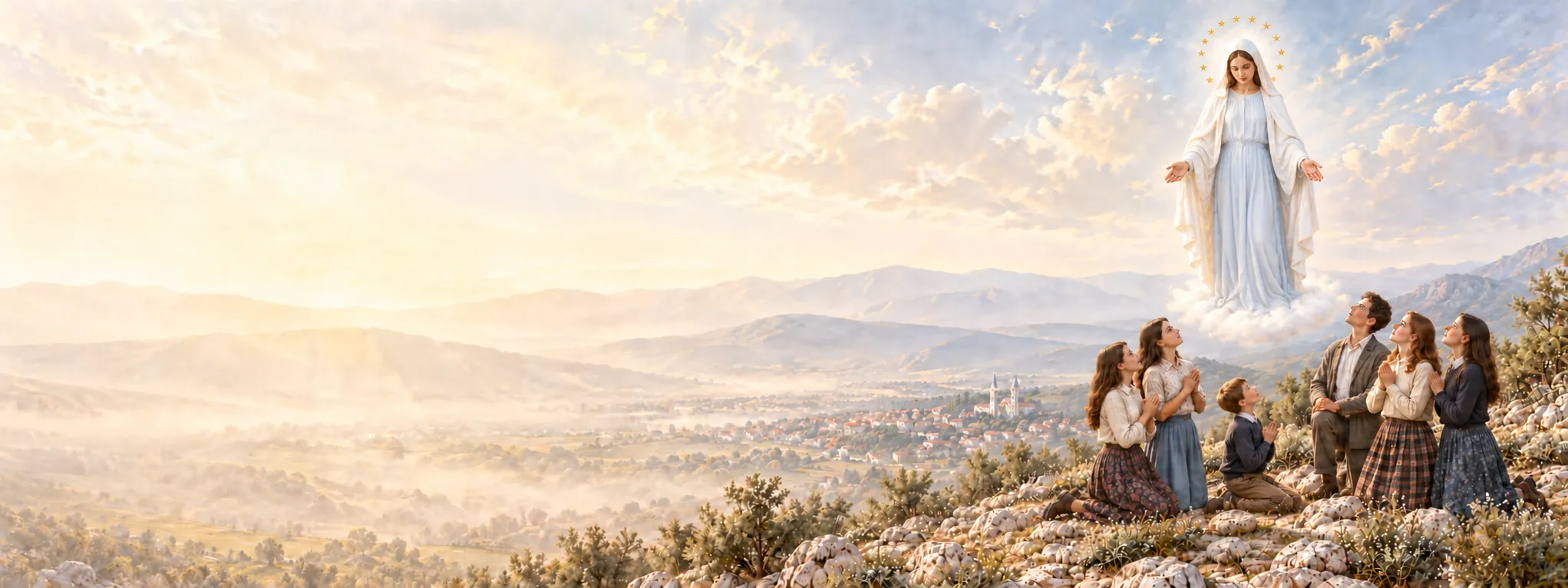
On June 24, 1981, young people near Medjugorje saw a woman holding a child on the hillside of Podbrdo. The next day, the group of six who became associated with the continuing accounts gathered there. They described the woman as the Blessed Virgin Mary. Their reports marked the beginning of a devotion that gradually transformed the parish into an international place of pilgrimage.
At the heart of Medjugorje’s spirituality is an invitation to return to God through prayer, conversion, fasting, and peace with others. Its parish life centres on the Eucharist, confession, and prayer. For many pilgrims, the most lasting fruit has been a renewed relationship with Christ, lived out in reconciliation, deeper faith, and service to those in need.
On September 19, 2024, the Church granted a nihil obstat to the spiritual experience associated with Medjugorje. This recognizes its pastoral value and permits public devotion, while leaving the supernatural authenticity of the apparitions unconfirmed. The Church encourages pilgrims to seek an encounter with Christ through Mary, Scripture, and the sacraments, rather than making extraordinary phenomena the purpose of their visit.
Church status: Nihil obstat: public devotion is authorized and its pastoral value recognized. Bishop Petar Palić of Mostar-Duvno issued the decree on September 19, 2024, following the Vatican’s assessment. Catholics are free to embrace the devotion prudently; they are not obliged to believe the claims of apparitions.
The setting and the witnesses
The names given are those commonly used in accounts of the original events. “1981–present” describes the continuing claims, not a Church declaration that apparitions are taking place.
The events began in the parish of St. James, administered by the Franciscans, in the Diocese of Mostar-Duvno. The first reports concerned Podbrdo, on the slopes of Crnica Hill near the village.
The witnesses of the first day were not exactly the same six who later became known internationally. Ivan Ivanković and Milka Pavlović were among the first group; Marija Pavlović and Jakov Čolo joined on June 25. This is why the first event is dated June 24, while the principal anniversary is June 25.
The story and the continuing accounts
Unlike apparitions confined to a short series of encounters, Medjugorje grew into a long-running body of reported experiences and messages.
The parish’s published account describes different patterns among the witnesses. It records the end of Mirjana’s daily encounters in 1982, Ivanka’s in 1985, and Jakov’s in 1998, followed by yearly encounters. Other witnesses have spoken of continuing frequent apparitions. These remain their claims, not findings established by the Church.
Public messages linked especially with Marija began weekly in 1984 and later became monthly. Their recurring themes are peace, faith, conversion, prayer, and fasting. Over time, the pilgrimage movement developed its own prayer groups, retreats, works of charity, and international gatherings.
The message
The parish sums up the messages in five closely related themes:
- Peace: reconciliation with God and with other people.
- Faith: a renewed relationship of trust in God.
- Conversion: a change of heart shown in daily life.
- Prayer: steady personal and communal communion with God.
- Fasting: self-discipline that supports freedom, generosity, and concern for others.
This summary presents the spirituality promoted at Medjugorje; it does not establish that every message attributed to Mary came from her. Bishop Palić’s decree especially welcomes the emphasis on Christ as the source of salvation, the work of the Holy Spirit, practical charity, and communion with the Church. The title Queen of Peace points toward a life transformed by God’s love, including forgiveness and service to the poor.
How the Church asks the messages to be read
The Vatican’s positive assessment comes with specific cautions:
- Some expressions need theological clarification.
- The messages must not replace Scripture or the Church’s ordinary pastoral discernment.
- Repeated calls to follow the messages can foster excessive dependence on them.
- Future messages, and those not yet published, must be reviewed by the apostolic visitor before publication.
The 2024 note therefore asks readers to look at the overall Gospel direction of the messages while treating unclear or problematic passages with prudence. It does not give blanket approval to everything attributed to Our Lady.
What the Church has said
| Date | Development |
|---|---|
| 1986 | A diocesan commission reached the judgment non constat de supernaturalitate: a supernatural character had not been established. |
| 1991 | The Yugoslav bishops’ Declaration of Zadar held that supernatural apparitions or revelations could not be affirmed on the basis of the investigations so far, while recognizing the need for pastoral care. |
| 2014 | The international commission chaired by Cardinal Camillo Ruini completed its work. Its full conclusions were not officially published. |
| 2017–2018 | Archbishop Henryk Hoser received a pastoral mission and later became apostolic visitor. |
| May 2019 | Pope Francis authorized pilgrimages organized by dioceses and parishes, without authenticating the apparitions. |
| September 2024 | The Vatican published “The Queen of Peace”, and Bishop Palić issued the nihil obstat. |
| October 31, 2026 | Bishop Francesco Cavina was appointed special apostolic visitor, succeeding Archbishop Aldo Cavalli. |
These steps distinguish the investigation of the claims from the care of pilgrims and from the recognition of the devotion’s spiritual value.
History, questions, and debate
Medjugorje has given rise to disagreement among bishops, commissions, clergy, and researchers, and the Vatican’s own history records differing evaluations. Reports of favourable conclusions about the earliest apparitions are not an official Church declaration authenticating them.
At the 2024 press conference, Cardinal Víctor Manuel Fernández also acknowledged serious difficulties in the wider history, including conflicts between some Franciscans and the local bishops. He explained that recognizing spiritual fruits does not require concluding that the messages have a supernatural origin.
Accounts of “secrets” belong to the witnesses’ testimony; they are not verified predictions or a timetable of future events. The Church’s decision concerns the pastoral value of the devotion, not the authentication of such claims.
Spiritual fruits and lasting devotion
The Church’s assessment gives great weight to conversions, renewed sacramental practice, and charitable service. At the Vatican presentation, particular attention was given to works supporting orphans, people with disabilities, and those struggling with addiction.
These fruits help explain the pastoral decision: people can encounter God and grow in the Christian life within this pilgrimage tradition, even while questions about its origin remain open.
Visiting today
Three places shape many pilgrimages:
- St. James Church: the centre of parish worship and sacramental life. The present church was consecrated in 1969, before the apparition reports.
- Apparition Hill (Podbrdo): linked with the earliest accounts and with the prayer of the Rosary.
- Cross Mountain (Križevac): known for its large cross, raised in 1934, decades before the apparition reports, and for the prayer of the Stations of the Cross.
Officially organized pilgrimages are permitted. For current prayer programmes and practical information, consult the website of the parish and its Information Centre.
Principal sources
| Resource | Best use |
|---|---|
| Vatican: “The Queen of Peace”, September 19, 2024 | The Dicastery’s note on the spiritual experience of Medjugorje. |
| Bishop Petar Palić’s decree (in Croatian and Italian) | The nihil obstat itself. |
| Vatican: history of the Church’s examination | The commissions and their differing evaluations. |
| Vatican: authorization of organized pilgrimages, 2019 | The pastoral permission given before the 2024 decision. |
| Vatican: explanation at the 2024 press conference | Cardinal Fernández on the scope of the decision. |
| Holy See: appointment of Bishop Francesco Cavina, 2026 | The current special apostolic visitor. |
