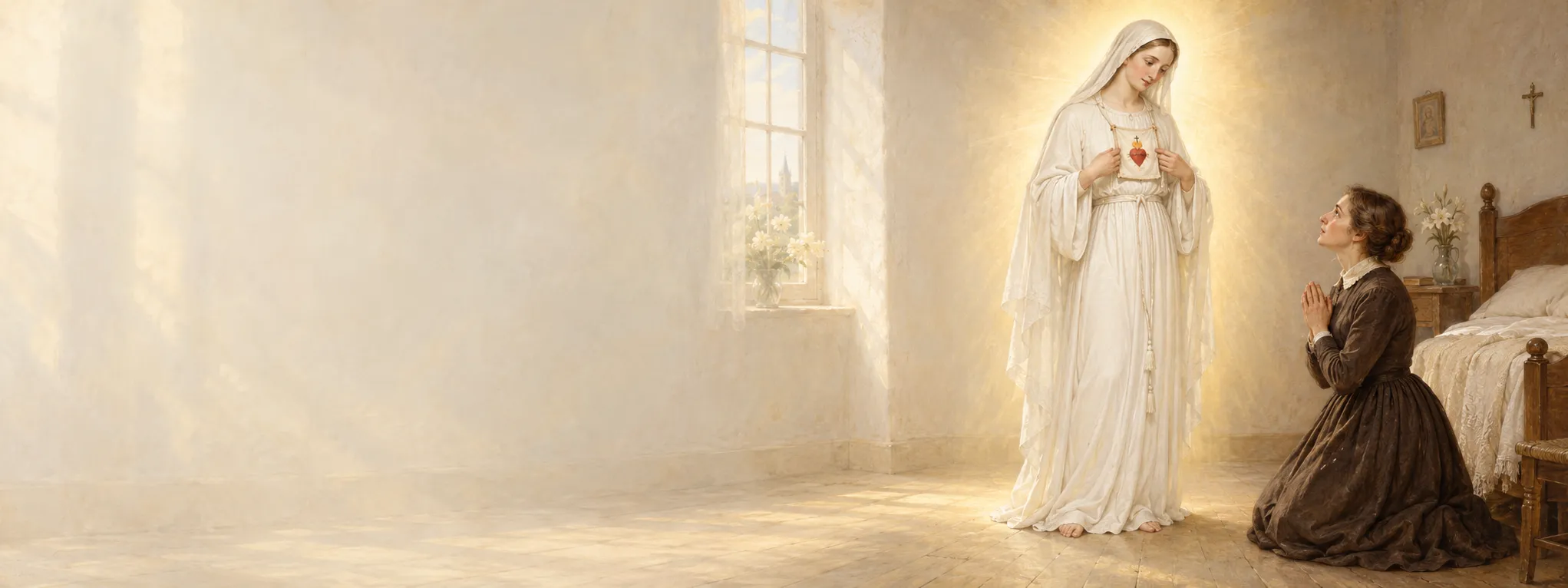
The story of Pellevoisin began with a deeply personal prayer. Gravely ill and worried about the family who depended on her, Estelle Faguette wrote a letter asking the Blessed Virgin Mary to obtain her healing from Jesus. In February 1876, she saw Mary beside her sickbed, offering reassurance and promising her recovery. After the fifth encounter, Estelle regained her health. Further encounters followed that year, ending on December 8.
At the heart of the devotion is Mary’s invitation to draw closer to her Son. Estelle described her wearing a scapular bearing the image of the Sacred Heart of Jesus, and understood that she was to make this devotion known, encouraging others to place their trust in Christ’s mercy. The scapular became Pellevoisin’s distinctive sign of a life entrusted to Jesus through Mary.
Estelle’s healing was recognized as miraculous in 1983. In 2024, the Dicastery for the Doctrine of the Faith authorized a nihil obstat, welcoming the spiritual value of the devotion and recommending it to those who freely embrace it. This judgment encourages the devotion without declaring the apparitions supernatural. Pellevoisin’s lasting invitation is to meet suffering with confidence and to take refuge in the loving Heart of Christ.
Church status: Nihil obstat: the devotion is authorized and encouraged. Archbishop Jérôme Beau issued the decree on August 30, 2024, with the Dicastery’s consent. Estelle’s healing and the apparitions have distinct Church judgments; the recognition of her healing is not an approval of all fifteen apparitions.
The setting and the witness
The dates and encounters follow the sanctuary’s account; the Church’s judgments are documented separately, in the sanctuary’s history of the recognition and in the Vatican’s letter.
Estelle’s life was marked by work, family responsibilities, and recurring illness. An earlier attempt at religious life ended after an injury. She then worked for the La Rochefoucauld family, including as a dressmaker and in caring for children.
Her plea for recovery was closely tied to her responsibilities toward others: she supported her parents and helped raise a niece. Her letter to Mary was placed in a replica of the Lourdes grotto at Montbel, expressing her hope that she could go on caring for them. These ordinary concerns give the account its very personal character: a woman asking for help amid illness and uncertainty.
The story: the fifteen encounters
The sanctuary arranges Estelle’s account in the following sequence:
| Dates in 1876 | Encounters | Principal elements |
|---|---|---|
| February 14–19 | 1–5 | Five successive nights of reassurance, correction, and a promised healing; her recovery followed the fifth encounter. |
| July 1–3 | 6–8 | Renewed encouragement toward patience, calm, and confidence. |
| September 9, 10, and 15 | 9–11 | The scapular of the Sacred Heart becomes central; the account also speaks of prayer and of concerns for the Church and for France. |
| November 1, 5, and 11 | 12–14 | Silent contemplation, encouragement in weakness, and support for making scapulars. |
| December 8 | 15 | A final encounter on grace and the spreading of the devotion. |
Estelle’s account connects her healing with the night of February 18–19 and her Communion the following morning, rather than with a single daytime date.
The message
Pellevoisin’s central themes are mercy, simplicity, patience, and confidence. Estelle’s account presents Mary as both consoling and gently correcting, encouraging an attentive Christian life.
If you want to serve me, be simple.
The message also calls for reverence in receiving Holy Communion and directs devotion toward Jesus. The Vatican’s assessment stresses that Mary’s role is to lead people to Christ: Estelle attributes her healing to the Son, through His Mother’s intercession. The reported words are to be read within that relationship, not as promises of grace apart from Jesus.
The scapular of the Sacred Heart
The scapular of Pellevoisin bears the image of Christ’s Heart, shown with a cross, flames, a crown of thorns, and a wound. According to Estelle, Mary wore it during the encounters.
Estelle went on to make and embroider scapulars, work that became both a means of support and part of her mission. Pope Leo XIII recognized the devotion in 1900.
Today, the sanctuary presents wearing the scapular as a commitment to Christian life: prayer, the Eucharist, reconciliation, and mercy toward others. Its meaning lies in conversion and communion with Christ; the scapular is not a guarantee of protection or recovery.
What the Church has said
The Church’s reception of Pellevoisin developed over a long period:
| Date | Development |
|---|---|
| 1877 | A Church investigation began, and a confraternity linked to the devotion was established. |
| 1900 | Pope Leo XIII recognized the scapular of the Sacred Heart. |
| 1983 | Archbishop Paul Vignancour recognized Estelle’s healing as miraculous, with the consent of the Holy See. |
| 2021–2024 | A commission of historians and theologians reviewed the case and its spiritual fruits. |
| August 2024 | The Dicastery consented to the proposed nihil obstat, followed by Archbishop Beau’s decree. |
The path was not an unbroken series of approvals. The sanctuary records restrictions on access to the chapel in 1905 and the resumption of pilgrimages in 1910. The devotion was received gradually; there was no single, comprehensive approval of the apparitions.
Historical record and interpretation
The detailed descriptions and conversations come mainly from Estelle’s own testimony, reproduced by the sanctuary from Estelle nous parle. Particular gestures, promises, and supernatural experiences are therefore her account.
Three things are distinct: what Estelle reported, the Church’s recognition of her healing, and its authorization of the devotion. Each has its own documentary basis and scope.
Visiting today
The sanctuary’s pilgrim route includes Estelle’s former room, the Montbel grotto linked with her letter, the parish church, and her grave. Other places of prayer include the Stations of the Cross and an oratory dedicated to the united Hearts of Jesus and Mary.
Together, these places join the devotion to Estelle’s everyday life and invite pilgrims to reflect on suffering, gratitude, and trust. Check the sanctuary’s official website for current access and times of celebrations.
Principal sources
| Resource | Best use |
|---|---|
| Vatican: 2024 letter on Estelle Faguette’s spiritual experience | The current Church judgment and its reasoning. |
| Official sanctuary: the apparitions (in French) | The fifteen encounters. |
| Official sanctuary: who was Estelle? (in French) | Estelle’s life. |
| Official sanctuary: the scapular (in French) | The scapular of the Sacred Heart. |
| Official sanctuary: the pilgrim route (in French) | The places to visit. |
