
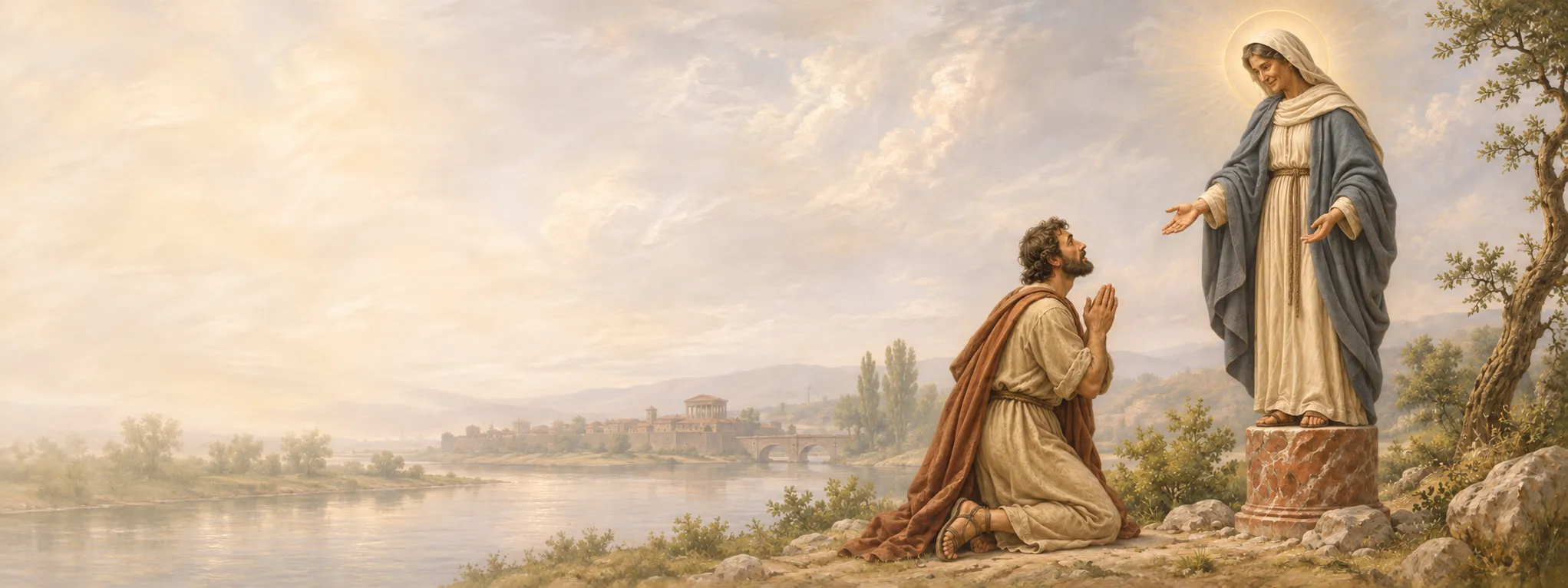
The story
Tradition holds that in AD 40, St. James the Greater was praying by the Ebro River at Caesaraugusta, modern Zaragoza, while discouraged by his mission. Our Lady, then still living in Jerusalem, appeared to him with angels and left a pillar, around which he built the first chapel.
What the Church has said
Popes granted indulgences to the shrine from the Middle Ages, and Callixtus III's bull of 1456 is the first document to mention a pillar. The Congregation of Rites approved an account of the apparition in 1723, in a liturgical context. Pius X granted the canonical coronation of the image in 1905. No inquiry in the modern sense has taken place.
History and debate
This date rests on devotion rather than documents. The oldest written testimony to Marian devotion at Zaragoza is usually identified as from 1155, the name Santa María del Pilar is attested in 1299, and the account of a chapel built by James first appears in 1318.
Visiting today
The Cathedral-Basilica of Our Lady of the Pillar stands on the Ebro in Zaragoza, built mainly from 1681. A small late Gothic wooden statue, about 36.5 cm tall, stands on a jasper pillar. Her feast on October 12 is the center of Zaragoza's Fiestas del Pilar. She is patroness of the Hispanic peoples.
Sources
Last reviewed: November 1, 2026