
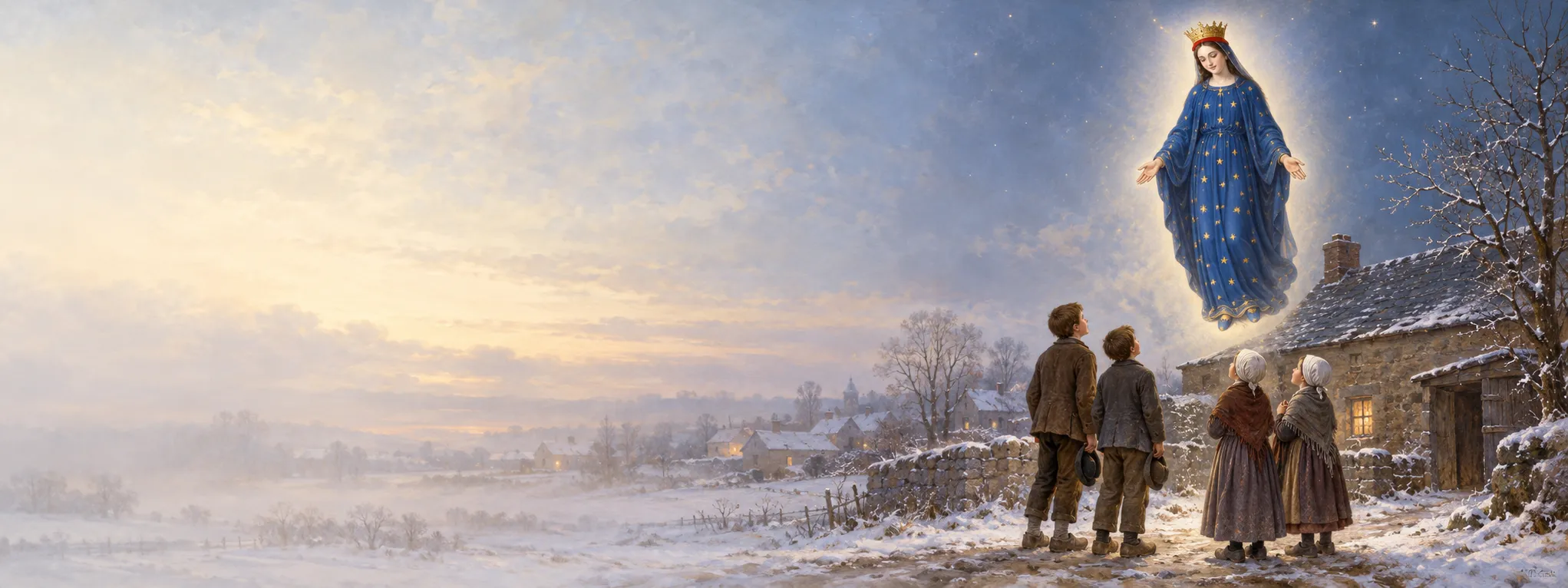
On a winter evening in 1871, twelve-year-old Eugène Barbedette stepped outside his family’s barn in Pontmain and saw a beautiful lady in the sky. His younger brother Joseph also saw her, followed by two girls, Françoise Richer and Jeanne-Marie Lebossé. The children described a smiling woman wearing a blue dress covered with golden stars. Their parents and the other adults could not see her, but neighbours gathered, and the parish priest, Father Michel Guérin, led them in prayer.
According to the children’s account, Mary remained silent. As the villagers prayed and sang, golden letters appeared on a banner beneath her, encouraging prayer and confidence in God. Later, her expression became sorrowful as she held a red crucifix before them. Before the apparition ended, her smile returned. The encounter lasted about three hours.
Bishop Casimir Wicart of Laval formally recognized the apparition on February 2, 1872. Venerated as Our Lady of Hope, Mary continues to invite pilgrims at Pontmain to bring their fears to God, persevere in prayer, and seek the peace of Christ.
Church status: Recognized as an authentic apparition by the Bishop of Laval on February 2, 1872. The original recognition was a diocesan judgment, followed by the growth of an established Catholic shrine and pilgrimage.
Setting and people
The four children named here are those included in the bishop’s recognition. The January 17 anniversary is a celebration of the shrine, not a feast of the universal Church.
A village living through war
The apparition took place during the Franco-Prussian War, when families feared the advancing armies and awaited news of relatives serving in the conflict. Thirty-eight men from the parish had gone to war, and fighting near Laval brought the danger close to home. This helps explain why the evening’s invitation to prayer was received with such intense hope.
The parish already had an active devotional life. Father Michel Guérin had encouraged Marian prayer, while the Sisters of Rillé ran the village school. Their teaching included the catechism, devotion to Mary, and meditation on Christ’s Passion. During the war, the children regularly prayed the Stations of the Cross.
The four children
| Witness | Background and later life |
|---|---|
| Eugène Barbedette | Aged twelve; the first to see the lady. Ordained in 1883, he served as a priest in the Diocese of Laval and died in 1927. |
| Joseph Barbedette | Aged ten; Eugène’s younger brother. He became a Missionary Oblate of Mary Immaculate, was ordained in 1884, and wrote an account of the apparition. He died in 1930. |
| Françoise Richer | About eleven. She later worked in domestic service and teaching, and eventually became Eugène’s housekeeper. She died in 1915. |
| Jeanne-Marie Lebossé | Aged nine. She entered the Sisters of the Holy Family of Bordeaux in 1881 and died in 1933. Her later questioning of her childhood testimony is discussed below. |
The apparition account
The following sequence summarizes the received account. Mary’s changing appearance and the surrounding signs were reported by the children; the gathered adults witnessed the children’s reactions and joined in the prayers.
The first sighting
The Barbedette brothers were helping their father prepare animal fodder in the barn. Eugène stepped outside and saw a lady above the house opposite. Joseph also saw her. Their parents saw nothing. Sisters from the school brought children to the scene, and Françoise and Jeanne-Marie likewise described the lady.
The gathering and the message
The children described Mary wearing a blue dress scattered with golden stars, a black veil, and a golden crown with a red band. An oval containing four candles surrounded her, and a small red cross appeared near her heart.
As the villagers prayed the Rosary and sang hymns to Our Lady, a banner appeared beneath her. Its golden letters appeared one by one. Mary did not speak aloud: the children read the message to the people around them.
The crucifix and the conclusion
Later, the banner disappeared. Mary became sorrowful and held a red crucifix bearing the figure of Christ. A star lit the four candles.
During the singing of the Ave Maris Stella, the crucifix disappeared and Mary smiled again. Two small white crosses appeared on her shoulders. A veil then rose before her, gradually hiding the vision until it ended.
The message and its meaning
But pray, my children. God will answer you soon. My Son allows Himself to be moved.
This is a translation of the French inscription the children read, not a record of spoken words. Three themes stand out:
- Perseverance in prayer: the invitation comes amid fear and uncertainty, encouraging the faithful to keep turning toward God.
- Confidence in Christ: the final sentence directs our attention to Mary’s Son. It invites us to trust His compassion; it is not a formula guaranteeing a particular outcome.
- Peace of heart: Pontmain’s meaning reaches beyond the war of 1871. Reflecting on the anniversary, the Bishop of Laval emphasized the peace of Christ in people’s hearts.
The crucifix gives the account a distinctly Christ-centred focus: Mary’s motherly reassurance leads us toward the suffering and saving love of her Son. This is a spiritual reflection on the account, not an additional message reported by the children.
What the Church has said
Initial investigation and recognition
The children were questioned soon after the event. The Sisters of Rillé record an interview at their motherhouse on January 28, 1871, whose proceedings were entered in the Pontmain parish register. This provides an early documentary point of reference.
On February 2, 1872, Bishop Casimir Wicart declared that the Virgin Mary had truly appeared at Pontmain to the four named children. This was a positive judgment on the apparition itself.
A second inquiry
A further canonical investigation took place in 1919–1920, connected with efforts to obtain a proper liturgical Office and Mass and with difficulties in locating the documents of the earlier inquiry.
On April 16, 1920, Bishop Eugène Grellier reaffirmed the recognition. His judgment referred specifically to the Barbedette brothers, by then priests, who had confirmed their earlier testimony.
Development of the shrine
| Date | Development |
|---|---|
| May 29, 1872 | Bishop Wicart entrusted the building of the sanctuary to the Missionary Oblates of Mary Immaculate. |
| October 15, 1900 | The sanctuary church was consecrated. |
| February 21, 1905 | Pope Pius X raised it to a basilica. |
| July 24, 1934 | The statue of Our Lady was crowned. |
These milestones show Pontmain’s continuing place in the life of the Church.
Sources and historical questions
What the adults witnessed
Seeing the apparition and being present at the event are different things. The priest, the sisters, and the other adults could describe the gathering, the prayers, the children’s behaviour, and what they heard the children say. They did not themselves report seeing the apparition the four children described.
Jeanne-Marie Lebossé’s later retraction
During the later investigation, Jeanne-Marie stated that she had not seen the apparition and had repeated what others said. Her retraction concerned her own testimony; it did not show any agreement among the children to invent the account.
René Laurentin, later commissioned to study Pontmain’s history, argued that her earliest testimony and the circumstances of her retraction point to religious scruples. That remains his interpretation, not an established diagnosis. Her retraction stands alongside the Church’s recognition, which was reaffirmed in 1920.
The apparition and the war
Local tradition associates Pontmain with protection from the advancing army and the safe return of the parish’s soldiers. The armistice was signed on January 28, 1871, eleven days after the apparition, not on the evening itself.
Historian Brigitte Waché examines how the timing of the apparition and the Prussian withdrawal fostered a tradition of Marian intervention. Her study also traces the early national, and sometimes nationalist, character of the pilgrimage, and its later emphasis on the spiritual message. The faithful’s conviction of providential protection is a reading of faith; history cannot show that the apparition caused a particular military decision.
How the sources are used
The official shrine is the principal source for the received devotional narrative. Early testimony, the records of the investigations, and historical scholarship answer different questions: how the account was recorded, how the Church evaluated it, and how its interpretation developed.
A useful scholarly study is Brigitte Waché’s “‘Dieu vous exaucera en peu de temps’: Pontmain, une apparition en temps de guerre (17 janvier 1871)”, in Annales de Bretagne et des Pays de l’Ouest, 128–4, 2021, pages 127–137.
Devotion and legacy
Pontmain is especially associated with Our Lady of Hope. Its lasting devotional character centres on prayer in times of uncertainty, confidence in Christ, and peace.
The apparition also has a strong communal dimension: children described what they saw while a parish gathered around them in prayer. The shrine continues this pattern through shared worship, pilgrimage, and the annual commemoration on January 17. The 150th anniversary was marked by a diocesan jubilee beginning in January 2021.
Pontmain invites us to bring our fears before God and remain faithful in prayer. Mary’s quiet presence directs our attention to her Son, encouraging us to trust His mercy and become bearers of His peace.
Visiting today
Pilgrims can visit the basilica, the parish church, and the Barbedette barn, which preserves the setting where the apparition began. The shrine’s heritage trail also includes places that explain the event and its history.
The sanctuary offers Mass, confession, the Rosary, and Eucharistic adoration. Its principal anniversary is January 17, and the Assumption is another important pilgrimage day. Check the official timetable before visiting: services move between the basilica and the parish church with the seasons, and special events can change the schedule.
Sources and further reading
| Resource | Best use |
|---|---|
| Sanctuary of Pontmain (in French) | History, the apparition narrative, and biographies of the witnesses. |
| Sisters of Christ the Redeemer (in French) | The Sisters of Rillé and Pontmain, including their part in events and the early interview. |
| French Bishops’ Conference: the 150th-anniversary jubilee | Pastoral reflections from the Bishop of Laval. |
| Brigitte Waché: Pontmain, an apparition in wartime (in French) | A historical study of the wartime setting and the later interpretation of the event. |
| René Laurentin, Dictionnaire encyclopédique des apparitions de la Vierge (2007) | The investigations and Jeanne-Marie’s retraction. |
