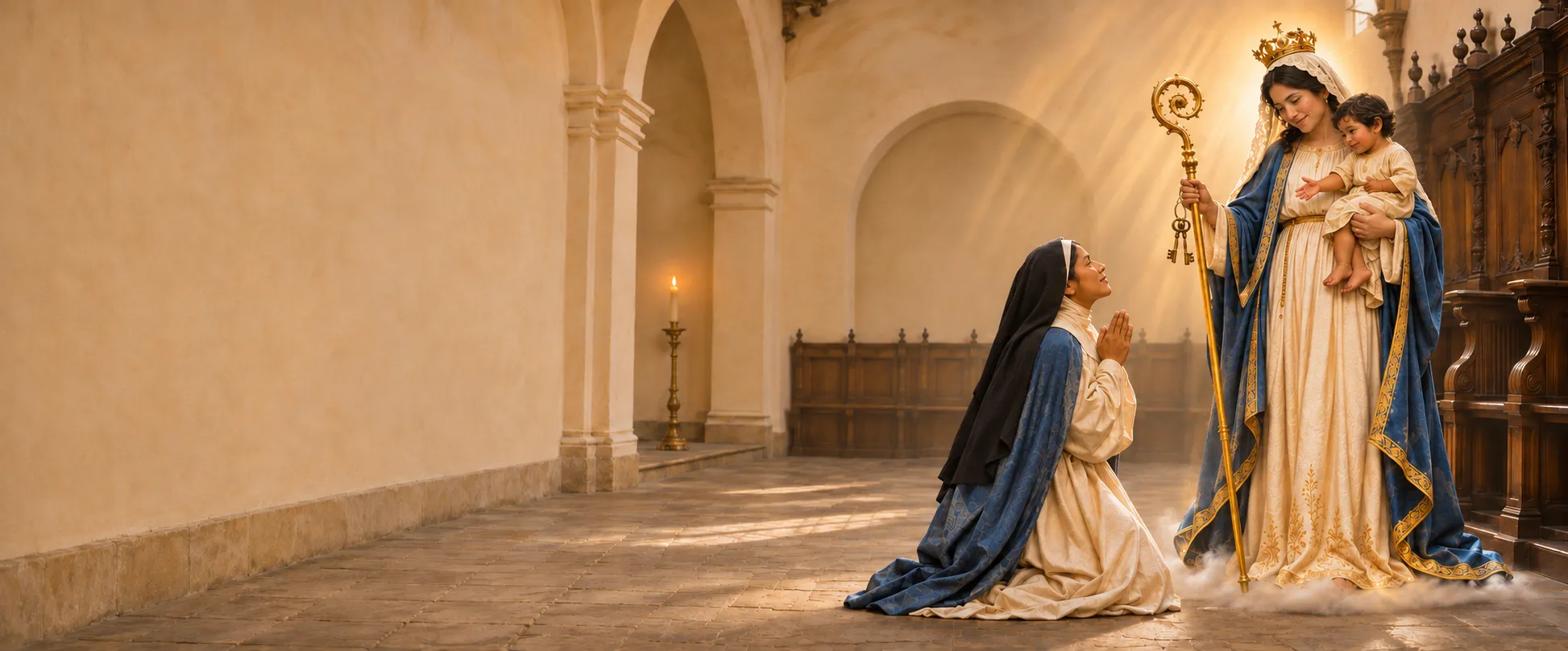
In the enclosed monastery of the Conceptionist nuns in colonial Quito, Mother Mariana de Jesús Torres, one of its founding sisters and later its abbess, lived a life of prayer and penance. According to the tradition of her community, the Blessed Virgin Mary visited her many times between 1594 and 1634, assuring the sisters of her motherly protection and asking them to persevere in prayer and faithfulness during their trials.
At the heart of the story is Our Lady’s request for an image of herself holding the Child Jesus and an abbess’s staff, so that she herself would govern the monastery as its true Mother. The statue, carved by Francisco del Castillo, was blessed in 1611 and is still venerated in the monastery church. Its feast falls on February 2, the Presentation of the Lord.
Four centuries later, Our Lady of Good Success still invites the faithful to receive Christ with Mary’s trust, to remain faithful in difficult times, and to live the Gospel with confidence and charity.
Church status: A historic devotion with archdiocesan recognition and a canonically crowned image. In 1991 the Archdiocese of Quito made the monastery church an archdiocesan Marian shrine and crowned the image on February 2. These acts honour the devotion and the image; they are not a formal judgment on every revelation attributed to Mother Mariana.
The monastery and the visionary
The Royal Monastery of the Immaculate Conception was founded in Quito in 1577 and is regarded as the oldest convent of nuns in Ecuador. Like other enclosed communities of Spanish America, it was a centre of prayer, community life, and sacred art in the young colonial city.
Mother Mariana Francisca de Jesús Torres y Berriochoa (about 1563–1635) was born in Spain and came to Quito with the founding sisters. She later served as abbess. Her biographers describe a life of deep prayer, penance, and suffering offered for the Church, and many mystical experiences. She died on January 16, 1635.
The Archdiocese of Quito opened her cause for beatification in the 1980s, and she is honoured as a Servant of God. She should not be confused with St. Mariana de Jesús de Paredes, the “Lily of Quito,” a different holy woman of the same city.
The story
The published accounts arrange the encounters in different ways, so the dates below follow the tradition in broad outline. The first apparition is commonly placed on February 2, 1594, as Mother Mariana prayed in the upper choir.
| Date | Event |
|---|---|
| 1577 | Foundation of the Conceptionist monastery in Quito. |
| 1594 | Traditional beginning of Our Lady’s visits to Mother Mariana. |
| 1610 | Our Lady asks for an image of herself to stand in the choir and govern the community. Sources give different days for this apparition. |
| February 2, 1611 | Bishop Salvador de Ribera blesses the finished image. |
| 1634 | Later encounters bring warnings of spiritual decline and encouragement to stay faithful. Many accounts place the last apparition on December 8. |
| January 16, 1635 | Death of Mother Mariana. |
| 1790 | Franciscan Manuel Sousa Pereira writes the long biography on which most later accounts rely. |
| 1991 | The monastery church becomes an archdiocesan Marian shrine, and the image is crowned on February 2. |
The image of Our Lady of Good Success
The image shows Mary carrying the Child Jesus, a reminder that all her motherly care leads us to her Son. In her right hand she holds an abbess’s staff. According to the tradition, Our Lady asked to be placed above the abbess’s seat in the choir, so that she herself would govern and protect the monastery.
The sculptor Francisco del Castillo received the commission with Church permission. The devotional account adds that the statue was completed in a wondrous way, with the help of heavenly figures, while the sculptor was away. This belongs to the supernatural tradition of the shrine, which the faithful receive with devotion, rather than to documented art history.
“Buen Suceso” means the “good event” rather than worldly success. The full title, Our Lady of Good Success of the Purification, points to February 2, when the Child Jesus was presented in the Temple: the good event is Mary’s gift of the Saviour to the world.
The message
The spiritual themes associated with Our Lady of Good Success include:
- Perseverance in faith during personal and communal trials.
- Prayer for the Church and for her priests and religious.
- Reverence for the sacraments and fidelity to consecrated life.
- Repentance, and confidence in Mary’s motherly intercession.
Like the sisters of Quito, we are invited to place our homes and communities under Mary’s care, to let her lead us to Jesus, and to remain faithful to Him when times are hard.
The prophecies attributed to Mother Mariana
Later biographies attribute to Mother Mariana warnings about future trials in the Church and in society: a crisis of faith, corruption of morals, harm to the innocence of children, and sufferings for the clergy. Some accounts also link her visions with later events, such as the definition of the Immaculate Conception and of papal infallibility, the consecration of Ecuador to the Sacred Heart, and the death of President Gabriel García Moreno in 1875.
Devotees read some of these passages as fulfilled prophecy. Because the surviving texts were written down long after her death, their exact wording calls for careful study. The Church has not judged them, and they should never be used to attach particular political views or the names of particular Church leaders to the words of Our Lady.
What the Church has said
The devotion has long enjoyed the support of the local Church. Bishop Salvador de Ribera blessed the image in 1611. Documents dated January 7, 1991, made the monastery church an archdiocesan Marian shrine and authorized the canonical coronation of the image, which took place on February 2, 1991. These documents also recall the apparition tradition.
Three questions remain distinct: whether devotion to Mary under this title is approved, which it is; whether the apparitions received a formal judgment of their supernatural character; and whether every text later circulated as a message is authentic. Crowning an image honours the devotion; it does not by itself authenticate an apparition.
It is not their role to improve or complete Christ’s definitive Revelation, but to help live more fully by it in a certain period of history.
History and questions about the sources
Most of what we know comes from the long biography written in 1790 by the Franciscan Manuel Sousa Pereira, more than 150 years after Mother Mariana’s death. He said he used her own writings and earlier lives of her, but those earlier works appear to be lost, so his text cannot be compared with them.
The historian Magnus Lundberg, in Mission and Ecstasy (2015), also notes that modern editions rely on a later manuscript copy. This does not disprove the tradition, but it limits how confidently the exact words and early history of individual predictions can be established.
Visiting today
The monastery stands in Quito’s historic centre, a few steps from the Plaza Grande. The principal celebration is February 2, prepared by a novena, and has traditionally included a Rosary procession at dawn and a solemn Mass.
The sisters still live in enclosure, so parts of the monastery are closed to visitors. Before travelling, confirm church opening hours, Mass times, and when the image can be seen.
Sources and further reading
| Resource | Best use |
|---|---|
| Catholic.net: Nuestra Señora del Buen Suceso (in Spanish) | A detailed telling of the traditional account. |
| Magnus Lundberg: Mission and Ecstasy (2015) | Historical study of the biographies of colonial nuns. |
| Catholic Answers: Is Our Lady of Good Success approved? | The difference between crowning an image and approving an apparition. |
| Catechism of the Catholic Church, 67 | The place of private revelations in the life of faith. |
| GCatholic: Royal Monastery of the Immaculate Conception | The shrine’s location and status. |
