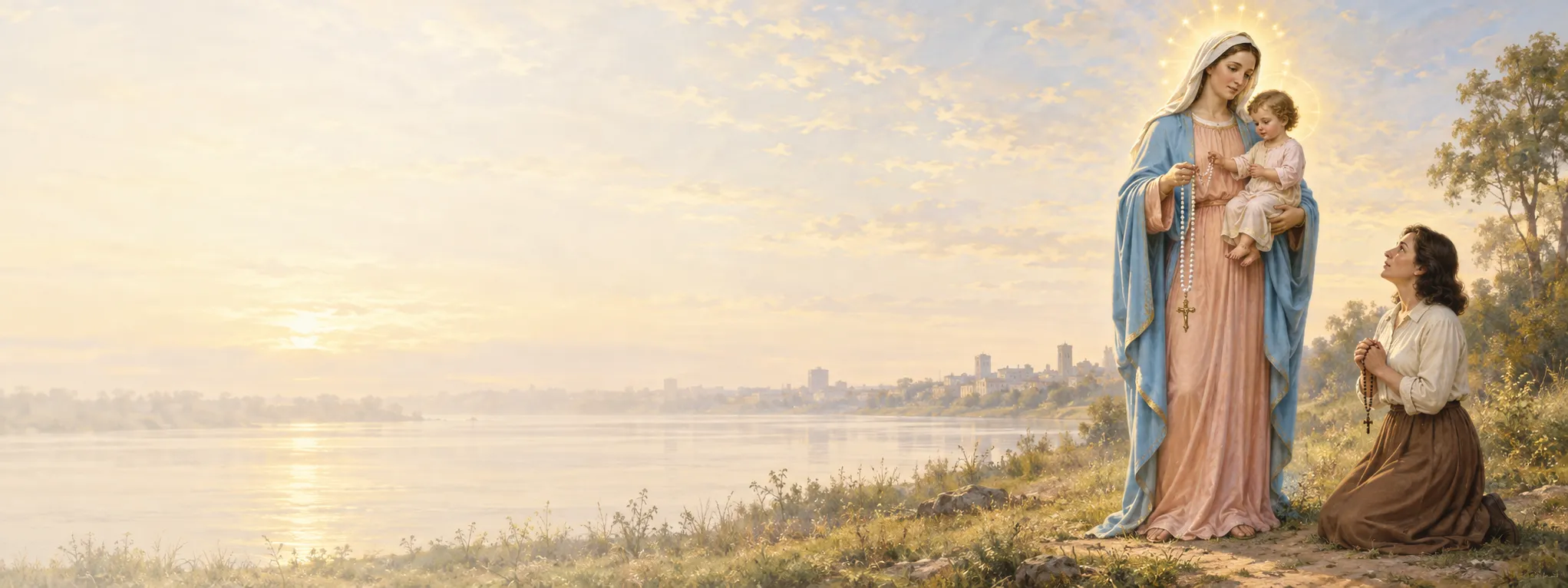
On September 25, 1983, Gladys Quiroga de Motta, a married woman living in San Nicolás de los Arroyos, saw Mary with the Child Jesus and a rosary. The first encounters were silent. After speaking with her confessor, Father Carlos Pérez, she began writing down the messages and the Bible passages connected with them.
An important moment came that November, when an older statue of Our Lady of the Rosary, kept in the cathedral’s bell tower, was found to match Gladys’s description. The statue was restored, and devotion grew around Mary’s request for a sanctuary near the Paraná River. The statue was moved to the new sanctuary in 1989.
The published messages call for renewed faith and a return to Christ through prayer and Mary’s motherly guidance. After decades of pastoral accompaniment and examination, Bishop Héctor Cardelli recognized the supernatural character of the Marian events on May 22, 2016. Today, the sanctuary welcomes pilgrims for prayer, Confession, Eucharistic adoration, and Mass.
Church status: Recognized by the diocesan bishop. On May 22, 2016, Bishop Héctor Cardelli formally recognized the supernatural character of the Marian events at San Nicolás.
The setting and Gladys Quiroga de Motta
The dates 1983–1990 cover the published collection of messages. Some later accounts report continuing private experiences, which are distinct from that collection.
Gladys was a married laywoman and the mother of two daughters. Her account arose from ordinary family life, not from a religious community. Father Carlos Pérez became an important early confidant and helped bring her experiences before the Church for examination.
The devotion also joined an older local tradition. An image of Our Lady of the Rosary had been brought to the parish in 1884, but by 1983 it was no longer on public display. Its identification with Gladys’s description linked the encounters to an existing image and title, not to a newly created one.
The story: a chronology
| Date | Event |
|---|---|
| September 25, 1983 | Gladys’s first apparition. |
| October 7, 1983 | After she asks what Mary wants, Gladys has a vision of a chapel. |
| October 12–13, 1983 | She speaks to her confessor; the published record gives October 13 as the first spoken message. |
| November 27, 1983 | The older cathedral statue is found to match her description. |
| April 1985 | A commission is appointed to study the events. |
| September 25, 1986 | Bishop Domingo Salvador Castagna lays the sanctuary’s foundation stone. |
| October 13, 1987 | Construction begins. |
| March 19, 1989 | The statue is moved to the sanctuary, whose first completed section is blessed. |
| February 11, 1990 | The last date in the principal published collection of messages. |
| November 14, 1990 | Bishop Castagna grants an imprimatur for the Spanish edition. |
| May 22, 2016 | Bishop Cardelli recognizes the supernatural character of the events. |
The building of the sanctuary, the permission to publish the messages, and the recognition of the events were separate stages.
The message
- Draw closer to Christ: Bishop Cardelli presented the messages as a spiritual school leading to Jesus, whom he called the fullness of revelation. Mary’s role is to guide the faithful to her Son.
- Pray with trust: the Rosary is central to the devotion. A message of February 3, 1985, explains the image of Mary with the Child and the rosary as new life in Christ, and as an invitation to bring our sufferings, needs, and petitions to prayer.
- Listen to Scripture: Bible references run throughout the published collection. The first spoken message, for example, directs Gladys to Ezekiel 2:4–10. Scripture is part of the account itself, not a later addition to the devotion.
- Let devotion become love: at the 2016 anniversary, Bishop Cardelli stressed that love must be expressed and shared. Prayer bears fruit in how Christians live and treat others.
The image and its devotions
The statue matters because it is older than the apparitions. According to the historical account, Father Pérez arranged its restoration and replaced the rosary in the hands of Mary and the Child. Its transfer to the sanctuary made it the focal image of the pilgrimage.
The devotional tradition, drawn from the messages, also includes:
- A medal: Mary under the title of Our Lady of the Rosary of San Nicolás on one side, and the Holy Trinity with seven stars on the reverse.
- A white scapular: associated with a message of March 5, 1986, and a commitment to prayer, especially for those suffering in body or soul.
What the Church has said
There are two important documentary milestones.
- Permission to publish, 1990: Bishop Castagna granted an imprimatur to the Spanish collection of messages on November 14, 1990. This concerned publication and doctrinal suitability, and is distinct from the later judgment of supernatural character.
- Recognition of the events, 2016: Bishop Cardelli stated that he had consulted experts and witnesses and weighed the events and their fruits. He then explicitly recognized their supernatural character, by his authority as diocesan bishop.
The declaration is not a separate papal decree, nor a blanket approval of every later message circulated under the title; its wording concerns the Marian events at San Nicolás.
Sources and historical questions
How many messages were there?
The published collection holds more than 1,800 messages. It separates early entries from a later sequence numbered 1–1804 and explains changes in numbering between editions. The entries are not each a separate apparition.
Did the encounters end in 1990?
The public collection closes in February 1990, but some Catholic accounts report continuing private experiences. The documented publication period is distinct from those later claims.
Does the recognition authenticate every reported healing?
Accounts describe conversions and physical healings, but each medical claim needs its own evidence. The general recognition of the Marian events does not mean that every healing story has been separately investigated by doctors and by the Church.
Devotion and legacy
San Nicolás has become a major place of pilgrimage in Argentina. Its September celebrations bring together walking pilgrimages, vigils, processions, and sacramental worship. The 2026 anniversary programme included Confession, Marian catechesis, Eucharistic adoration, and Mass, showing how the devotion is lived within the ordinary life of the Church.
Visiting today
The sanctuary and the adjoining Campito welcome both personal prayer and large outdoor gatherings. September 25 is the principal anniversary, and especially large numbers of pilgrims come for the celebrations around it.
The municipality counts the sanctuary among the country’s major places of pilgrimage and has improved the pedestrian areas around it. Confirm current opening hours and liturgical schedules before travelling.
Principal sources
| Resource | Best use |
|---|---|
| AICA: Bishop Cardelli’s 2016 declaration (in Spanish) | Reporting of the judgment at the time. |
| María del Rosario de San Nicolás: Mensajes 1983–1990 (in Spanish) | The digitized collection, with the permissions to publish and editorial notes. |
| AICA: historical account for the fortieth anniversary (in Spanish) | The early encounters, the statue, and the growth of the devotion. |
| AICA: the September 2026 celebrations (in Spanish) | Recent evidence of continuing diocesan pilgrimage and worship. |
