
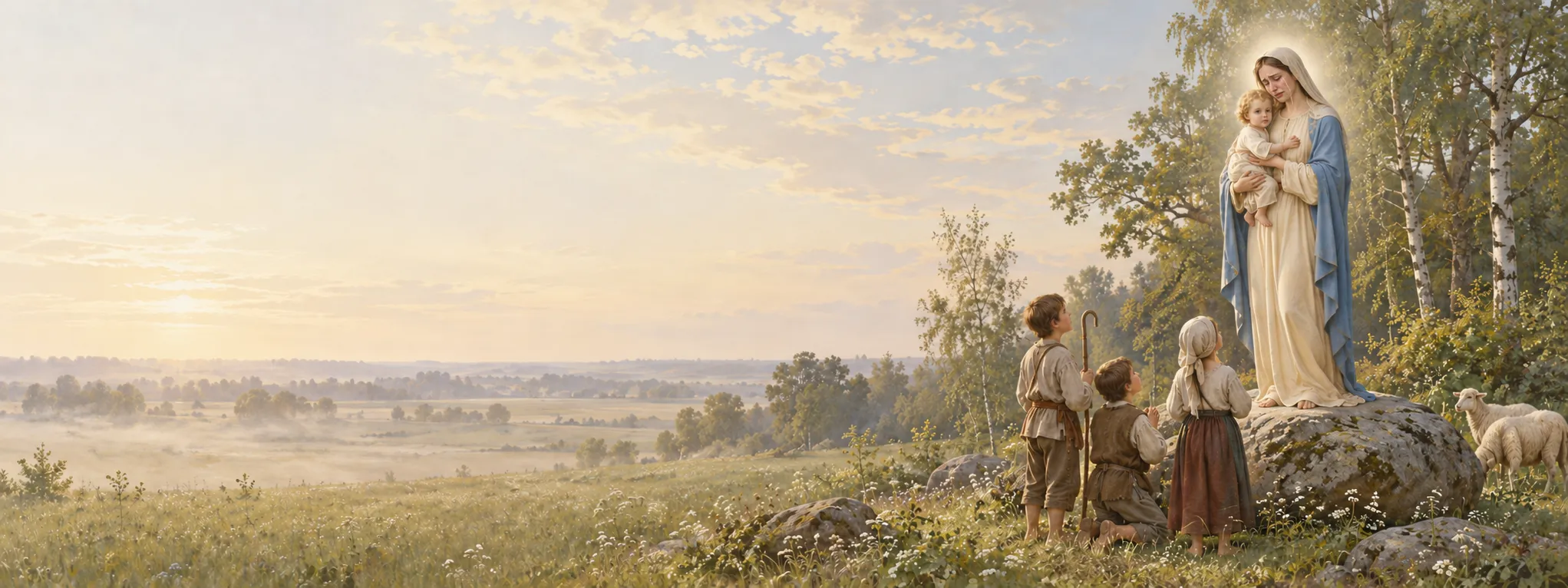
According to the traditional account, the Blessed Virgin Mary appeared in 1608 to children tending their flocks at Šiluva, Lithuania. Standing on a stone with the Child Jesus in her arms, she was weeping. When asked why she cried, she explained that her Son had once been worshipped there, but the land was now being ploughed and sown. Her words recalled the Catholic church that had previously stood at the site.
The account connects the apparition with the rediscovery of a buried chest containing church documents and sacred objects. These documents helped the Catholic community recover the property in 1622. A new church was subsequently built, and pilgrims returned to honour Mary and worship her Son.
Today, Šiluva remains a cherished Lithuanian sanctuary. Mary’s tears are remembered as a motherly invitation to renew our faith, make room for Christ in our lives, and return to Him in prayer. Pilgrims continue to gather there seeking consolation, reconciliation, and spiritual renewal.
Church status: Long-established Catholic apparition tradition and shrine with papal recognition of its devotion. The image of Our Lady was crowned with papal authorization in 1786, and St. John Paul II visited Šiluva in 1993. The scope of the often-cited “1775 approval” is explained below.
Historical setting
Šiluva’s Catholic history began before the apparition. A parish existed there by the fifteenth century. Its foundation is traditionally dated to 1457 and attributed to Petras Simonas Gedgaudas, although historians have questioned the authenticity of the foundation document. A reference to a Šiluva priest in 1466 provides firmer evidence that the parish already existed.
During the sixteenth-century Reformation, local landowners supported Protestant communities, and Šiluva became an important Reformed centre. The Catholic church lost its property and ceased functioning. These changes involved religious conviction, noble patronage, land ownership, and competing legal claims.
The shrine’s history relates that, around 1569, the Catholic priest Jonas Holubka buried an iron-bound chest containing church valuables and documents to protect them. This chest later became central to the apparition narrative.
The apparition is remembered as taking place where Catholic worship had disappeared, during a time of religious division and of efforts to recover former church property.
The apparition account
The children and the weeping woman
The traditional narrative begins with children tending animals near the former church site. They see a woman standing on a large stone, carrying a child and weeping.
The children spread the news. Local adults become involved, including representatives of the Reformed community. Different retellings describe the order of their arrival differently; some present successive encounters rather than one continuous scene.
The adult witnesses
The shrine’s account names Mikalojus Fiera, a Calvinist catechist, and Saliamonas Grocijus, associated with the local Protestant school or seminary. Their names and roles appear with variations in modern translations.
They are figures named in the account as it was handed down, not authors of surviving eyewitness statements from 1608.
Mary’s explanation
When asked why she was weeping, Mary is said to have explained that her Son had previously been worshipped at that place, which was now used for farming. The apparition then disappeared.
The narrative’s emphasis is the restoration of worship and the remembrance of Christ. It does not give a detailed programme of future events or a series of dated messages.
The message
“Once, my Son was worshiped here… Now it is plowed and sown.”
This is the wording used in the shrine’s English presentation. It is a translation of the traditional account, not a transcript made in 1608.
At Šiluva, Mary’s sorrow directs our attention to her Son. Her words invite us to remember Christ, to restore prayer where faith has been neglected, and to make room for His worship in our lives.
The account arose amid conflict between Christians. It can be read today in the light of St. John Paul II’s prayer at Šiluva in 1993: that persecution give way to religious peace, hatred to forgiveness, and intolerance to dialogue and mutual understanding.
The buried chest and the healing
According to tradition, an elderly blind man remembered the burial of the church’s possessions. He helped identify the place where the chest had been hidden, and his sight was restored in connection with its recovery.
The recovered documents were understood to establish the Catholic church’s rights to its former property. This links the devotional narrative to the legal struggle over the site.
The shrine’s historical account dates the discovery of the documents to 1612, four years after the traditional apparition date, and places the successful end of the property case in 1622. The apparition, the discovery, the court ruling, and the rebuilding therefore unfolded over several years, not all at once.
The restoration of the man’s sight belongs to the tradition handed down at the shrine. No contemporary medical investigation of it is known.
Restoration of the church
Historical research places the recovery of the Catholic endowment within proceedings in 1622–1623. Father Jonas Kazakevičius Smolka played an important role in this restoration.
The legal recovery of the property is a documented historical event. The shrine’s tradition sees in it the work of Mary’s intercession.
The shrine dates the construction of a small replacement wooden church to 1623–1624. Pilgrimage celebrations resumed, and a larger wooden church was completed in 1641 as attendance increased.
Construction of the present masonry church began in 1760, and it was consecrated on September 8, 1786.
The image of Our Lady of Šiluva
The painting venerated in the basilica depicts Mary holding the Child Jesus. The Catholic John Paul II Pilgrim Route dates it to the first half of the seventeenth century.
Its composition belongs to the Hodegetria tradition and follows the celebrated Salus Populi Romani image in Rome’s Basilica of St. Mary Major. In 1674, the figures received a precious-metal covering made by the Königsberg goldsmith Lawrence Hoffman from pilgrims’ votive offerings.
The painting was examined and restored at the Lithuanian Art Museum’s Pranas Gudynas Restoration Centre in 2002–2003.
Some popular accounts identify the present painting with an image said to have been buried before the Reformation. The seventeenth-century dating given by the Catholic pilgrimage route does not support calling today’s painting the original fifteenth-century image recovered from the chest.
The apparition, the recovered church possessions, and the painting are therefore treated separately on this page.
What the Church has said
Papal authorization for the image’s coronation
The shrine records that a request to crown the image was sent to Rome in 1774, and authorization was received in 1775. The coronation took place on September 8, 1786, together with the consecration of the new church. These are clear acts of the Church’s recognition of the shrine’s devotion.
What does “approved in 1775” mean?
Many summaries describe Šiluva as an apparition approved by Pope Pius VI in 1775. An article hosted by the Lithuanian government gives the specific date of August 17 that year. The shrine’s detailed history, however, describes the 1775 act as the authorization to crown the image.
The original text of a separate 1775 judgment formally declaring the apparition supernatural has not been located in the sources reviewed here. That does not mean no such act existed; it means the scope of the 1775 act cannot yet be treated as settled.
St. Paul VI — 1966
In a letter concerning the Lithuanian chapel at the National Shrine in Washington, D.C., Pope Paul VI warmly affirmed devotion to Our Lady of Šiluva. He described the apparition with care:
“according to a pious tradition, is said to have appeared in Siluva”
The letter also encouraged Lithuanian Catholics and expressed hope for religious liberty in their homeland.
St. John Paul II — 1993
On September 7, 1993, St. John Paul II visited Šiluva and led a Liturgy of the Word. He thanked God for Lithuania’s emergence from oppression, honoured the Christians who had persevered under persecution, and urged the faithful to build their future on Christ. His prayer entrusted Lithuania to Mary and called for forgiveness, solidarity, and renewed Christian life.
Benedict XVI — 2008
Benedict XVI appointed Cardinal Joachim Meisner as his special envoy to the celebrations of the fourth centenary of the apparitions at Šiluva. The appointment is further direct evidence of the Holy See’s part in the shrine’s devotional life.
History and questions about the sources
The earliest written account
The literary historian Vigmantas Butkus identifies the earliest version of the Šiluva narrative as an account written in 1661 by the local dean, Mikalojus Sviechovskis. According to his research, it survives through a Polish copy from 1786.
This places the earliest known narrative more than fifty years after the traditional apparition date. It is important evidence for how the tradition was handed down, but it is not a report written at the time of the event.
Dates and details differ
The Lithuanian Pilgrims Association notes that the date of the apparition is not precisely established and that the accounts vary. This page therefore uses 1608 as the traditional date and does not treat September 8, the shrine’s principal feast, as the day of the apparition. It gives no definite number of apparitions or witnesses, and it does not name the shepherd children or give their ages, since no specific source supports them.
The earlier foundation
Even the parish’s traditional 1457 foundation document has drawn historical criticism. Historians distinguish the disputed document from the parish’s independent mention in 1466; what is certain is that a Catholic parish existed here by the fifteenth century.
Devotion and lasting significance
Šiluva became a place of communal pilgrimage, thanksgiving, and perseverance. Organised processions brought parish groups and students to the shrine.
During Soviet rule, the authorities tried to obstruct pilgrimages with roadblocks, intimidation, and penalties against organisers. Nevertheless, pilgrims kept coming. The John Paul II Pilgrim Route describes the part played by young people and the Friends of the Eucharist, whose processions became an expression of enduring faith.
Devotion also travelled with Lithuanian emigrants. Paul VI’s 1966 letter on the Lithuanian chapel in Washington shows how Šiluva helped connect communities abroad with their faith, culture, and homeland.
Šiluva became a place where Lithuanian Catholics kept their faith alive through religious conflict, exile, and persecution.
Visiting today
Basilica of the Nativity of the Blessed Virgin Mary
The red-brick basilica houses the venerated painting of Mary and Jesus at its principal altar. Its late-Baroque interior includes an elaborate ensemble of altars, pulpit, baptistery, and organ loft associated with the artist Tomas Podgaiskis. The artwork presents Mary in relation to Christ and the life of the Church.
Apparition Chapel
The separate Apparition Chapel marks the traditional apparition site. Designed by Antanas Vivulskis, it had its cornerstone blessed in 1912 and was completed and dedicated in 1924, after the disruption of the First World War.
The chapel rises about 44 metres. Its central altar stands over the stone associated with the apparition. Frescoes illustrate the shrine’s history, and stations dedicated to Mary’s Seven Sorrows form another part of its devotional setting.
The annual Šilinės pilgrimage
The principal celebrations honour the Nativity of the Blessed Virgin Mary. The shrine currently gives September 7–15 as the festival period. For the current programme and Mass times, see the shrine’s website.
Sources and further reading
| Resource | Best use |
|---|---|
| Šiluva Shrine: the Reformation period | The buried documents and the property dispute. |
| Šiluva Shrine: the revival of Šiluva | The rebuilding, the coronation authorization, and the 1786 ceremonies. |
| John Paul II Pilgrim Route: the painting of Our Lady of Šiluva | Dating, iconography, metal covering, and restoration. |
| Vigmantas Butkus, 2007: study of the Šiluva narrative | The 1661 account and its surviving copy. |
| Vaida Kamuntavičienė, 2009: the Šiluva parish in the seventeenth century | Archival research on the parish and its restoration. |
| Paul VI: letter of September 4, 1966 | The Pope’s own words about the tradition. |
| John Paul II: Liturgy of the Word at Šiluva, September 7, 1993 | The shrine’s meaning after persecution. |
| Benedict XVI: letter to the special envoy for the 2008 anniversary | The Holy See’s part in the fourth centenary (in Latin). |
